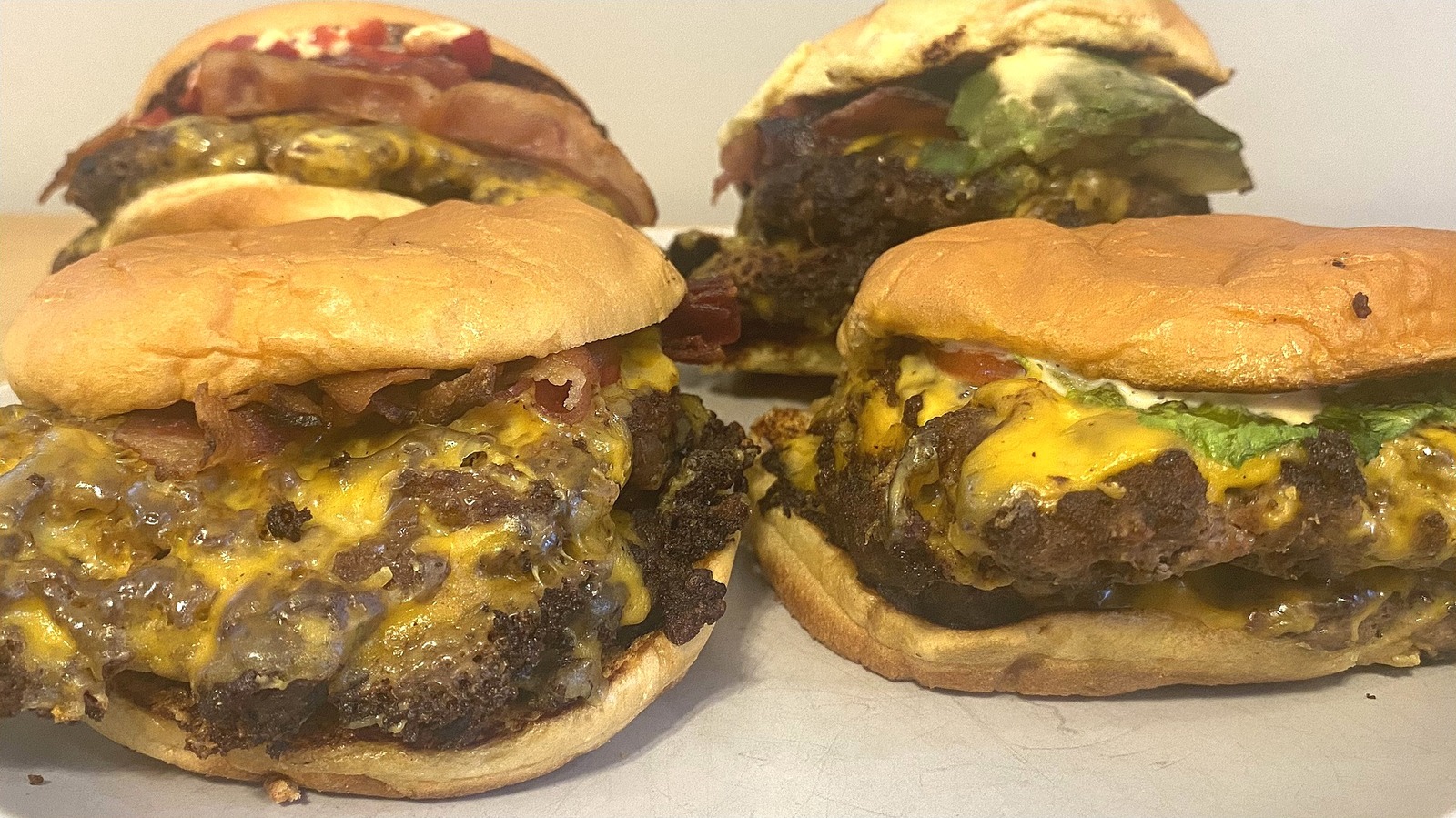
Generally, Shake Shack offers a dependable experience, matching a tasty selection of foods with pleasant service and efficient operation. It's all too easy to forget that the burger giant started as a hot dog cart, especially when you glance at all the bun-based sandwiches on the menu. Unlike the minimalist offerings of some chains, Shake Shack doesn't fear experimentation, with a range that includes Korean-inspired flavors, varying chicken options, and a plant-based mushroom offering. Even exclusively among beef-based patties, there are nearly a dozen items to choose from — so our own Food Republic took to tasting and ranking every Shake Shack burger.
The worst-reviewed option? The basic hamburger. You wouldn't expect Shake Shack to disappoint with such a no-frills staple, but our taster found the sandwich dry and one-dimensional. To the chain's defense, the menu item only entails two ingredient: beef and bread. You can pick between one to three ¼-pound patties, all served on the chain's signature potato bun. Yet order it as it comes, and you're not even getting a condiment (although you can add the ShackSauce free of charge).
Our reviewer did find the beef itself flavorful and well-cooked — however, the dish simply comes off too chewy, and desperately misses some balance. It's a sentiment shared by others: "The burger was average ... and salty," wrote a Reddit user; another commenter described them as "mediocre at best." So leave the simple stuff to the other chains, and go for a more topping-heavy Shake Shack offering.
Shake Shack shines with additional burger toppings
Opposed to other burger chains, Shake Shack draws extra critical assessment. For one, there's the price. Even an order of the basic burger with two patties costs $9.29 (per a Texas location) — not winning points for cost-effectiveness compared to other chains. Furthermore, the abundance of interest has led to lines and inflated expectations. "Is Shake Shack really worth the hype?" one Reddit thread reads.
Yet Shake Shack customers are quick to defend the chain's niche, noting it occupies a specific position in the burger market. "Compare it to McDonalds [and it's] incredible, compare it to the best burgers in town [and it's] average at best," one Redditor wrote. Essentially, Shake Shack focuses on a standardized, good sandwich that's a little pricier, with a gourmet twist — all reasons why a basic burger isn't the best showcase of the chain.
Pay the Shake Shack premium, and you might as well add toppings like pickles, lettuce, onions, tomato, and ShackSauce — all available free of charge. The couple of dollars spent on avocado is worth it, too; our reviewer thought it considerably improved the sandwich. Better yet, go for the more complex Shack Stack or SmokeShack (our top-ranked burgers) for a medley of ingredients that comes together delectably. It's certainly not the cheapest fast food burger in the U.S., but a spiffier Shake Shack order has a charm all its own.
Facts Only
Shake Shack began as a hot dog cart and now offers a menu with nearly a dozen beef-based patty options, including Korean-inspired flavors and plant-based choices.
The basic hamburger at Shake Shack consists of beef and a potato bun, with no default condiments unless requested.
The basic hamburger was criticized as dry, chewy, and one-dimensional in a review by Food Republic.
The beef in the basic hamburger was described as flavorful and well-cooked, but the overall sandwich lacked balance.
Reddit users have described the basic burger as "average" and "mediocre at best."
A two-patty basic burger costs $9.29 at a Texas location.
Shake Shack allows free additions of toppings like pickles, lettuce, onions, tomato, and ShackSauce.
The Shack Stack and SmokeShack burgers were ranked as the top options in the review.
Some customers defend Shake Shack as a mid-tier option, better than McDonald’s but not as good as local gourmet burgers.
Long lines and high expectations contribute to mixed perceptions of the chain’s value.
Executive Summary
Shake Shack, known for its diverse menu and efficient service, offers a wide range of burgers, including Korean-inspired flavors, chicken options, and plant-based choices. However, its basic hamburger—comprising only beef and a potato bun—has been criticized as dry, one-dimensional, and lacking balance, despite the beef being flavorful and well-cooked. The basic burger starts at $9.29 for two patties, which some find overpriced compared to other fast-food chains. While Shake Shack occupies a niche between fast food and gourmet burgers, customers suggest that its strength lies in more complex offerings like the Shack Stack or SmokeShack, which feature additional toppings like avocado, pickles, and ShackSauce. The chain’s popularity has led to long lines and high expectations, with opinions varying: some praise its quality over chains like McDonald’s, while others find it average compared to local gourmet options. The consensus is that Shake Shack’s value comes from its premium toppings and creative combinations rather than its minimalist burger.
The review highlights a tension between Shake Shack’s positioning as a higher-end fast-casual chain and the expectations of customers who compare it to both budget-friendly and high-end alternatives. While the basic burger underwhelms, the chain’s more elaborate options receive praise for their flavor and quality, suggesting that the Shake Shack experience is best enjoyed with additional customization.
Full Take
**STEELMAN:** The narrative presents a fair critique of Shake Shack’s basic burger while acknowledging the chain’s strengths in more elaborate offerings. It avoids hyperbole, grounding its assessment in specific observations (dryness, lack of balance) and contextualizing the criticism within the broader fast-casual market. The piece also gives voice to differing customer perspectives, avoiding a one-sided dismissal.
**PATTERN SCAN:** The article avoids overt manipulation, but there’s a subtle framing of Shake Shack as a "premium" chain that *should* deliver more, which could nudge readers toward expecting gourmet quality at fast-food speeds. The comparison to McDonald’s and local burgers risks a false equivalence—Shake Shack isn’t trying to be either, but the binary setup might oversimplify its niche. No overt emotional exploitation or bad faith tactics are present.
**ROOT CAUSE:** The underlying paradigm is the tension between standardization and artisanal expectations in fast-casual dining. Shake Shack’s model relies on consistency and scalability, but customers increasingly demand both affordability *and* customization. The critique reflects a broader cultural shift where "basic" is no longer enough—even for a chain that started as a hot dog cart.
**IMPLICATIONS:** For consumers, this highlights the trade-offs in fast-casual dining: paying more for perceived quality but still expecting flexibility. For Shake Shack, the risk is alienating cost-conscious customers while failing to satisfy gourmet seekers. The second-order effect? Chains may feel pressured to inflate menus with premium options, raising prices further and distancing themselves from their original value propositions.
**BRIDGE QUESTIONS:**
If Shake Shack’s basic burger is intentionally minimalist, is the criticism fair, or does it reflect unrealistic expectations for fast-casual food?
How much should a chain’s origin story (e.g., hot dog cart) influence our judgment of its current offerings?
Would Shake Shack benefit from rebranding its basic burger as a "blank canvas" for customization, rather than a standalone product?
**COUNTERSTRIKE SCAN:** A bad actor pushing this narrative might amplify the "overpriced" angle to fuel anti-corporate sentiment or pit Shake Shack against competitors in a manufactured rivalry. However, the article’s balanced tone and lack of inflammatory language suggest no alignment with such a playbook. It’s a straightforward review, not a coordinated attack.
**Patterns detected: none**
Sentinel — Human
The article appears to be written by a human journalist, exhibiting signs of personal voice, idiosyncratic emphasis, and erratic sentence length variance. However, the absence of certain repetitive patterns and the lack of an obvious argumentative structure raise some questions.