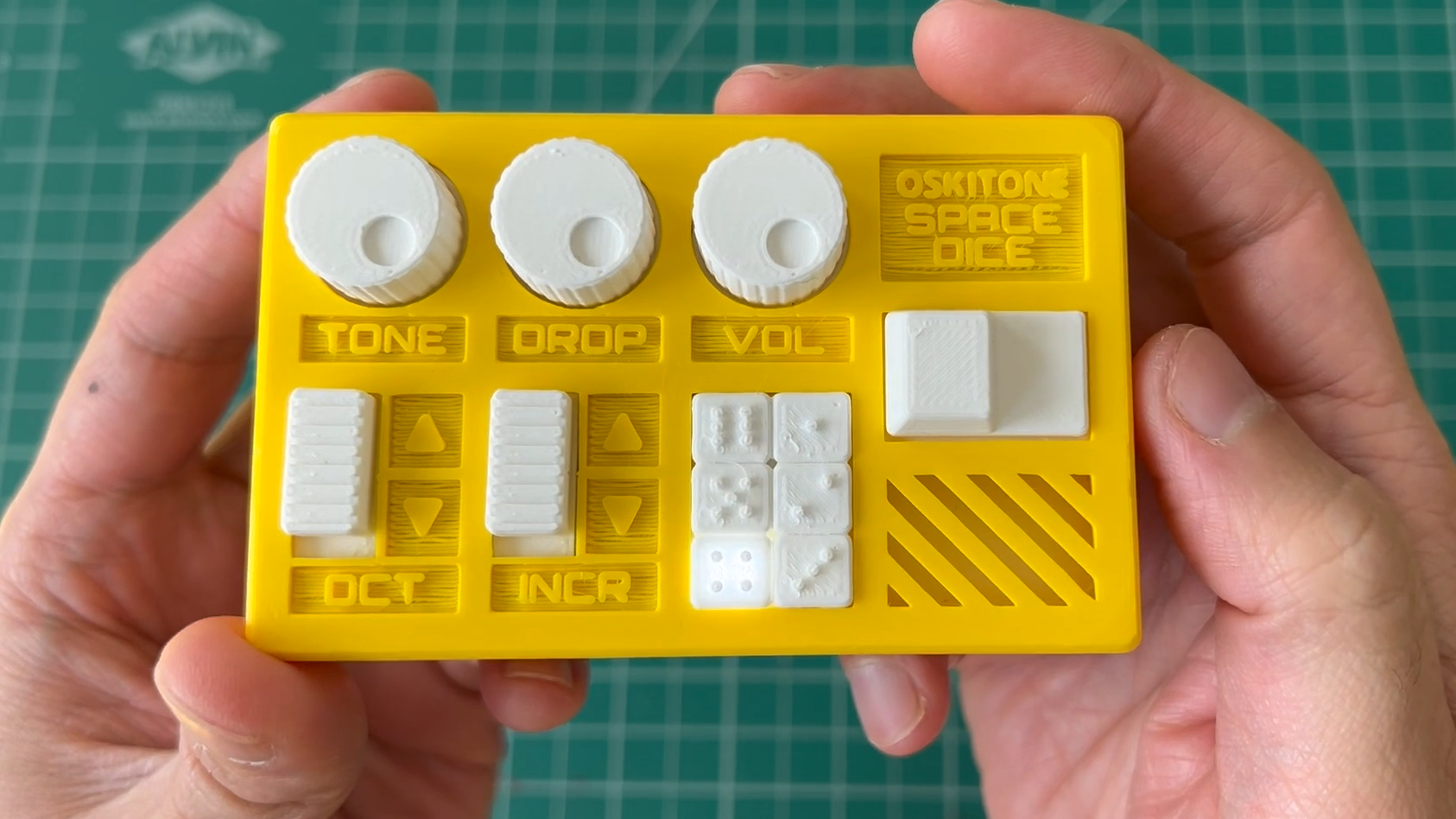
[Tommy] at Oskitone has been making hardware synth kits for years, and his designs are always worth checking out. His newest offering Space Dice is an educational kit that is a combination vintage sci-fi space laser sound generator, and six-sided die roller. What’s more, as a kit it represents an effort to be genuinely educational, rather than just using it as a meaningless marketing term.
There are several elements we find pretty interesting in Space Dice. One is the fact that, like most of [Tommy]’s designs, there isn’t a microcontroller in sight. Synthesizers based mostly on CMOS logic chips have been a mainstay of DIY electronics for years, as have “electronic dice” circuits. This device mashes both together in an accessible way that uses a minimum of components.
There are only three chips inside: a CD4093 quad NAND with Schmitt-trigger inputs used as a relaxation oscillator, a CD4040 binary counter used as a prescaler, and a CD4017 decade counter responsible for spinning a signal around six LEDs while sound is generated, to represent an electronic die. Sound emerges from a speaker on the backside of the PCB, which we’re delighted to see is driven not by a separate amplifier chip, but by unused gates on the CD4093 acting as a simple but effective square wave booster.
In addition, [Tommy] puts effort into minimizing part count and complexity, ensuring that physical assembly does not depend on separate fasteners or adhesives. We also like the way he uses a lever assembly to make the big activation button — mounted squarely above the 9 V battery — interface with a button on the PCB that is physically off to the side. The result is an enclosure that is compact and tidy.
We recommend checking out [Tommy]’s concise writeup on the design details of Space Dice for some great design insights, and take a look at the assembly guide to see for yourself the attention paid to making the process an educational one. We love the concept of presenting an evolving schematic diagram, which changes and fills out as each assembly step is performed and tested.
Watch it in action in a demo video, embedded just below. Space Dice is available for purchase but if you prefer to roll your own, all the design files and documentation are available online from the project’s GitHub repository.
Thank you! I love it! Freaking awesome, as if an unexpected but beautiful miracle to use for a decision to share with the magic of random…
And the color choice I like… the white… and for the dice itself, suggesting not the darkness in your path but light and bright…
Charming
Facts Only
Tommy at Oskitone has designed hardware synth kits for years.
Space Dice is a new educational kit combining a space laser sound generator and an electronic die roller.
The kit uses CMOS logic chips instead of microcontrollers.
It contains three chips: CD4093 (oscillator), CD4040 (prescaler), and CD4017 (decade counter).
The CD4017 drives six LEDs and generates sound through a speaker on the PCB.
Unused gates on the CD4093 amplify the sound without a separate amplifier chip.
The design minimizes part count and avoids separate fasteners or adhesives.
A lever mechanism connects a large activation button to a smaller PCB-mounted button.
The enclosure is compact and tidy, with a 9V battery power source.
Assembly guides include an evolving schematic that updates with each step.
Space Dice is available for purchase, with all design files and documentation on GitHub.
The project emphasizes accessibility and educational value.
Executive Summary
Tommy at Oskitone has designed Space Dice, an educational hardware synth kit that combines a vintage sci-fi space laser sound generator with a six-sided electronic die roller. The kit is intentionally educational, avoiding microcontrollers in favor of CMOS logic chips to simplify the design and minimize components. It uses three chips: a CD4093 for oscillation, a CD4040 as a prescaler, and a CD4017 to drive six LEDs and generate sound. The speaker is driven by unused gates on the CD4093, eliminating the need for an amplifier chip. The physical design is compact, with a lever-activated button and no separate fasteners, making assembly straightforward. All design files and documentation are publicly available, and the kit is also sold commercially. The project emphasizes accessibility and hands-on learning, with an evolving schematic that guides users through assembly and testing.
The design reflects a broader trend in DIY electronics, where simplicity and educational value are prioritized over complexity. By avoiding microcontrollers, the kit lowers the barrier to entry for beginners while still delivering an engaging, functional device. The attention to detail in both the hardware and documentation underscores a commitment to making electronics education more approachable.
Full Take
Space Dice is a compelling example of how educational design can bridge creativity and technical learning. The strongest version of this narrative highlights its accessibility—using minimal components and avoiding microcontrollers makes it approachable for beginners while still delivering a functional and engaging device. The emphasis on hands-on learning, with an evolving schematic and clear documentation, aligns with constructive educational principles. It’s a thoughtful response to the often-overwhelming complexity of modern electronics, offering a tangible entry point for learners.
Pattern-wise, the presentation avoids manipulation tactics, focusing instead on transparency and utility. The design’s simplicity and open-source nature resist common pitfalls like jargon overload or false framing. However, the enthusiastic tone in the closing remarks ("Freaking awesome... magic of random") could be seen as a mild appeal to emotional engagement, though it doesn’t cross into exploitation. The project’s core strength lies in its pedagogical integrity—it doesn’t just claim to be educational; it demonstrates it through structure and execution.
Root cause: This reflects a broader paradigm shift toward demystifying technology. By stripping away unnecessary complexity, Space Dice challenges the assumption that electronics must be opaque or intimidating. It echoes historical DIY movements, where simplicity and accessibility were key to empowering makers.
Implications: For human agency, this lowers barriers to entry, allowing more people to engage with hardware design. The cost is minimal—just time and basic components—but the benefit is a deeper understanding of logic circuits and sound synthesis. Second-order consequences could include a resurgence of interest in analog electronics, countering the dominance of microcontroller-based projects.
Bridge questions: How might this approach scale to more complex educational tools? What trade-offs exist between simplicity and functionality in learning? Would this model work as well for software-based projects?
Counterstrike scan: If this were part of a coordinated campaign, the playbook might involve leveraging nostalgia (vintage sci-fi sounds) and simplicity to sell kits under the guise of education. However, the actual content aligns with genuine educational goals—open documentation, minimalism, and clear learning outcomes. No structural alignment with manipulation is detected.
Patterns detected: none