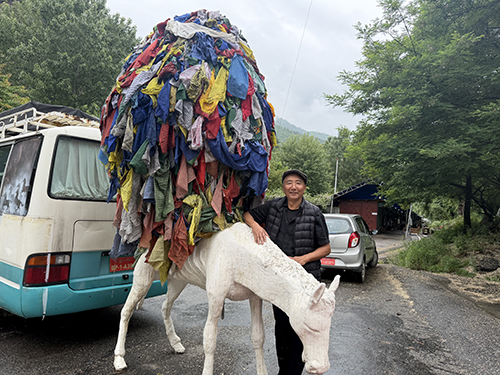
Lungta (wind horse) prayer flags have long been a significant symbol of culture and religion in the Himalayas. These colorful flags are hoisted with the spiritual meaning of peace, compassion, good fortune, and wisdom to flourish.
Hoisting prayer flags along monasteries, forests, hills, mountain passes, and trails has been a common practice and is deeply personal and meaningful to the individual, believing that the blessings and goodwill embodied by the flags will spread across the lands.
While the practice of hoisting Lungta prayer flags is a vital part of Buddhist spirituality, there is an underlying reality of the type of prayer flags being hoisted that carries detrimental effects to the environment.
Therefore, VAST Bhutan recognised this importance and is actively attempting to create greater awareness in society, working tirelessly to spread the message for a more mindful hoisting of prayer flags.
The Unseen Problem
Executive Director of VAST Bhutan, Passang, said that the essence of hanging authentic prayer flags is being lost as the prayer flags available in the market today are those made of polyester instead of cotton and its strings made from high resistance materials, which leads to choking trees and hampering branch growth.
Most of the cotton-made traditional prayer flags in the market have been replaced by imported ones, which are made of polyester, which is a plastic material.
Its quality is also visible in the printed Lungta texts, with missing and incorrect mantra spellings.
“Authentic prayer flags are cotton-made and their mantra inscriptions are also printed using a xylographic block method,” she said.
She noted that the traditional xylographic is also slowly disappearing as there is only one remaining person who uses the traditional method to create authentic prayer flags.
Passang said that hanging prayer flags is often a gesture of good fortune, luck and goodwill, but people are losing sight of the essence of it as most aren’t aware of these unauthentic prayer flags.
For the environment, this is especially bad news as young trees and their branches are often choked by the strings, leading to stunting of trees and branch growth.
A recent fire at Sangaygang stood as another strong proof of their movement as the fire also engulfed the flags that were hoisted in the hills.
“Flags made from cotton fabric burn well and turn into ash afterwards. However, polyester-made prayer flags after burning left hardened plastic lumps which pollute the environment more,” Passang said.
What’s even more concerning is the synthetic strings that bind the flags. The VAST team gathered all the flags after the fire incident and collected the flags. Looking at the strings, they held strong resistance to the fire as opposed to the flags that turned into plastic lumps.
While the practice of Lungta is considered spiritual and done with sentiments of goodwill, Passang clarified that VAST’s objective is not to discourage people from hanging prayer flags but to be more mindful while doing so.
Her aspiration for the festival is to bring awareness to the public.
“Our actions have consequences and if we aren’t aware of what we are doing especially in terms of Lungta, they might be doing more harm than good.”
Therefore, coinciding with the Year of the Horse, VAST Bhutan is currently in the midst of hosting its year-long Lungta Art Festival, which aims to bring awareness of the Lungta and drive meaningful change through art.
Unveil, Untangle and Unleashing the Lungta
The festival is oriented into three segments: unveil, untangle, and unleash of the Lungta through a diverse list of activities including art exhibitions, collection of soiled prayer flags, art talks, and hands-on workshops to turn the collected flags into bio-degradable materials.
The objectives of the LAF are clear: Promoting social-cultural and spiritual values for societal growth, peace and harmony, creating awareness and stewardship on environmental protection needs in the fragile mountain ecosystem, and fostering positive social and behaviour change through community engagements.
Passang said that the majority of activities planned are five solo exhibitions (for individuals to reflect on the Lungta) and three group shows depending on the budget.
Additional shows and exhibitions throughout other dzongkhags will also be hosted if we get an additional budget.
A xylographic workshop in collaboration with the Department of Culture was conducted recently for youths to learn the process of printing.
One of the main goals is to recycle the flags by making them into something reusable.
She said that VAST is currently looking into ordering a shredder machine (a pilot phase), to process the collected flags into shreds and looking into creating eco–friendly blocks.
Currently, the CSO is looking to collaborate with different government stakeholders from the tourism and environment sectors to enable strengthened participation in fighting this battle.
Asha Kama, the Director of the festival said, “as the LAF director, my dream is to understand the basic phenomena of the Lungta and share them with my fellow artists.”
“Together we hope to relate our finds through our art to a wider audience – with involvement of a bigger community we hope to untangle some prayers, prayer flags and some trees,” he added.
Passang said that mindfulness is part of our fabric as Bhutanese and any support to this festival may help the outside world understand what Bhutan is all about.
Practicing mindfulness comes from our actions and can contribute to Bhutan as a champion of harmony and peace and inspire more to take similar courses of action.
She added that if we practice mindfulness and if the outside world sees us like that, then the value of the Gelephu Mindfulness City (GMC), also becomes higher.
Facts Only
Lungta prayer flags are a cultural and religious symbol in the Himalayas, traditionally made of cotton and inscribed with mantras using xylographic block printing.
Modern prayer flags are often made of polyester and synthetic strings, which are non-biodegradable and harmful to the environment.
VAST Bhutan is an organization working to raise awareness about the environmental impact of non-biodegradable prayer flags.
Polyester prayer flags can choke trees, stunt branch growth, and leave plastic residues after fires, unlike cotton flags, which burn completely.
A recent fire at Sangaygang demonstrated the environmental harm of polyester flags, as they left hardened plastic lumps after burning.
Traditional xylographic printing for prayer flags is nearly extinct, with only one remaining practitioner in Bhutan.
VAST Bhutan is hosting the Lungta Art Festival, a year-long event coinciding with the Year of the Horse, to promote mindful flag-hoisting practices.
The festival includes art exhibitions, workshops, and the collection of soiled prayer flags for recycling into biodegradable materials.
VAST Bhutan is collaborating with government agencies, including the Department of Culture and environmental sectors, to strengthen participation in the initiative.
The organization aims to recycle collected flags using a shredder machine and create eco-friendly products.
The festival’s objectives include promoting spiritual values, environmental awareness, and positive social change through community engagement.
VAST Bhutan emphasizes that the goal is not to discourage the practice of hanging prayer flags but to encourage mindfulness in their use.
Executive Summary
Lungta prayer flags are a deeply rooted cultural and spiritual symbol in the Himalayas, traditionally made of cotton and inscribed with mantras using xylographic block printing. However, modern prayer flags are increasingly made of polyester and synthetic materials, which pose environmental hazards. VAST Bhutan, an organization focused on cultural and environmental stewardship, is raising awareness about the ecological impact of these non-biodegradable flags, which can choke trees, leave plastic residues after fires, and disrupt fragile mountain ecosystems. The group is hosting the Lungta Art Festival to promote mindfulness in flag-hoisting practices, encouraging the use of authentic, biodegradable materials and recycling collected flags into eco-friendly products. The festival includes art exhibitions, workshops, and collaborations with government agencies to foster cultural preservation and environmental responsibility. While the initiative aims to preserve spiritual traditions, it also seeks to address the unintended consequences of modern materials on Bhutan’s natural landscape.
The movement highlights a tension between cultural practices and environmental sustainability, emphasizing the need for community engagement and education. VAST Bhutan’s efforts reflect a broader commitment to aligning Bhutan’s values of harmony and mindfulness with practical solutions, such as reviving traditional flag-making techniques and exploring recycling methods. The festival serves as a platform to untangle the spiritual significance of Lungta from its environmental impact, inviting artists and the public to rethink their relationship with these symbols. The organization’s approach balances respect for tradition with a call for adaptive, eco-conscious practices, positioning Bhutan as a model for mindful cultural preservation.
Full Take
The narrative around Lungta prayer flags presents a compelling case study in the intersection of tradition, environmentalism, and cultural identity. At its core, the issue reflects a broader global tension between preserving heritage and adapting to ecological realities. The strongest version of this narrative—steelman—acknowledges the genuine spiritual significance of prayer flags while highlighting the unintended consequences of modern materials. VAST Bhutan’s approach is constructive, framing the problem not as an attack on tradition but as an opportunity to restore authenticity and sustainability. This avoids the pitfalls of cultural erasure or moral panic, instead positioning mindfulness as a bridge between past and present.
Pattern scan: The article avoids overt manipulation, but subtle framing could be interpreted as a form of *ARC-0024 Ambiguity*—the tension between spiritual intent and environmental harm is presented as a binary that requires resolution, though the solution (mindful practices) is framed as harmonious rather than divisive. The emphasis on "authentic" vs. "inauthentic" flags might also risk *ARC-0043 Motte-and-Bailey*, where the motte (preserving tradition) is defensible, but the bailey (environmental critique) could be seen as an expansion of the original spiritual purpose. However, the narrative resists exaggeration and maintains a focus on actionable solutions.
Root cause: The paradigm driving this narrative is the collision of globalization (cheap, synthetic materials) with localized cultural practices. The unstated assumption is that tradition and sustainability are inherently compatible, which may not always hold true in other contexts. Historically, this echoes broader movements where indigenous or spiritual practices are re-examined through an ecological lens, such as the slow food movement or sacred grove conservation.
Implications: The initiative’s success hinges on whether mindfulness can scale beyond individual actions to systemic change. If adopted widely, it could reduce plastic pollution in fragile ecosystems while revitalizing traditional crafts—a win for both culture and environment. However, the cost of authenticity (higher production costs, limited artisans) may limit accessibility, risking elitism in spiritual practice. Second-order consequences could include tourism impacts (if visitors perceive Bhutan as overly restrictive) or unintended cultural commodification (if "eco-friendly" flags become a marketable trend).
Bridge questions: How might this model apply to other cultural practices with environmental externalities? Could the revival of traditional methods create economic opportunities for local artisans, or would it remain a niche effort? What metrics would define success—reduced plastic waste, increased use of cotton flags, or broader cultural shifts in mindfulness?
Counterstrike scan: If this were a coordinated campaign, the playbook might involve leveraging Bhutan’s global reputation for mindfulness to push a broader anti-plastic agenda, using cultural symbols as a Trojan horse. However, the content aligns more with genuine grassroots advocacy than manipulation. The focus on collaboration, education, and practical solutions (e.g., recycling) suggests authenticity rather than covert influence. No structural alignment with a hypothetical attack pattern is detected.
Sentinel — Human
The article demonstrates high localized specificity and a human-driven narrative flow, making it highly likely to be human-authored reporting on a specific cultural and environmental initiative.