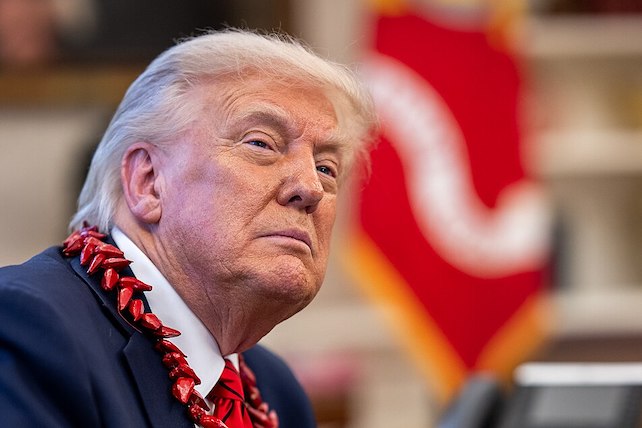
President Trump’s reaction to the death of a high-profile figure has again created controversy and backlash. After the death of former FBI Director Robert Mueller was announced on Saturday (March 21), Trump posted on Truth Social, “Good, I’m glad he’s dead. He can no longer hurt innocent people.”
Mueller, a decorated military veteran and longtime public servant, died Friday night at age 81. No cause of death was given for Mueller, who was diagnosed with Parkinson’s disease in 2021. The Bronze Star and Purple Heart recipient led the FBI from 2001 to 2013.
Mueller then served as special counsel to investigate Russian interference in the 2016 U.S. presidential election. He eventually charged several high-profile Trump associates with crimes but, as a professional courtesy, stopped short of saying whether the sitting president had obstructed justice.
Trump, who still refers to the “Russia hoax,” has spoken ill of the deceased previously. After movie director Rob Reiner and his wife were murdered last December, the president posted that the cause of death was Reiner’s “anger he caused others through his massive, unyielding, and incurable affliction with a mind crippling disease known as TRUMP DERANGEMENT SYNDROME.”
RELATED: Christian Leaders Denounce President Trump’s Rob Reiner Comments as ‘Vile’ and ‘Shameful’
President’s Post About Robert Mueller Draws Backlash
After President Trump indicated he was “glad” Robert Mueller had died, faith and political leaders pushed back. “God help us,” posted Fr. James Martin, a Jesuit priest. “This is disgraceful language coming from a Christian, or anyone with a soul.” He added, “It was just as wrong to celebrate the death of Charlie Kirk as it is to celebrate that of Robert Mueller. May they both rest in peace. And may we never forget that Jesus’s message is about mercy.”
Theology professor Esau McCaulley wrote, “I am so tired of character and decorum mattering for every job except the highest elected office in the land.” In a comment below that, someone wrote, “If you were falsely accused for 12 years, you would have disliked Mueller too.”
Another person replied to that comment by writing, “The man died and his family is grieving their loss. If you have nothing decent to say just keep your mouth shut. Stop making excuses for [Trump].”
Messianic Jewish author Ron Cantor, president of Shelanu TV, posted, “If the faith council that surrounds President Trump had even a little bit of the DNA of the Hebrew prophets, they would confront President Trump over this [comment about Mueller’s death’].”
“Too often, they are more like the false prophets of 1 [Kings] 22 who just tell the king what he wants to hear,” said Cantor.
RELATED: Critics Call Out Christian Leaders for Attending Oval Office Prayer Session With Paula White
This is disgraceful language coming from a Christian, or anyone with a soul, said Fr. James Martin.Click to Post
Facts Only
Former FBI Director Robert Mueller died on March 21 at age 81.
Mueller served as FBI Director from 2001 to 2013 and later as special counsel investigating Russian interference in the 2016 U.S. presidential election.
Mueller was a decorated military veteran, receiving the Bronze Star and Purple Heart.
He was diagnosed with Parkinson’s disease in 2021.
President Trump posted on Truth Social that he was "glad" Mueller had died, stating he could no longer "hurt innocent people."
Trump has previously criticized Mueller, referring to the Russia investigation as a "hoax."
In December, Trump made controversial comments about the deaths of filmmaker Rob Reiner and his wife, attributing it to "Trump Derangement Syndrome."
Faith leaders, including Fr. James Martin and Ron Cantor, condemned Trump’s remarks about Mueller’s death.
Theology professor Esau McCaulley criticized the lack of character expectations for the presidency.
Some commentators defended Trump, citing perceived false accusations over 12 years.
Others argued that public figures should refrain from negative comments during times of grief.
Executive Summary
President Trump’s response to the death of former FBI Director Robert Mueller has sparked significant controversy. Mueller, a decorated military veteran and public servant who led the FBI from 2001 to 2013 and later served as special counsel investigating Russian interference in the 2016 election, died at age 81. Trump posted on Truth Social that he was "glad" Mueller had died, stating he could no longer "hurt innocent people." This remark drew sharp criticism from faith and political leaders, including Jesuit priest Fr. James Martin, who called the language "disgraceful" and inconsistent with Christian values. Theology professor Esau McCaulley lamented the lack of character expectations for the presidency, while others defended Trump, citing years of perceived false accusations. The backlash highlights ongoing tensions between Trump’s rhetoric and traditional norms of decorum, particularly in moments of national mourning.
The incident follows a pattern of Trump’s contentious comments about deceased figures, including his previous remarks about filmmaker Rob Reiner’s death, which were also widely condemned. Critics argue that such statements undermine civic discourse, while supporters frame them as justified reactions to prolonged political persecution. The debate underscores broader questions about the boundaries of public speech, the role of empathy in leadership, and the polarization of political and religious discourse in the U.S.
Full Take
The strongest version of this narrative highlights a clash between political grievance and civic decorum. Trump’s remarks about Mueller’s death are framed as a visceral reaction to years of perceived injustice, resonating with supporters who view the Russia investigation as a partisan attack. The backlash, however, underscores a broader cultural expectation that public figures—especially those claiming moral or religious authority—should uphold dignity in moments of loss. The pattern here aligns with **ARC-0024 Ambiguity** (leveraging unresolved grievances to justify inflammatory speech) and **ARC-0043 Motte-and-Bailey** (retreating to "free speech" or "justified anger" when criticized, while advancing provocative claims).
Rooted in this dynamic is a paradigm where political identity supersedes shared norms. The assumption that "character matters for every job except the presidency" reflects a systemic erosion of accountability, where outrage becomes a currency for mobilization. Historically, this echoes moments when leaders weaponize grievance to consolidate support, often at the cost of social cohesion. The implications are stark: when public discourse prioritizes tribal validation over empathy, human dignity becomes collateral damage. Who benefits? Those who thrive on polarization. Who bears the cost? A civil society already frayed by distrust.
Bridge questions: How might leaders reconcile accountability with empathy in polarized times? What would it take for political opponents to acknowledge each other’s humanity without surrendering principle? And if decorum is dismissed as "weakness," what replaces it as the bedrock of public trust?
Counterstrike scan: A coordinated influence campaign would amplify Trump’s remarks to deepen divisions, framing critics as "elite hypocrites" while rallying supporters around perceived persecution. The actual content partially matches this playbook—Trump’s statement is inflammatory, and the backlash is predictable—but the article itself resists full manipulation by including diverse perspectives. The pattern is concerning but not structurally aligned with a deliberate disinformation operation.
Sentinel — Human
The article shows strong human stylistic markers, including emotional language and specific, verifiable details, with minimal signs of synthetic generation.