Boris van der Spek
correspondent Mexico en Midden-Amerika
Boris van der Spek
correspondent Mexico en Midden-Amerika
Het zijn videobeelden die Mexicaanse nieuwskanalen op dinsdag beheersen: tientallen veelal buitenlandse toeristen die op de grond liggen bij het beroemde tempelcomplex Teotihuacán, terwijl een man met een vuurwapen in salvo's kogels afvuurt. Beelden die dankzij sociale media ook de rest van de wereld over gaan. En die in de aanloop naar het WK voetbal de vraag doet rijzen: hoe veilig is Mexico eigenlijk?
Bij de schietpartij op maandag kwam een Canadese vrouw om het leven. Dertien mensen raakten gewond, onder wie twee kinderen. Onder de gewonden is ook een Nederlandse vrouw. De schutter, een man van 27 uit de staat Guerrero, beroofde zichzelf van het leven na een schotenwisseling met de politie.
Beelden van de schietpartij:
Op haar dagelijkse persconferentie sprak de Mexicaanse president Claudia Sheinbaum van een man met "psychische problemen". Op achtergelaten stukjes papier liet de dader weten "inspiratie van buitenaf" te hebben gehad, in zijn rugtas werden boeken over de schietpartij op de Amerikaanse Columbine-school in 1999 gevonden en Mexicaanse media ontdekten dat hij op sociale media extreemrechtse uitingen deed. Maar wat Mexicaanse autoriteiten vooral benadrukken: hij was een lone wolf, iemand die alleen handelde. Hoe gruwelijk ook, de schietpartij staat op zichzelf, zeggen zij.
Maar het zijn de beelden die beklijven. Teotihuacán is een van de meest iconische archeologische vindplaatsen van Mexico, die jaarlijks door zo'n 1,6 miljoen mensen wordt bezocht. Toeristen kunnen op zo'n 40 kilometer van hoofdstad Mexico-Stad tempels beklimmen en een adembenemend uitzicht krijgen over het eeuwenoude complex. De schutter deed dit maandag ook, toen hij met zijn wapen de 45 meter hoge Piramide van de Maan beklom en daar uiteindelijk ook zichzelf doodde.
Beveiliging opgeschroefd
Sheinbaum kondigde direct na de schietpartij aan dat de beveiliging bij archeologische vindplaatsen en toeristische gebieden in Mexico opgeschroefd zou worden, en dat tassen van bezoekers strenger gecontroleerd gaan worden. Want nu de beelden van toeristen, die rennen voor hun leven tussen eeuwenoude Mexicaanse ruïnes, rondgaan, wordt ook die door de regering zo verafschuwde veiligheidsvraag weer gesteld.
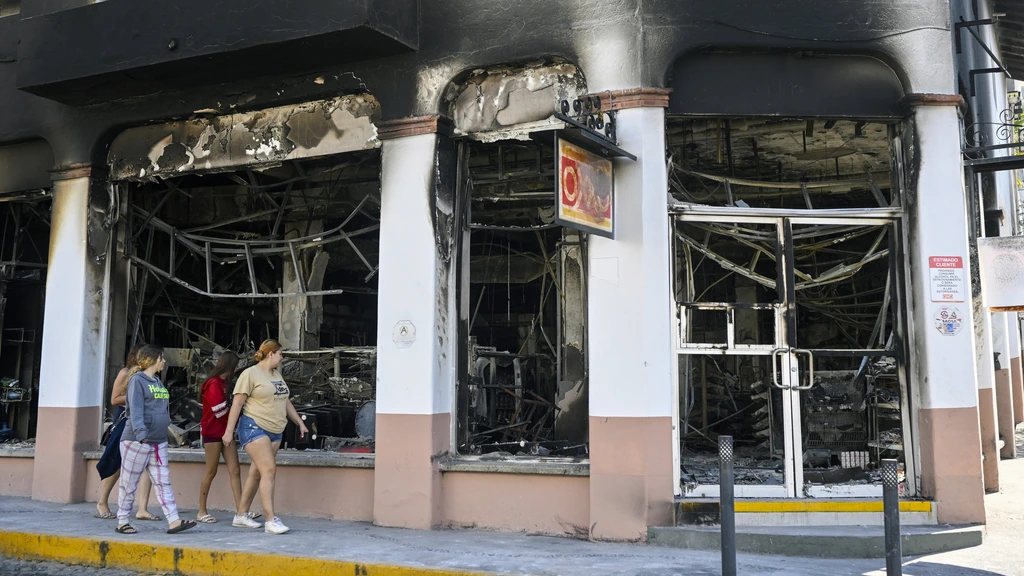
Het is bijna twee maanden geleden dat de gevreesde drugsbaas El Mencho, oprichter van het Jaliscokartel, werd gedood bij een militaire operatie. Na zijn dood gingen in twintig Mexicaanse staten leden van kartels de straat op. Auto's en winkels werden in brand gestoken, in verschillende steden werd openbaar vervoer stilgelegd, werden scholen gesloten en werd de plaatselijke bevolking opgeroepen binnen te blijven. Onder meer in Guadalajara, speelstad op het WK, en de populaire toeristische bestemming Puerto Vallarta stegen rookpluimen op.
Twee maanden later is er nog veel onduidelijk over de nasleep. De Mexicaanse regering heeft nooit informatie gegeven over de omvang van deze "narcoblokkades" of hoe groot de schade was aan infrastructuur. Waar de dood van El Mencho gevierd werd als triomf van de Mexicaanse regering tegen de georganiseerde misdaad, werd de uitbarsting van geweld na afloop doodgezwegen.
Buitenlandse journalisten ontvingen wel een kort persbericht van Mexicaanse ambassades waarin stond dat de orde in Mexico, met name in staat Jalisco, weer hersteld was. In Jalisco gold op dat moment nog code rood, wat betekende dat alle scholen en publieke instellingen gesloten waren.
Dagen later presenteerde de regering haar veiligheidsplannen voor het aanstaande WK voetbal, waarin stond dat 100.000 agenten en militairen, geholpen door onder meer drones en robothonden, de veiligheid rond stadions zullen bewaken.
Minder moorden: 50 per dag
De Mexicaanse regering blijft benadrukken dat het land zowel tijdens het WK als ervoor en erna een veilige bestemming voor toeristen is. Er wordt gewezen op de scherpe daling van het aantal moorden: gemiddeld vijftig per dag, het laagste in tien jaar tijd. Al zijn er twijfels over de manier waarop de regering cijfers over moorden bijhoudt. Tegelijkertijd voelt ruim 60 procent van de Mexicanen zich niet veilig in hun stad.
Er is de regering veel aan gelegen om ervoor te zorgen dat de problemen van Mexico binnenskamers blijven, zeker rond het WK voetbal. Ook inwoners van speelsteden merken dat: in Mexico-Stad, Monterrey en Guadalajara worden posters met gezichten en namen van vermiste mensen uit het straatbeeld verwijderd, tot woede van zoekende nabestaanden.
Teotihuacán, het beroemde toeristencomplex, zal spoedig weer opengaan. En op de dagelijkse persconferentie van Sheinbaum zal het de komende tijd vooral gaan over het pittoreske, kleurrijke Mexico. Want met de écht grote problemen van het land, hoeft de buitenwereld niet lastiggevallen te worden.
Facts Only
A 27-year-old man from Guerrero opened fire at the Teotihuacán archaeological site on Monday.
The attack killed one Canadian woman and injured 13 others, including two children and a Dutch woman.
The shooter died by suicide after exchanging gunfire with police.
The incident took place at the Pyramid of the Moon, part of the Teotihuacán complex near Mexico City.
Authorities found extremist social media posts and references to the Columbine shooting in the attacker’s belongings.
Mexican President Claudia Sheinbaum described the shooter as a "lone wolf" with psychological issues.
The government announced enhanced security measures at tourist sites, including stricter bag checks.
Two months prior, cartel leader El Mencho was killed in a military operation, sparking violent protests in 20 states.
Protests included arson, blocked roads, and school closures in cities like Guadalajara and Puerto Vallarta.
The government has not disclosed the full extent of damage or casualties from the post-El Mencho unrest.
Mexico plans to deploy 100,000 security personnel, drones, and robothonden for World Cup security.
Official statistics show homicides at a 10-year low, averaging 50 per day.
Over 60% of Mexicans report feeling unsafe in their cities.
Posters of missing persons have been removed from streets in World Cup host cities.
Teotihuacán will reopen soon, with authorities emphasizing Mexico’s safety for tourists.
Executive Summary
A shooting at the Teotihuacán archaeological site in Mexico has raised concerns about safety ahead of the upcoming World Cup. On Monday, a 27-year-old man from Guerrero opened fire, killing a Canadian woman and wounding 13 others, including two children and a Dutch woman, before taking his own life. Authorities described the attacker as a "lone wolf" with psychological issues, citing extremist social media posts and references to the 1999 Columbine shooting. The incident occurred at the iconic Pyramid of the Moon, a major tourist destination near Mexico City.
The Mexican government, led by President Claudia Sheinbaum, has emphasized that the attack was isolated and announced increased security measures at archaeological sites and tourist areas. This follows recent unrest after the killing of cartel leader El Mencho, which triggered violent protests across 20 states, including Guadalajara, a World Cup host city. While the government claims order has been restored, details about the scale of the unrest remain undisclosed. Meanwhile, officials highlight a decline in homicides—now averaging 50 per day, the lowest in a decade—but public perception of safety remains low, with over 60% of Mexicans feeling unsafe in their cities. The government is deploying 100,000 security personnel, drones, and robothonden to secure World Cup venues, even as critics note efforts to suppress visibility of ongoing issues, such as the removal of posters for missing persons in host cities.
Full Take
The strongest version of this narrative acknowledges a genuine security incident at a high-profile tourist site, framed by the government as an isolated act of a disturbed individual. However, the timing—amid World Cup preparations and recent cartel violence—creates a tension between official reassurances and public skepticism. The government’s emphasis on "lone wolf" dynamics and declining homicide rates serves a clear purpose: projecting stability for international visitors. Yet the removal of missing persons’ posters and the lack of transparency about post-El Mencho unrest suggest a pattern of image management over systemic accountability.
**Patterns detected: ARC-0024 Ambiguity (selective disclosure of unrest details), ARC-0043 Motte-and-Bailey (isolated incident vs. broader safety concerns)**
The root cause here is the Mexican state’s paradoxical need to balance tourism-driven economic interests with the reality of entrenched violence. The narrative echoes historical patterns of governments downplaying insecurity during major events, prioritizing optics over structural solutions. The implications for human agency are stark: while tourists may feel temporarily shielded, locals—especially victims’ families—face erasure of their struggles. The second-order consequence is a potential erosion of trust in institutions, as the gap between official messaging and lived experience widens.
Bridge questions:
1. How might the government’s security theater during the World Cup obscure long-term vulnerabilities?
2. What would it take for Mexico’s homicide statistics to align with public perceptions of safety?
3. If cartel violence persists post-World Cup, how will the government reconcile its current messaging with future realities?
**Counterstrike scan:** A coordinated influence campaign would exploit this incident to either undermine Mexico’s global reputation (e.g., amplifying fear narratives) or, conversely, suppress criticism by framing dissent as "unpatriotic" during a national event. The actual content does not match this pattern; it presents a nuanced tension between official claims and ground truths, without clear signs of manipulation. The government’s actions—while self-serving—appear reactive rather than part of a premeditated disinformation play.
Sentinel — Human
This article is a human-written journalistic piece that uses factual events to construct a narrative about the complex, often contradictory, relationship between security, tourism, and public perception in Mexico.