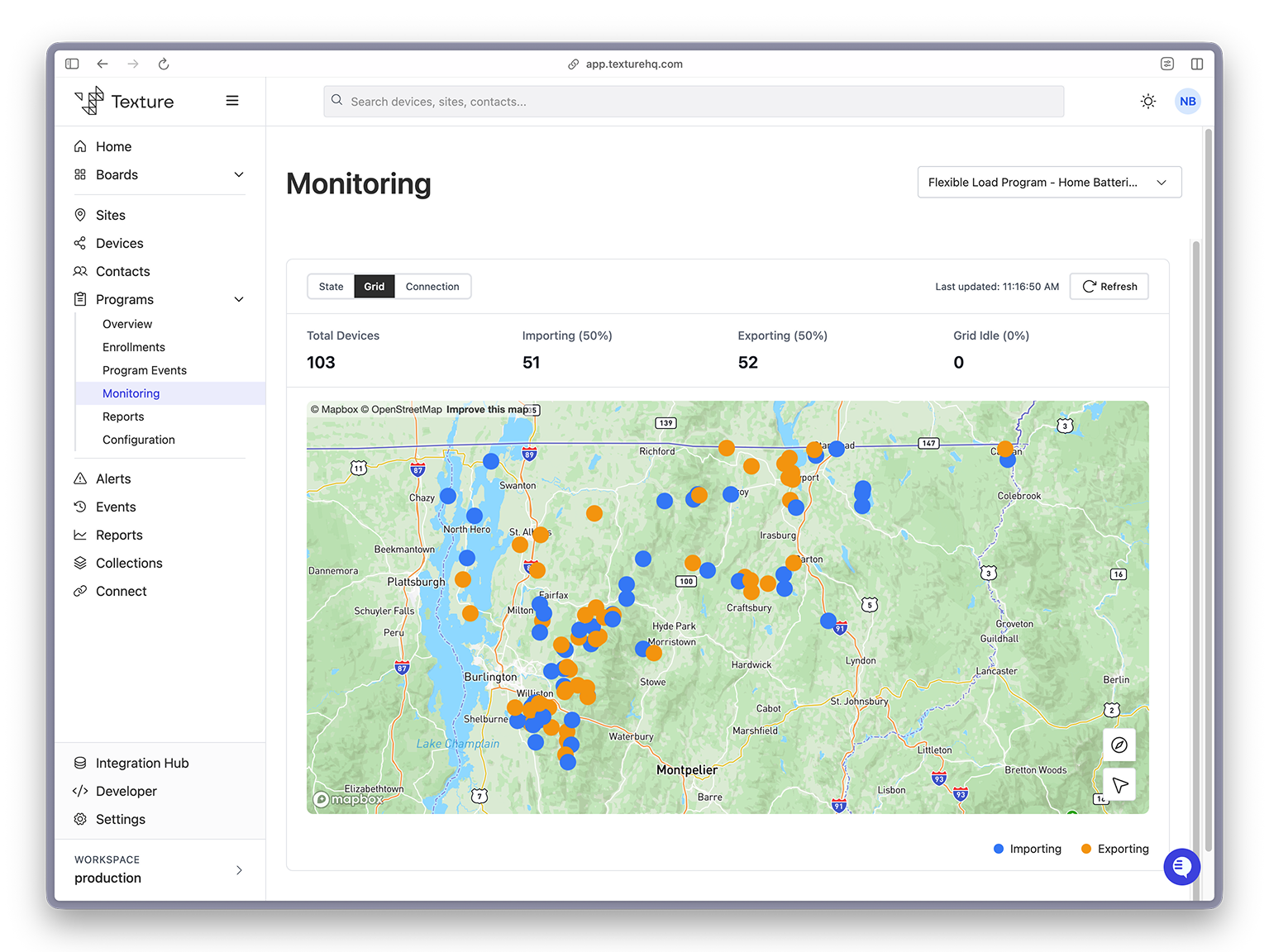
VoLo Earth and Equal Ventures co-lead Series A in grid technology firm building an “operating system” to help utilities consolidate data and maximize value across operations — from data center load to renewables growth to distributed energy resources.
Texture, the grid software platform that provides utilities a single view of every device and data source on their network, announced on May 20 a $12.5 million Series A co-led by VoLo Earth Ventures and Equal Ventures, with participation from Lerer Hippeau and Abstract Ventures. The funding supports a platform already operational at utility cooperatives and energy companies, providing the coherent data infrastructure needed to operate the grid in real time.
Power utilities are operating a system that’s drifted far from what it was originally built to handle. Grids built for one-way power flow are now expected to coordinate insatiable demand from data centers, manage increased congestion, integrate utility-scale renewables, manage local networks amid an influx of electric vehicles and distributed generation, and harden transmission assets against extreme weather, all at once. At the same time, they’re being asked to ensure the wave of new technologies being deployed to modernize the grid — artificial intelligence (AI), sensors, grid-enhancing technologies, advanced metering — actually delivers on the investment.
Texture connects to any meter, device, or data source, giving operators a real-time picture of the system state. Advanced metering infrastructure (AMI) systems, supervisory control and data acquisition (SCADA), batteries, electric vehicles (EVs), solar, and smart thermostats all flow into a single layer where alerts surface when action is needed. The platform doesn’t require rip-and-replace of existing systems or dedicated engineering teams to manage it.
Market Entry Through Co-ops
Texture’s offering is gaining early traction at utility cooperatives, member-owned organizations serving 42 million Americans across distributed and rural territory, including 92% of the country’s persistent-poverty counties. Co-ops manage coal plant retirements, data center load growth, and aging infrastructure with teams and budgets that are a fraction of those of investor-owned utilities. Enterprise grid software was built for utilities 10 times their size. Texture provides the same capabilities without enterprise budgets or multi-year implementations.
“Co-ops kept telling me the same thing,” said Sanjiv Sanghavi, Texture’s co-founder and CEO. “They wanted to run modern grid programs but didn’t have software built for their scale or budget. A co-op serving 15,000 members shouldn’t have to build custom technology to launch a battery program or manage transformer load. We built Texture so they don’t have to.”
Unlike legacy vendors with multi-year implementation timelines, utilities using Texture are operational within days. The platform connects to existing systems, models the data into a coherent layer, and makes it available where operators need it.
Capital Deferral and Market Access
The platform’s real-time monitoring alerts operators to transformer overload, voltage anomalies, and outage risk before failures occur. A home that adds an EV can double its energy draw overnight. Multiplied across a neighborhood, that kind of load shift puts real stress on distribution infrastructure that was never sized for it. Texture sees that signal at the meter level and traces its impact up through the feeder, giving operators a chance to act before a transformer fails. Transformer prices have risen as much as 95% since 2019, according to Wood Mackenzie, and lead times on large units now exceed two years. Preventing a single failure avoids not just replacement cost but months of operational exposure.
Vermont Electric Cooperative, one of the country’s few carbon-neutral utilities and widely cited as among the most innovative co-ops in the northeast, uses Texture to monitor its grid and manage hundreds of batteries across its service territory.
“As a co-op, our job is to provide affordable, reliable energy to our members. The challenge is that we have so many systems, and the data is spread out. You can’t afford to spend half the day just hunting down the right numbers. Texture helps us bring that visibility into one place, so we’re not chasing information just to figure out what to do next,” said Peter Rossi, COO of Vermont Electric Cooperative.
Through Texture, co-ops gain access to hardware integrations they couldn’t secure on their own. Many of the biggest original equipment manufacturers (OEMs) require minimum deployment thresholds before providing direct data access. Texture has already built those integrations, with first-party connections to 50+ OEMs, including Tesla, FranklinWH, Honeywell, Ecobee, and SolarEdge, with direct relationships and service-level agreements. Ann Arbor’s Sustainable Energy Utility used that access to launch a community battery program with FranklinWH across 100 homes, operational as of March 2026.
Partnership and Deployments
Along with the funding, Texture is partnering with NRTC (National Rural Telecommunications Cooperative), whose network represents 850 utility co-ops across the country. Through the relationship, Texture will provide member co-ops with access to grid management infrastructure previously available only to larger utilities.
“Our members are under pressure to integrate new resources and manage a growing load, without adding headcount or relying on vendors whose products weren’t built for co-ops. We’ve partnered with Texture to offer the NRTC DERMS [distributed energy resource management system] powered by Texture, giving co-ops a practical way to coordinate batteries, thermostats, and other distributed resources in real time,” said Milt Geiger, vice president of Smart Grid Solutions with NRTC.
Kareem Dabbagh, managing partner at VoLo Earth Ventures, joined Texture’s board as part of the financing. “Co-ops are managing the hardest grid transitions happening right now. Coal plant closures, battery deployments in rural communities, and data center load growth that wasn’t in anyone’s forecast five years ago. Texture is the infrastructure layer that makes those programs work. That’s why VoLo and Equal came in together on this round and why I joined the board,” said Dabbagh.
“Our initial thesis was that APIs [application programming interfaces] and data connectivity would be enough. We were wrong in the best possible way. What Texture has evolved into is the operating layer the energy industry has been missing: the infrastructure that lets utilities and VPPs [virtual power plants] actually act on their data, not just collect it. The teams building this industry’s future need a foundation they can trust. That’s what Texture is becoming, and it’s why we’re doubling down,” said Rick Zullo, co-founder and general partner with Equal Ventures.
The Series A brings Texture’s total funding to approximately $23 million. The capital will fund team growth and platform expansion. Texture has integrations with leading OEM and energy data companies, including Tesla, FranklinWH, Honeywell, Ecobee, SolarEdge, Leap Energy, and WattTime, and has completed its System and Organization Controls (SOC) 2 Type I and Type II security certifications.
Texture is a grid software platform built for the decisions utility operators make under pressure. The platform connects to any meter, device, or data source and provides real-time monitoring, outage detection, transformer load tracking, and DER coordination. Co-ops, municipal utilities, and energy companies use Texture to prevent hardware failures, manage rising load, and coordinate distributed resources without enterprise budgets or multi-year implementations. Headquartered in New York City. Learn more at texturehq.com.
Facts Only
Texture, a grid software platform, announced a $12.5 million Series A funding round on May 20, co-led by VoLo Earth Ventures and Equal Ventures.
The funding includes participation from Lerer Hippeau and Abstract Ventures.
Texture’s platform connects to meters, devices, and data sources, providing utilities with real-time grid monitoring and management.
The platform is operational at utility cooperatives and energy companies.
Utility cooperatives serve 42 million Americans, including 92% of persistent-poverty counties.
Texture enables real-time monitoring of transformer overload, voltage anomalies, and outage risks.
Vermont Electric Cooperative uses Texture to manage hundreds of batteries across its service territory.
Texture has integrations with 50+ OEMs, including Tesla, FranklinWH, Honeywell, Ecobee, and SolarEdge.
The platform is partnered with NRTC, representing 850 utility cooperatives.
Texture has completed SOC 2 Type I and Type II security certifications.
The Series A funding brings Texture’s total funding to approximately $23 million.
The company is headquartered in New York City.
Executive Summary
Texture, a grid software platform, has secured $12.5 million in Series A funding co-led by VoLo Earth Ventures and Equal Ventures, with participation from Lerer Hippeau and Abstract Ventures. The funding supports Texture’s platform, which provides utilities with a unified view of their grid data, enabling real-time monitoring and management of distributed energy resources (DERs), transformer loads, and outage risks. The platform is already operational at utility cooperatives and energy companies, addressing the challenges of modernizing aging grid infrastructure amid rising demand from data centers, electric vehicles, and renewables.
Texture’s solution is particularly valuable for utility cooperatives, which serve 42 million Americans, often in rural areas with limited budgets and technical resources. The platform integrates data from meters, SCADA systems, batteries, EVs, and other devices, offering real-time alerts without requiring costly system overhauls. Partnerships with organizations like NRTC (National Rural Telecommunications Cooperative) and integrations with major OEMs (e.g., Tesla, FranklinWH) further expand access to advanced grid management tools for smaller utilities. The funding will support team growth and platform expansion, building on Texture’s existing SOC 2 security certifications and integrations with leading energy data providers.
Full Take
The strongest version of this narrative highlights Texture’s role as a critical infrastructure layer for modernizing the grid, particularly for underserved utility cooperatives. The platform addresses a genuine gap: smaller utilities lack the budget and technical capacity to manage the complexities of modern grids—rising demand from data centers, EV adoption, and renewable integration—while legacy vendors offer solutions designed for larger, better-funded utilities. Texture’s rapid deployment and OEM integrations provide a practical path to real-time grid management, preventing costly hardware failures and enabling distributed energy programs. The partnership with NRTC and endorsements from innovative co-ops like Vermont Electric lend credibility to its scalability and impact.
However, the narrative leans heavily on the urgency of grid modernization without interrogating broader systemic challenges. For instance, while Texture’s solution is framed as democratizing access to advanced grid tools, the reliance on OEM integrations could create new dependencies. If Texture becomes a dominant intermediary, smaller utilities might face vendor lock-in or pricing pressures down the line. Additionally, the focus on co-ops—while laudable—risks obscuring whether investor-owned utilities, which serve the majority of customers, would adopt similar platforms or pursue proprietary alternatives. The article also assumes that real-time data alone can solve operational inefficiencies, but human and institutional factors (e.g., regulatory hurdles, workforce training) often determine success.
Root cause: The narrative reflects a broader trend in energy tech where software is positioned as the silver bullet for hardware and infrastructure challenges. This echoes historical patterns in industrial modernization, where digital layers are overlaid on aging physical systems, sometimes masking deeper structural issues like underinvestment in transmission or equity in energy access. The paradigm assumes that data consolidation and AI-driven insights will inherently lead to better outcomes, but without addressing the political and economic incentives shaping utility behavior, these tools may only optimize existing inefficiencies.
Implications: For human agency, Texture’s platform could empower smaller utilities to participate in the energy transition on more equal footing. However, the benefits may accrue unevenly—co-ops with existing technical capacity will likely adopt faster, while the most resource-constrained may still struggle. The second-order consequence is the potential for a new layer of intermediation in the energy sector, where platforms like Texture become essential gatekeepers between utilities and hardware providers. This could either streamline innovation or introduce new fragilities if the platform itself becomes a single point of failure.
Bridge questions: How might regulatory frameworks need to evolve to ensure equitable access to these tools? What safeguards are needed to prevent platform dependency from becoming a new form of vendor capture? And crucially, if real-time data is the solution, why have previous attempts at grid modernization fallen short—is it purely a technological gap, or are there deeper institutional barriers at play?
Counterstrike scan: A coordinated influence campaign pushing this narrative might emphasize the "David vs. Goliath" framing (small co-ops vs. legacy vendors) to rally support for tech-driven solutions while downplaying systemic barriers like regulatory inertia or corporate resistance. The actual content aligns with this pattern but does not appear manipulative; it presents a genuine solution to a documented problem. The focus on co-ops as early adopters is strategically sound, but the lack of critique around long-term dependencies or scalability risks could be a blind spot worth probing.
Patterns detected: none
Sentinel — Human
The text exhibits the complex, context-heavy synthesis typical of high-quality financial journalism, grounded in specific sources and nuanced stakeholder dialogue, suggesting human authorship.