Shock Line
Iran declares US talks over and threatens total Hormuz blockade.
What Changed (Last 24 Hours)
Iran state media announced complete halt of message exchanges with the US and vowed to fully block the Strait of Hormuz.
US Central Command struck Iranian radar and drone command sites and intercepted two Iranian ballistic missiles targeting US forces in Kuwait.
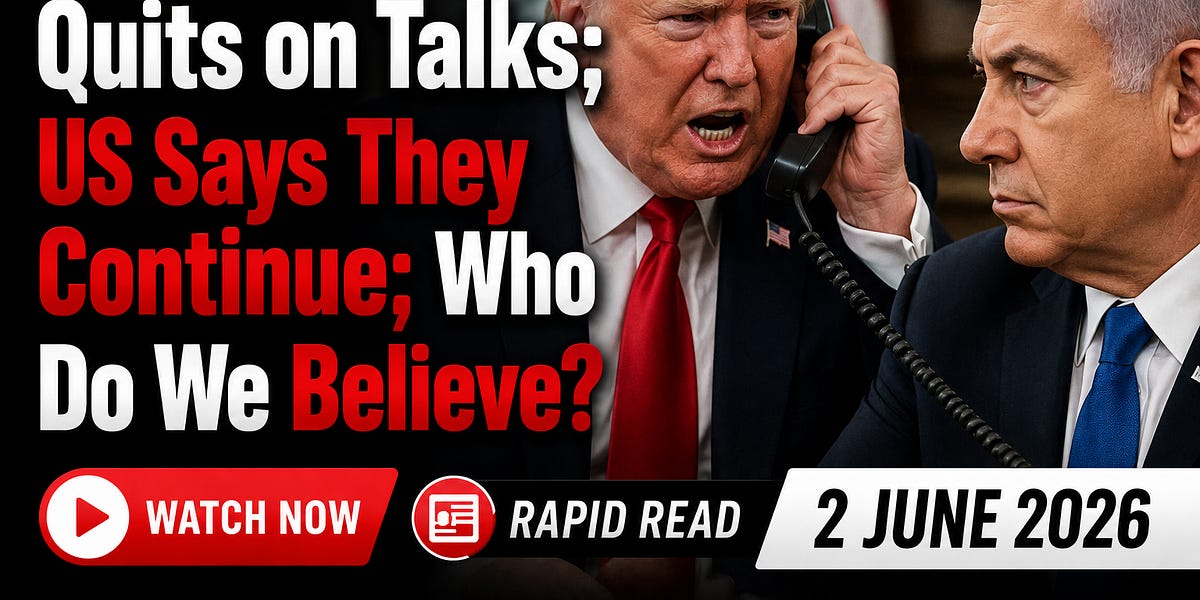
President Trump stated Iran never informed the US of ending negotiations and asserted talks continue at rapid pace.
Trump announced after call with Netanyahu that Israeli troops en route to Beirut have been ordered to turn back.
Russia extended ban on aviation fuel exports until 30 November citing Ukrainian strikes on refineries.
Canada signaled potential cancellation of portion of US F-35 order in favor of Swedish Gripen fighters.
Why This Matters (The System)
The fragile Hormuz Ceasefire Regime broke.
Physical access to the world’s most critical energy chokepoint is now under explicit Iranian veto threat while US-Iran communication channels are severed.
Hard anchor: near-2 million barrel Iraqi crude supertanker arrival at Vietnam’s Nghi Son port after prior US Navy hold underscores rerouting realities.
What Breaks Next (Forward Risk)
If Iranian blockade threat holds, tanker insurance and operational clearances for Hormuz transit collapse within days, not weeks.
First-mover crude buyers lock Asian refining runs on non-Middle East barrels, accelerating optionality loss for Europe.
Israeli de-escalation in Lebanon frees Hezbollah resources for other fronts if attrition strategy succeeds.
Russia’s aviation fuel ban tightens Central Asian air connectivity, limiting military logistics flexibility.
Canada’s fighter procurement shift strains NORAD integration timelines and US defense industrial contracts.
Legal uncertainty around Section 301 tariff relief freezes India-US trade deal optionality ahead of July hearings.
Signal vs. Noise
Signal:
Severed US-Iran messaging + explicit Hormuz blockade threat
Confirmed US strikes and missile interceptions
Israeli troop turnaround after Trump-Netanyahu call
Noise:
Record 2025 US energy export numbers
Anthropic IPO filing and AI chip announcements
Kazakhstan coal-to-chemicals projects
The Line to Remember
When sovereigns lose the ability to clear commerce through chokepoints they control, legal ceasefires become theater.
Community Notes:
We are very happy to announce that we have a new YouTube page.
PLEASE go to www.YouTube.com/@GeopoliticsUnpluggedRapidRead and SUBSCRIBE.
Why You Should Upgrade to Paid Membership
Upgrade to Paid Membership Now to Access the Full Rapid Read Edition That Cuts Through the Fog of the Iran-US Hormuz Crisis.
In this critical moment where conflicting claims between Iran and the US threaten the world’s most vital energy artery, paid subscribers gain immediate entry to the complete unfiltered analysis that free readers cannot access, empowering them with the clearest signal on whether the fragile ceasefire has truly collapsed and what it means for global supply chains in the coming days and weeks.
With an upgrade you get…
Deep-dive forward risk assessments on tanker insurance collapse timelines and Asian refining shifts that only paid members receive to position ahead of market moves.
Exclusive geopolitical risk scoreboard with quantified drivers and impacts plus the full Contrarian Take challenging mainstream narratives that free readers miss entirely.
Complete detailed breakdowns of every developing thread from severed communications to Israeli de-escalation that provide the actionable context essential for informed decision-making.
Our proprietary Our Take synthesis tying together the Hormuz flashpoint with cascading effects across alliances and commodities available solely behind the paywall.
This edition summarizes 64 news stories and 13 substack articles. Upgrade today so you do not miss the insights that separate those navigating uncertainty from those merely reacting to it.
Facts Only
Iran state media announced a complete halt of message exchanges with the U.S.
Iran vowed to fully block the Strait of Hormuz.
U.S. Central Command struck Iranian radar and drone command sites.
U.S. intercepted two Iranian ballistic missiles targeting U.S. forces in Kuwait.
President Trump stated Iran never informed the U.S. of ending negotiations and asserted talks continue at a rapid pace.
Trump announced Israeli troops en route to Beirut have been ordered to turn back after a call with Netanyahu.
Russia extended its ban on aviation fuel exports until November 30, citing Ukrainian strikes on refineries.
Canada signaled potential cancellation of a portion of its U.S. F-35 order in favor of Swedish Gripen fighters.
A near-2 million barrel Iraqi crude supertanker arrived at Vietnam’s Nghi Son port after a prior U.S. Navy hold.
Tanker insurance and operational clearances for Hormuz transit could collapse within days if the Iranian blockade threat holds.
Israeli de-escalation in Lebanon could free Hezbollah resources for other fronts.
Russia’s aviation fuel ban tightens Central Asian air connectivity, limiting military logistics flexibility.
Canada’s fighter procurement shift could strain NORAD integration timelines and U.S. defense industrial contracts.
Legal uncertainty around Section 301 tariff relief freezes India-U.S. trade deal optionality ahead of July hearings.
Executive Summary
Iran has declared an end to all communications with the United States and threatened a full blockade of the Strait of Hormuz, a critical global energy chokepoint. This follows U.S. Central Command strikes on Iranian radar and drone command sites, as well as the interception of two Iranian ballistic missiles targeting U.S. forces in Kuwait. President Trump, however, stated that negotiations with Iran are ongoing at a rapid pace, contradicting Iran's claims. Additionally, Trump announced that Israeli troops en route to Beirut have been ordered to turn back after a call with Israeli Prime Minister Netanyahu. Russia extended its ban on aviation fuel exports until November 30, citing Ukrainian strikes on refineries, while Canada signaled a potential shift in its fighter jet procurement from U.S. F-35s to Swedish Gripen fighters. The situation in the Strait of Hormuz remains volatile, with tanker insurance and operational clearances at risk of collapse if the Iranian blockade threat materializes. The broader geopolitical landscape is further complicated by Russia's fuel export ban, Canada's defense procurement shifts, and unresolved U.S.-India trade deal negotiations.
The conflicting statements from Iran and the U.S. highlight the fragility of the current ceasefire regime in the Hormuz region. If the blockade threat is realized, global energy markets could face significant disruptions, particularly in Asia and Europe. The Israeli de-escalation in Lebanon may also have cascading effects on regional dynamics, potentially freeing up Hezbollah resources for other fronts. Meanwhile, Russia's fuel export ban could strain military logistics in Central Asia, and Canada's potential shift in fighter procurement could impact NORAD integration and U.S. defense contracts. The situation remains fluid, with multiple actors and interests at play, making it difficult to predict the exact trajectory of events.
Full Take
The narrative presented here is a high-stakes geopolitical drama centered on the Strait of Hormuz, with Iran's blockade threat and the severing of U.S.-Iran communications as the focal points. The strongest version of this narrative is that Iran is escalating tensions, potentially disrupting global energy flows, while the U.S. and its allies are responding with military and diplomatic maneuvers. The source deserves credit for synthesizing multiple threads—military actions, diplomatic signals, and economic shifts—into a coherent, if alarming, picture.
However, several patterns from the A.R.C. Codex are detectable. The framing leans toward **ARC-0024 Ambiguity**, as the conflicting statements from Iran and the U.S. create a fog of uncertainty about the true state of negotiations. There’s also a hint of **ARC-0043 Motte-and-Bailey**, where the headline’s dramatic "total Hormuz blockade" threat is later qualified by the possibility of insurance collapse "within days, not weeks"—a softer, more plausible claim. The emphasis on "paid membership" for deeper insights could be seen as **ARC-0012 Authority Games**, leveraging exclusivity to borrow credibility.
The root cause of this narrative is the long-standing U.S.-Iran rivalry, exacerbated by regional proxy conflicts and global energy dependencies. The unstated assumption is that Iran’s actions are primarily reactive, while the U.S. and its allies hold the initiative—a framing that may oversimplify Iran’s strategic calculus. Historically, this echoes Cold War-era brinkmanship, where chokepoints like Hormuz become leverage in broader power struggles.
The implications for human agency are stark: if the blockade materializes, millions could face energy price shocks, while military logistics in Central Asia and defense procurement in North America could be disrupted. The second-order consequences—such as Hezbollah’s potential redirection of resources—could further destabilize the Middle East. Who benefits? Defense contractors, energy traders, and geopolitical analysts selling "exclusive insights." Who bears the costs? Ordinary citizens facing higher fuel prices and increased regional instability.
Bridge questions: What evidence would confirm or refute Iran’s willingness to follow through on the blockade threat? How might other regional actors, like Saudi Arabia or China, respond to a prolonged Hormuz crisis? What alternative explanations exist for Iran’s sudden severing of communications—could this be a negotiating tactic rather than a prelude to war?
Counterstrike scan: If this were part of a coordinated influence campaign, the playbook would involve amplifying fear of energy disruptions, framing the U.S. as the stabilizing force, and using exclusivity (e.g., "paid membership") to create urgency. The actual content aligns partially with this pattern, particularly in its dramatic framing and emphasis on "unfiltered analysis" behind a paywall. However, the inclusion of multiple perspectives (e.g., Trump’s contradictory statements, Canada’s procurement shift) suggests a more nuanced approach than a pure propaganda push. The alignment is concerning but not definitive.
Sentinel — Human
This analysis provides a blend of factual reporting on a geopolitical crisis and high-level strategic commentary, anchored by specific events but framed by a strong, commercial editorial thesis.