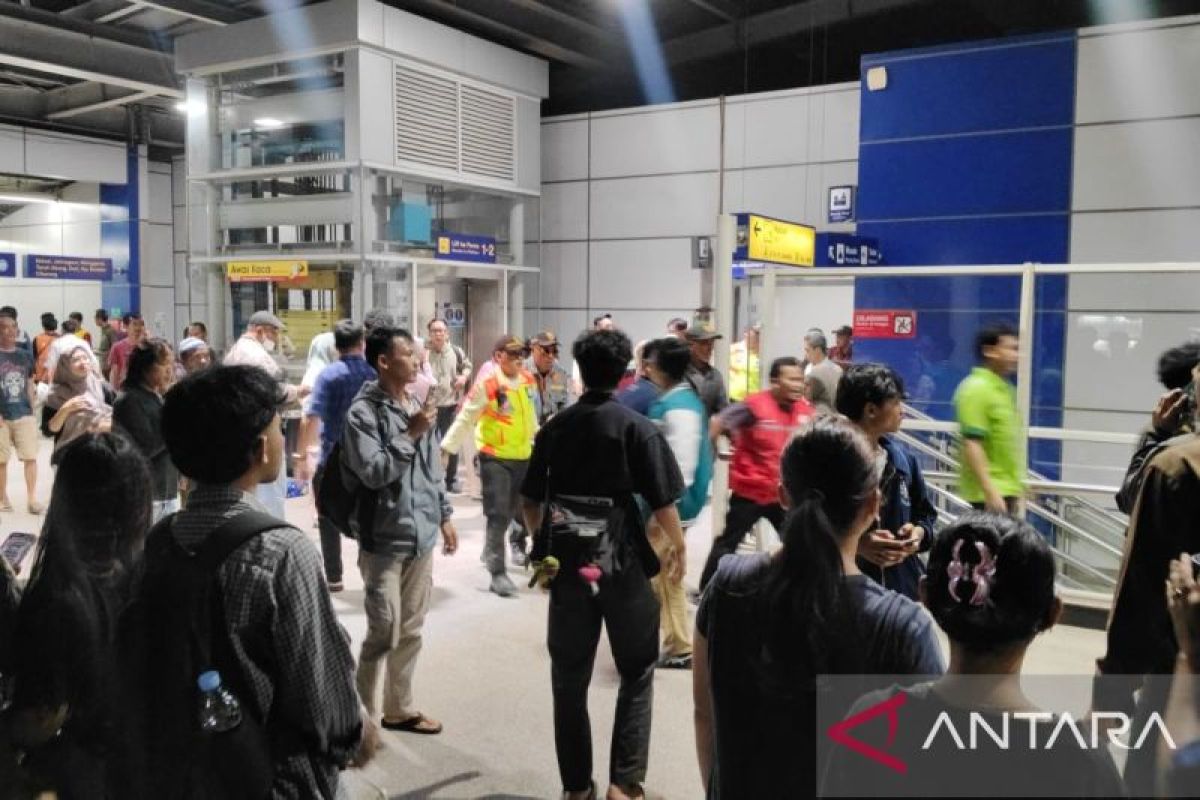
Based on initial finding, the CommuterLine was stopping on track 1 heading eastward toward Cikarang when a long-distance train from the west entered the same track and collided with it.
"The CommuterLine was crushed at the rear. We were all immediately evacuated by officers," surviving passenger Heri said at the scene.
As of 9:50 p.m., officers and the public were still evacuating passengers. Several evacuated passengers suffered injuries and were unconscious.
PT Kereta Api Indonesia (KAI) is maximizing the evacuation process for affected passengers.
KAI Operations Area 1 Jakarta Public Relations Manager, Franoto Wibowo, stated that the evacuation process is currently underway and hopes that operations in Operations Area (DAOP) 1 can return to normal soon.
"PT KAI, along with the police, is currently evacuating the train and assisting with the victims at the scene. We are making every effort to ensure that train operations can return to normal as soon as possible," he said in a statement.
KAI Vice President of Corporate Communications Anne Purba apologized to customers for the incident.
"We apologize for this incident. Our current focus is ensuring that all passengers and staff receive the best possible care as quickly and as effectively as possible," she remarked.
Meanwhile, the Basarnas (National Search and Rescue Agency) had deployed elite personnel from the Basarnas Special Group (BSG) to handle the train accident.
The deployed SAR team comprised trained personnel with specialized qualifications and complete equipment for extractions in land transportation accidents.
Dozens of victims injured in the accident were rushed to the nearest hospital for medical treatment.
Related news: Train accidents spike in Jakarta, KAI warns public to stay alert
Related news: Tragic selfie incident: 3 teenagers die after hit by train in C Java
Related news: Two new tunnels to be built in Jember to improve railway safety
Translator: Pradita Kurniawan, Resinta Sulistiyandari
Editor: M Razi Rahman
Copyright © ANTARA 2026
Facts Only
A CommuterLine train stopped on track 1 heading eastward toward Cikarang.
A long-distance train from the west entered the same track and collided with the CommuterLine.
The CommuterLine was crushed at the rear during the collision.
Passengers were evacuated by officers, with some suffering injuries and unconsciousness.
PT Kereta Api Indonesia (KAI) is leading the evacuation and recovery efforts.
KAI Operations Area 1 Jakarta Public Relations Manager Franoto Wibowo confirmed ongoing evacuation and efforts to normalize operations.
KAI Vice President of Corporate Communications Anne Purba apologized for the incident.
The National Search and Rescue Agency (Basarnas) deployed elite personnel from the Basarnas Special Group (BSG) to assist.
Dozens of injured victims were rushed to the nearest hospital.
The incident occurred as of 9:50 p.m. local time.
Related news highlights a spike in train accidents in Jakarta and recent fatal incidents involving trains.
Two new tunnels are planned in Jember to improve railway safety.
Executive Summary
Full Take
This incident reflects systemic vulnerabilities in Indonesia’s railway infrastructure, where operational failures—such as two trains occupying the same track—have catastrophic consequences. The immediate response by KAI and Basarnas demonstrates institutional preparedness, but the recurrence of such accidents suggests deeper issues in signaling, scheduling, or enforcement of safety protocols. The apology from KAI, while necessary, raises questions about accountability and long-term corrective measures beyond crisis management.
The narrative leans on emotional appeals (e.g., "crushed at the rear," "unconscious passengers") to underscore urgency, but it avoids speculative blame, focusing instead on factual reporting and institutional responses. However, the inclusion of unrelated incidents (e.g., the "tragic selfie incident") may subtly frame this as part of a broader "railway safety crisis," potentially amplifying public anxiety without direct causal links.
Root causes likely include aging infrastructure, human error, or inadequate automation in track management. The implications extend beyond immediate casualties: eroded public trust in rail safety could deter ridership, undermining transportation efficiency and economic mobility. Second-order effects may include regulatory reforms or accelerated infrastructure investments, but these depend on political will and resource allocation.
Bridge questions: What specific safety protocols failed in this collision? How does Indonesia’s railway safety record compare to regional peers, and what lessons can be adapted? Would independent audits of KAI’s operational procedures reveal systemic negligence or isolated failures?
Counterstrike scan: A coordinated influence campaign might exploit this incident to undermine confidence in public transportation, framing it as a "government failure" to push privatization or alternative agendas. However, the article’s focus on factual reporting and institutional responses does not align with such manipulation. No overt patterns of distortion or bad faith are detected.
Patterns detected: none
Sentinel — Human
The text exhibits the structure and attribution patterns of human journalistic reporting, focusing on a factual event and official statements.