Skip to content
Chimera readability score 43 out of 100, College reading level.
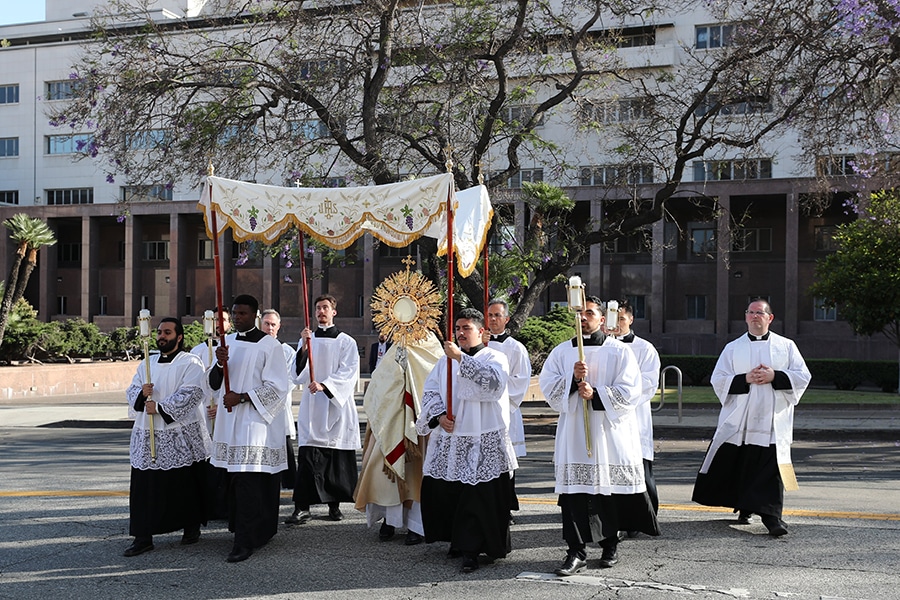
Lessons from Corpus Christi May 30, 2026By Father Patrick Briscoe OSV News Filed Under: Commentary, Eucharist We did not have a procession on Corpus Christi when I was growing up. It’s not because we didn’t believe in the Real Presence. In fact, some of my most powerful childhood memories are from the Holy Thursday procession. The incense. The chant. The parish jammed into a tiny chapel for adoration. Another very vivid memory was the first time I attended Eucharistic Adoration. One of our young associates, with the permission of our pastor, added a holy hour after our Sunday night youth Mass. The Briscoes naturally stayed for the whole thing. (If your mother was Mary Briscoe, you would have stayed too … .) I remember learning to serve Benediction and falling in love with the ancient rites of the Church. The first time I attended a Corpus Christi procession at my home parish was a Mass of Thanksgiving I offered after my priestly ordination. Flanked by roughly 7,000 altar servers (OK, that’s a slight exaggeration), we made a loop of the parish property. Around the church where I went to Sunday Mass for almost 20 years. Around the parish school which I attended for eight years. Around the gym where I occasionally pretended to be athletic. Around the playground where I enjoyed many recesses (and even got into a few fights). Later, one of my sisters would marry in the same church. I would concelebrate my childhood pastor’s funeral Mass there. The procession was more than a victory lap. It was a lesson for a new priest. Hidden in the Eucharistic mystery is the whole of Christian life. The mystery of past, present and future. In the Sacred Host we worship with special love today, we encounter the mystery of Christ’s past death on Calvary. We receive the outpouring of graces for our present life. And we look forward with longing to the kingdom of glory to come. In the Church’s understanding, memorial does not mean a sentimental glance backward, as though we were merely recalling a noble death from long ago. At Mass, the sacrifice of Christ is sacramentally made present. The cross is not repeated, but its saving power is brought into our midst. That is why Eucharistic devotion is never a detour from the Passion. It leads us straight into it. When we kneel before the monstrance, we are not escaping the drama of salvation; we are entering more deeply into it. But the Eucharist is not only about the past. It is also the source of present graces. Christ does not merely tell us what he once did. He feeds us now. He strengthens the weary, steadies the tempted, heals what sin has bruised and quietly conforms us to himself. We often want grace to arrive dramatically, with fireworks and certainty and unmistakable emotional force. Usually it does not. Usually grace comes the way daily bread comes: hidden. Yet that hiddenness should not deceive us. In Holy Communion, the Lord is at work. He nourishes charity. He deepens union with his Church. He gives us strength for the ordinary heroism of Christian life. I first loved Eucharistic Adoration for St. Thomas Aquinas’ Latin hymns, the smell of incense and ritual connection to an ancient past. Now I love that I can sit alone with the Lord. I know that the only thing I need is to be near to him. That is one of the reasons Corpus Christi is such a joyful feast. It is not only a feast about doctrine, though doctrine matters here with absolute seriousness. It is a feast of God’s nearness. Our Lord has not left his people to fend for ourselves in a cold and lonely world. He remains. He feeds. He abides. The Eucharist is the sacrament of the present moment.And then there is the last horizon: the future glory we await. St. Paul tells us, “Eye has not seen, ear has not heard what God has ready for those who love him” (1 Cor 2:9). I have to believe that’s true. What’s down here just isn’t good enough. It’s not worth my heart. It’s not worth my life. Every procession on Corpus Christi says, in its own public and beautiful way, that we are made for more than what this world can offer. We are pilgrims, and this sacrament is food for the journey. What we receive under sacramental signs now, we hope one day to behold unveiled. What is hidden will be manifest. What is veiled in mystery will blaze forth in glory. That hope is essential to Christian life. Without it, our religion becomes cramped and anxious, as though grace were only about managing decline. But the Eucharist teaches us that our destiny is not exhaustion, nor disappointment, nor death but communion. read more commentary ‘Magnifica Humanitas’: A feast of a message needing measured bites Question Corner: Will everyone know each other’s sins at the last judgement? ‘Magnifica Humanitas’ explores being human in the age of artificial intelligence What the pope’s new encyclical on AI Is asking of you Flannery O’Connor: Southern writer made Catholic vision ‘apparent by shock’ When Life’s Impossible, Talk to St. Rita Copyright © 2026 OSV News Print

Facts Only

* The author recalls memories of Holy Thursday processions and Eucharistic Adoration.
* The author participated in a Corpus Christi procession at his home parish after his priestly ordination.
* The procession involved a loop of parish property, including the church, parish school, gym, and playground.
* The author learned about serving Benediction and ancient rites.
* The author states that the Eucharist contains the mystery of Christ’s past death, present graces, and future glory.
* The author suggests that grace is often hidden, like daily bread.
* The author connects Eucharistic devotion to the need for hope regarding future glory.
* The author asserts that the Eucharist is the sacrament of the present moment.

Executive Summary

The author reflects on personal memories associated with Eucharistic devotion, particularly the Holy Thursday procession and Eucharistic Adoration, noting a journey of evolving spiritual understanding. The author recounts participating in a Corpus Christi procession at his home parish and reflects on the role of procession as a lesson. The text posits that the Eucharistic mystery encompasses the past, present, and future, connecting Christ's death to present grace and future glory. The author suggests that grace is not always dramatic but often comes in a hidden, daily form, found in Holy Communion. The piece concludes that the Eucharist is the sacrament of the present moment and a feast of God's nearness, offering hope for a destiny of communion rather than exhaustion.

Full Take

The narrative frames the mystery of the Eucharist as a mechanism for managing existential anxiety, transitioning the focus from linear decline to eternal communion. The pattern observed is the use of deeply personal, sensory memories (incense, chant, smell) to anchor abstract theological concepts. The argument pivots on the idea that divine grace, typically perceived as dramatic, is often concealed ("hidden") and must be discovered through a specific spiritual posture. The underlying assumption is that religious practice functions as a corrective against a cold, lonely world, offering a transcendent promise that counters worldly exhaustion. This addresses the tension between the immediate reality of suffering and the promise of future glory. The rhetorical strategy relies on establishing the inherent worth of human existence (being "made for more") and linking spiritual practice directly to that purpose. This is an attempt to establish cognitive sovereignty by positioning faith not as passive belief, but as an active pathway to manifest destiny, rather than mere management of decline.

Sentinel — Human

Confidence

The text reads as a highly personal, reflective commentary rooted in lived religious experience, characterized by a passionate, idiosyncratic voice and strong anecdotal detail.

Lessons from Corpus Christi — Arc Codex