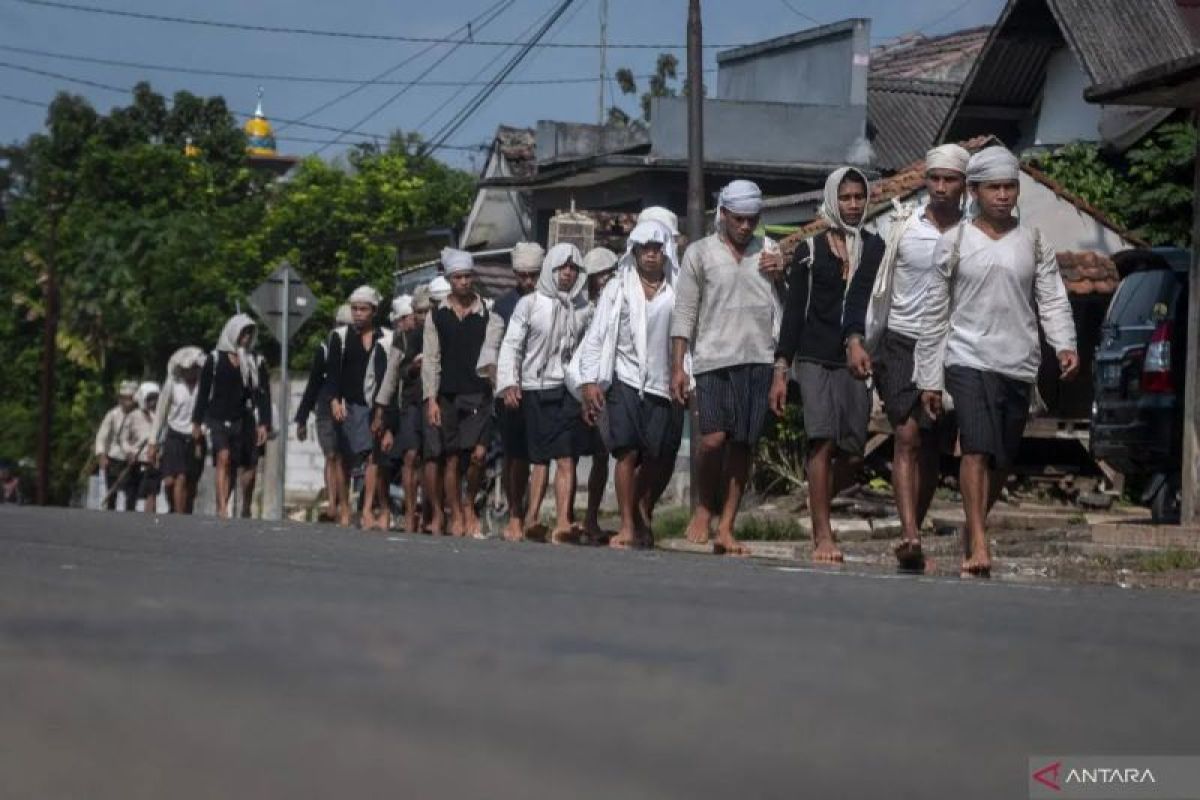
The Baduy people have demonstrated how to protect the environment in sustainable manner. This is crucial for the survival of humans and the ecosystem,Lebak, Banten (ANTARA) - Around 3:00 in the morning, while most people were still asleep, dozens of Inner Baduy people walked together through the dark forest in the Kendeng Mountains area of Lebak Regency, Banten.
Without lights, they followed a path through the steep hills, a path that often posed risks, from slippery terrain to the threat of venomous snakes.
The journey was nothing out of the ordinary for them. The Inner Baduy are accustomed to walking everywhere without vehicles.
However, this particular journey had a special purpose: to participate in the Seba tradition, a centuries-old annual ritual observed by the Baduy community.
The tradition is usually carried out in April or May after the Kawalu, the Baduy’s annual fasting and thanksgiving ritual.
From the main villages of Cibeo, Cikawartana and Cikeusik in Kanekes Village, they made the long journey to Rangkasbitung, then continued on to Serang City.
With a total round-trip distance of 200 kilometers, they covered it entirely on foot, in accordance with the traditional customs they still uphold.
Along the way, they took sufficient rest while eating rice and tubers for energy sources.
Despite the tiring process, the journey was undertaken with the full awareness that the Seba tradition was not just an annual event, but a sacred traditional obligation.
"We walked to participate in Seba after undergoing Kawalu for three months. This is a rule from our ancestors," Rahman, 50, an Inner Baduy resident, said.
During the Seba tradition, Baduy people visit the local government to convey traditional messages of friendship.
They address the regional head as ‘Bapak Gede’. They also present agricultural products such as dry rice, sweet potatoes, fruit and laksa as a symbol of respect.
The request was simple: a guarantee of a safe, peaceful and secure life for their tribe.
Past experiences underpinned this hope. Residents admitted to having faced security disturbances, such as the loss of livestock and illegal mining activities that have destroyed the forest.
"Now the situation is safe. No more livestock has been lost, and the forest has not been destroyed. We are grateful to the government," Rahman stated.
For some residents, Seba is not just a tradition, but also an obligation that cannot be abandoned.
Ato, 55, said that not attending Seba could have dire consequences according to traditional beliefs.
"This has been going on for hundreds of years, since the time of our ancestors and the Banten Sultanate. It must continue to be carried out," he said.
At the 2026 Seba celebration, 1,552 Inner and Outer Baduy residents were recorded as attending the Lebak Regency Hall. They came with a collective spirit to preserve traditions that have been passed down through generations.
Jaro Oom, a traditional elder and head of Kanekes Village, explained that Seba has broad significance. In addition to being an expression of gratitude for the harvest, this tradition also symbolizes the relationship between the indigenous community and the government.
"The handover of agricultural produce is a form of respect and a reminder that this relationship must be well-maintained," he said.
Seba also reflects the values held dear by the Baduy people, such as togetherness, peace and balance in life. These values are reflected in the way they manage the environment.
Related news: Indonesia readies antivenom for Baduy people against snakebites
Protecting environment
The Baduy, an indigenous Sundanese community in Lebak, Banten, are known for strictly maintaining a traditional lifestyle, rejecting modern technology and living in harmony with nature.
Within their customary territory of approximately 5,200 hectares, they maintain forests as protected areas. Dozens of rivers in this region serve as important water sources for communities downstream in Banten.
"We protect the forest because it is a legacy from our ancestors. If the forest is damaged, life will also be disrupted," Saidi Yunior, an Inner Baduy traditional elder emphasized.
Customary laws strictly regulate forest use, including prohibitions against destroying certain areas known as closed forests. The Baduy people also protect dozens of mountains in Banten to prevent exploitation or conversion.
These efforts are considered to contribute significantly to maintaining ecosystem balance. River water in the Baduy region, for example, remains clear and of good quality, even amidst environmental pressures in other areas.
The local government recognizes the important role of the Baduy people in environmental conservation.
Lebak Regent Mochamad Hasbi Asyidiki expressed his appreciation for their consistent efforts in protecting forests and nature.
"The Baduy people have demonstrated how to protect the environment in sustainable manner. This is crucial for the survival of humans and the ecosystem," he said.
The government, he continued, is committed to protecting the area from exploitation, including illegal mining activities.
Not only a traditional tradition, Seba is also beginning to be seen as a potential destination for cultural and tourism development.
The Lebak Regency Government is targeting this celebration to be included in the top 10 Karisma Event Nusantara (KEN) celebrations, which include MSME product exhibitions, art performances and wayang golek performances.
The events are expected to attract tourists and provide an economic impact for the community.
However, preserving traditional values remains a top priority. Leiden University researcher Jet Bakels believes that the strength of the Baduy people lies in its ability to maintain a balance between tradition and change.
"Since the Pajajaran era, the Baduy community has had a responsibility to protect their customary forests. That value persists to this day," she said, referring to a golden age for the Sunda Kingdom in West Java, during 1482-1579 period.
Amidst the tide of modernization, the Baduy community maintains a simple way of life, without electricity, modern infrastructure and electronic devices.
Their houses are built from natural materials such as bamboo and wood, in harmony with the environment.
Their early morning journey of Seba is not merely a physical journey, but part of a life cycle that is constantly being maintained.
Within the long steps toward Seba lies a commitment to upholding tradition, protecting nature and maintaining the balance that underpins their lives.
Related news: Foreign tourists banned from visiting Indonesia's Inner Baduy hamlets
Related news: Ministry enhances collaboration for Outer Baduy children's rights
Translator: Mansyur Suryana, Yashinta Difa
Editor: M Razi Rahman
Copyright © ANTARA 2026
Facts Only
The Baduy people, an indigenous Sundanese community, live in Lebak Regency, Banten.
They participate in the Seba tradition, an annual ritual involving a long journey on foot to visit local government officials.
The journey often covers a round-trip distance of 200 kilometers, starting from villages like Cibeo, Cikawartana, and Cikeusik.
Seba follows the Kawalu, a three-month fasting and thanksgiving ritual observed by the Baduy.
During Seba, the Baduy present agricultural products such as dry rice, sweet potatoes, and fruit to government officials.
The tradition is seen as a sacred obligation, with consequences for those who do not participate.
The Baduy protect approximately 5,200 hectares of customary forests, maintaining them as closed areas to prevent exploitation.
Their conservation efforts contribute to clear river water and prevent deforestation in the region.
The Lebak Regency Government recognizes the Baduy's role in environmental conservation and supports their traditions.
The government aims to promote Seba as a cultural tourism event, targeting inclusion in national cultural celebrations.
The Baduy live without modern technology, using natural materials for their homes and maintaining a simple lifestyle.
Researchers note the Baduy's historical responsibility to protect their forests, dating back to the Pajajaran era (1482-1579).
Executive Summary
The Baduy people, an indigenous Sundanese community in Lebak, Banten, uphold a centuries-old tradition called Seba, an annual ritual where they walk long distances to visit local government officials. This tradition, following their three-month Kawalu fasting period, involves presenting agricultural products as symbols of respect and seeking guarantees for a safe and peaceful life. The journey, often covering 200 kilometers on foot, reflects their commitment to preserving cultural and environmental values. The Baduy are known for their sustainable lifestyle, rejecting modern technology and protecting their customary forests, which span approximately 5,200 hectares. Their efforts contribute to maintaining clear river water and preventing deforestation, earning recognition from local authorities. The Lebak Regency Government appreciates their role in environmental conservation and aims to promote Seba as a cultural tourism event while preserving traditional values. Researchers highlight the Baduy's ability to balance tradition with necessary adaptations, emphasizing their historical responsibility to protect their forests since the Pajajaran era.
The Seba tradition is not only a cultural obligation but also a means of reinforcing the relationship between the Baduy community and the government. It serves as a reminder of mutual respect and the importance of maintaining harmony with nature. The Baduy's way of life, devoid of modern amenities, demonstrates a deep connection to their environment, which they view as a legacy from their ancestors. While the government supports their conservation efforts, it also sees potential in leveraging Seba for tourism, aiming to include it in national cultural events. However, the Baduy remain steadfast in their commitment to tradition, ensuring that their practices continue to sustain both their community and the ecosystem.
Full Take
The narrative surrounding the Baduy people presents a compelling example of how indigenous communities can maintain sustainable practices while navigating the pressures of modernization. The strongest version of this story highlights their commitment to tradition, environmental stewardship, and the preservation of cultural identity. The Seba tradition, in particular, serves as a bridge between the Baduy and the government, reinforcing mutual respect and the importance of protecting their way of life. The article effectively steelmans this narrative by emphasizing the Baduy's resilience and the tangible benefits of their conservation efforts, such as clear river water and protected forests.
However, a pattern scan reveals potential elements of idealization and selective framing. The article focuses heavily on the positive aspects of the Baduy's lifestyle and their harmonious relationship with the government, without delving into potential challenges or conflicts. For instance, while the Baduy's rejection of modern technology is portrayed as a virtue, it may also limit their access to essential services like healthcare or education. Additionally, the government's support for their traditions could be seen as a form of cultural preservation, but it might also serve as a way to control or exploit their practices for tourism purposes. The article does not explore these complexities, which could be seen as a form of semantic manipulation (ARC-0024) or forced binary choices (ARC-0043), where the narrative is framed in a way that excludes alternative perspectives.
The root cause of this narrative appears to be a desire to highlight the Baduy as a model of sustainable living and cultural preservation. This paradigm assumes that traditional practices are inherently superior to modern ones, without critically examining the trade-offs or the potential for exploitation. The implications of this narrative are significant, as it reinforces the idea that indigenous communities must remain static to be valued, potentially limiting their agency and dignity. While the Baduy's conservation efforts are commendable, it is essential to consider who benefits from this narrative and who bears the costs. For example, the government's promotion of Seba as a tourism event could lead to increased visibility and economic opportunities, but it might also disrupt the Baduy's way of life.
Bridge questions to consider include: What are the potential downsides of the Baduy's rejection of modern technology? How might the government's involvement in promoting Seba impact the Baduy's autonomy? What perspectives are missing from this narrative, particularly those of the Baduy who may not fully support these traditions? These questions invite readers to think critically about the complexities of cultural preservation and environmental stewardship.
Counterstrike scan: If this narrative were part of a coordinated influence campaign, the playbook might involve idealizing the Baduy's lifestyle to promote a specific agenda, such as environmental conservation or cultural tourism. The actual content does not fully match this pattern, as it primarily focuses on reporting the Baduy's traditions and their relationship with the government. However, the lack of critical examination of potential challenges or conflicts could be seen as a form of sanewashing (ARC-0024), where the narrative is framed in a way that excludes alternative perspectives.
Sentinel — Human
This analysis is grounded in specific, localized details and human-centric narratives, suggesting a high probability of human authorship, likely a feature article or beat reporting.