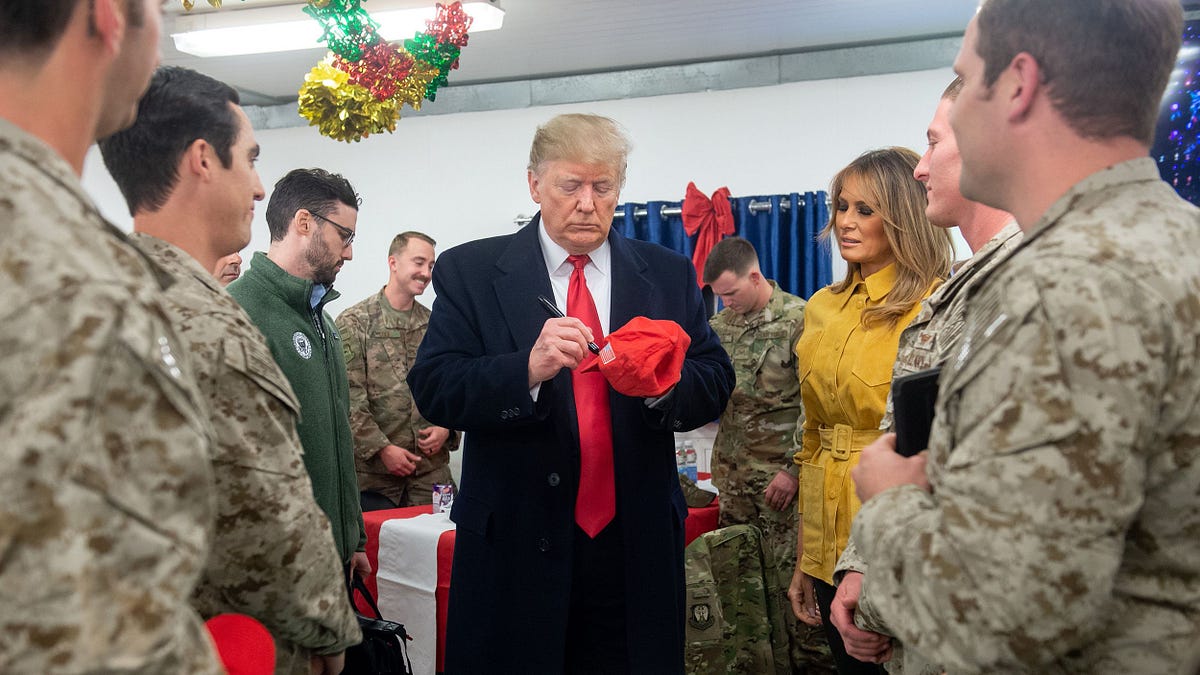
On Memorial Day, a military veteran and democracy advocate reminds us why keeping the armed forces out of domestic politics isn't optional
Dear Readers:
Last Memorial Day, we published an essay by Christopher Purdy—a veteran of the Army National Guard (including a deployment to Iraq) and the founder of The Chamberlain Network, a pro-democracy advocacy organization for vets. In that essay, Purdy made the case for fiercely guarding the military’s independence from partisan politics. After Trump addressed West Point graduates in a MAGA hat as though it were a campaign rally, Purdy emphasized that a military drawn into partisan politics cannot serve as the guardian of the republic. Once the armed forces become an appendage of the party in power, they become a threat to the very liberties they were built to defend.
Well, here we are one year later and … things are actually worse. Over the past year, National Guard troops have been deployed into American cities for domestic law enforcement purposes, with federal courts ruling multiple deployments illegal under the Posse Comitatus Act, as we’ve extensively covered at The UnPopulist.
Two days ago, Defense Secretary Pete Hegseth delivered this year’s West Point commencement address and—surprise!—he opted to turn that occasion into a culture-war broadside. He mocked “foolish and feckless” leaders who he claimed tried to turn the academy into “woke Princeton,” declaring “our diversity is our strength” to be “the single dumbest phrase in military history,” and promising graduates their “hands are untied.” In the same speech, Hegseth was somehow able to say with a straight face that West Point is “above politics.” This from a man who, just days ago, traveled to Kentucky to campaign against Rep. Thomas Massie—a Republican—on behalf of a Trump-backed primary challenger, in what critics said raised Hatch Act concerns.
The ideal Purdy articulated last year is in even greater danger this year. We’re republishing his essay as the country approaches its 250th anniversary—and with it, an occasion to rededicate ourselves to the principles that made it worth founding in the first place.
Berny Belvedere
Senior Editor
Many worried that President Donald Trump would use the U.S. military for domestic immigration enforcement—blurring the line between national defense and internal policing. They were right. Trump is making the military an active element of federal enforcement.
In Texas, members of the National Guard have been federally deputized to investigate, arrest, and transport migrants for civil immigration violations. Many military installations are being prepared to hold tens of thousands of detainees and others, such as the Guantanamo Bay Naval Base, have already been repurposed.
But even more concerning is what comes next. Public statements and policy signals suggest that the administration is considering deploying the military against states unwilling to participate in its enforcement efforts. Some in administration circlesare flirting with treating a state’s refusal to support federal immigration operations not as a political disagreement, but as a breakdown in civil order—potentially justifying stronger executive action by invoking the rarely-used Insurrection Act.
Trump’s Private Army
This Act does grant the president authority to deploy the military domestically in cases of violent unrest or obstruction of federal law. But, to date, it has been used only in moments of extreme crisis—insurrections, riots, and refusals to comply with court orders—not to settle intergovernmental policy disputes.
Consider the contrasts: Presidents Eisenhower and Kennedy invoked the Act and dispatched federal troops to Arkansas and Mississippi, respectively, after these states defied court orders barring segregated schools. President George H. W. Bush used it during the 1992 Los Angeles riots after the California governor requested assistance following days of violence that overwhelmed local law enforcement. In each case, the Act was used to restore order or uphold existing legal mandates—not to compel states to enforce a sitting administration’s highly controversial policy.
Applying it to immigration enforcement would mark a profound break from tradition. A state’s disagreement with federal priorities is not rebellion. It is a feature of our federal system. Redefining legitimate dissent as disorder akin to rebellion opens the door to military force being used as a standard tool for the implementation of an executive’s domestic policy agenda.
Trump’s defenders might argue that “past presidents used the military to enforce civil rights—why not now for border security?” But the difference is critical: past uses of the Insurrection Act enforced legal rights under the Constitution after they had been affirmed by courts. This administration is considering doing so to suppress political resistance to its agenda—in the absence of violence or judicial defiance.
There is no precedent in modern American history for the use of active-duty military forces—or federally directed National Guard units—to conduct immigration arrests in non-cooperating states. Even during past periods of crisis, such as the 1992 L.A. riots or the desegregation standoffs of the 1960s, the Insurrection Act was used only after courts had ruled or violence had erupted, and local governments had failed to act. But using military force as a first resort in a political dispute between the federal government and the states would be unprecedented.
Weaponizing the Military Toward Immigration Enforcement
Even more worrying is how few checks remain to thwart Trump.
Congress has largely ceded its role in conducting meaningful oversight of this administration. In the face of increasingly aggressive executive actions—from sweeping immigration orders to violations of longstanding legal norms—legislative resistance has been minimal. Trump, meanwhile, is treating court rulings as temporary obstacles rather than binding decisions. Witness his refusal to bring back Kilmar Abrego Garcia from the Salvadoran gulag where he was wrongfully deported—despite being ordered to do so by the Supreme Court.
And the public, already fatigued by years of political volatility, may not fully grasp how extraordinary the sight of soldiers arresting civilians and dispatching them to military bases would be.
Even though the administration is framing these steps as necessary and temporary, history teaches us that once such powers are seized, they are rarely surrendered. For example, the surveillance and other powers the federal government amassed in the Patriot Act after 9/11 have yet to be relinquished.
The normalization of military for domestic enforcement could also happen through smaller, less dramatic means besides invoking the Insurrection Act. Under Title 32 of the United States Code, National Guard troops can be federally funded while remaining under nominal state control. This means the federal government could shovel more funding to friendly governors for using their state’s National Guard to carry out immigration enforcement while withholding it from non-cooperating ones. Such a move would fall in a legal gray zone that would not trigger full Insurrection Act judicial scrutiny.
Misusing the National Guard is not the only loophole in the law that the administration could exploit to involve the military in immigration enforcement. Few noticed, but in April, President Trump designatedthe Roosevelt Reservation, a 60-foot-wide strip of land along the U.S.-Mexico border, as a “National Defense Area” and transferred it from the Department of the Interior to the Department of Defense. This will allow U.S. troops to not only participate in the construction of border barriers, including the installment of detection equipment to monitor the border, but also detain migrants in the zone, even if they are merely trying to come to seek asylum.
This Is Not What the Armed Forces Are For
Using military personnel for domestic enforcement—especially in politically charged areas like immigration—creates a dangerous feedback loop. It militarizes policy and politicizes the military. Over time, it teaches the public to accept force instead of debate or compromise to settled disagreements.
There are also operational consequences. Soldiers are not trained to perform community policing. They are equipped for defense and deterrence—not checking documents or following civilian detention protocols. Police and law enforcement agencies already face challenges with oversight and public accountability. Bringing in military forces, which operate under a separate and less transparent legal system, would further complicate any meaningful checks on abusive power. Service members would be thrust into scenarios they are not trained to navigate, increasing the risk of escalation, legal missteps, civil rights violations, and long-term damage to both civil-military relations and public trust.
Moreover, preparing the military for domestic deployment would require an enormous diversion of time, personnel, and resources that would diminish readiness for actual battle. Mobilizing units for non-combat missions requires months of dedicated training. During the Iraq and Afghanistan wars, when the military blended combat operations with nation-building and peacekeeping, National Guard units often spent six months or more in training. At a time when, regardless of spending increases the House may approve, the Department of Defense is actively seeking to reduce the size of the force, it shouldn’t have to face the added responsibility of carrying out large-scale domestic missions targeting migrants inside the United States.
This risks not only straining the military from the inside but also eroding public trust from the outside. Every time the military is used to carry out politically charged domestic missions, it becomes harder to maintain the trust that holds the institution together. Morale declines. Recruitment suffers. The next generation of Americans begins to see military service not as a commitment to the Constitution, but as a weapon of politics. That does not strengthen the military but compromises it because the military’s legitimacy isn’t just built on strength, it’s built on the widespread consensus among the American people that it is doing the right thing.
Finally, deploying the military for immigration enforcement inevitably raises the question of what kind of democracy we want to live in. If the military is routinely turned against the people it serves, we risk becoming a nation where political disputes are settled at the end of a bayonet.
When the commander-in-chief turns the military inward—toward political opposition, toward communities that dissent, toward the institutions that keep power in check—he isn’t defending the country; he’s reshaping it. And the question becomes, “Where will he stop? Will there be any lines?”
Veterans understand what’s at stake. Those of us who served did so under the assumption that the military’s role was to defend the nation, not to enforce policy at home. We swore an oath to the Constitution, not to a president or a political movement. That oath doesn’t expire when we take off the uniform. It obligates us to speak up when we see the lines between civil and military life starting to blur.
The military’s legitimacy in American life rests on its apolitical role and its restraint from involvement in civilian governance. Using it to compel compliance in political disputes will erode trust and undermine this vital institution.
We need to rededicate ourselves to America’s bedrock commitment to a non-partisan military that is dedicated to defending the country abroad, not fighting political battles at home.
© The UnPopulist, 2026
Follow us on Bluesky, Threads, YouTube, TikTok, Facebook, Instagram, and X.
We welcome your reactions and replies. Please adhere to our comments policy.
Robert Reich says Democrats should tie Trump Administration corruption to affordability-economy
TO: Democratic candidates in the 2026 midterm elections
RE: Connect Trump’s lousy economy to his corrupt regime.
“The purpose of this memo is to help you shape your midterm message around the crisis of affordability and Trump Republican corruption. I urge you to present these two issues as aspects of the same underlying problem: The economy is lousy for most Americans because Trump Republicans are enabling super-rich oligarchs to siphon off most of its gains while exerting increasing control over it. Their — and Trump’s — self-dealing is undermining trust and confidence in the U.S. economic system. “
"On a Pentagon town hall on February 7, 2025, Hegseth called “our diversity is our strength” the “single dumbest phrase in military history.” Then, on May 23, 2026, he carried the same soggy little banner to West Point’s graduating class and told our future defenders of the Constitution, “Diversity is not our strength. Unity is our strength.” And by unity, he means unity without diversity.
"Hegseth managed to insult a lot of dead soldiers in one white nationalist speech.
"Hegseth insulted the soldiers Washington picked up by the throat in Harvard Yard. He insulted the soldiers who died at Lexington and at Concord and at Bunker Hill and at Trenton and at Princeton and at Saratoga and at Yorktown. He insulted the Marblehead fishermen. He insulted the racially mixed army who rowed Washington across the Delaware on Christmas night of 1776, with muffled oars and a river full of ice. He insulted the soldiers of the 442nd, who went to war for a country that had locked up their parents.
"Pete Hegseth insulted every man buried in every military cemetery this country has filled since 1775.
"Those soldiers did not die for a unity built on removal."
https://thegrimhistorian.substack.com/p/hegseth-says-diversity-is-our-strength
Facts Only
Christopher Purdy, a veteran and founder of The Chamberlain Network, argued in a 2025 essay that the military must remain independent from partisan politics.
National Guard troops have been deployed for domestic law enforcement, with federal courts ruling some deployments illegal under the Posse Comitatus Act.
Defense Secretary Pete Hegseth delivered a West Point commencement address on May 23, 2026, criticizing "woke" policies and calling "our diversity is our strength" the "single dumbest phrase in military history."
Hegseth campaigned in Kentucky against Rep. Thomas Massie, a Republican, raising Hatch Act concerns.
The Trump administration has considered using the Insurrection Act to deploy the military against states unwilling to participate in federal immigration enforcement.
The Insurrection Act has historically been used only in extreme crises, such as insurrections or riots, not for policy disputes.
The administration has federally deputized National Guard members in Texas to investigate, arrest, and transport migrants for civil immigration violations.
The Roosevelt Reservation, a 60-foot-wide strip along the U.S.-Mexico border, was designated a "National Defense Area" in April 2026, allowing military detentions of migrants.
Military installations are being prepared to hold tens of thousands of detainees, including repurposing Guantanamo Bay Naval Base.
Veterans and advocates warn that using the military for domestic enforcement risks politicizing the institution and eroding public trust.
The article was republished ahead of the U.S.'s 250th anniversary, emphasizing the need to uphold principles of a non-partisan military.
Executive Summary
The article highlights growing concerns about the politicization of the U.S. military, particularly under the Trump administration. Over the past year, National Guard troops have been deployed for domestic law enforcement, with some deployments ruled illegal under the Posse Comitatus Act. Defense Secretary Pete Hegseth recently delivered a politically charged commencement address at West Point, criticizing "woke" policies and dismissing diversity as a strength, while simultaneously claiming the academy is "above politics." The administration has also explored using the Insurrection Act to enforce immigration policies in non-cooperating states, a move that would mark a significant departure from historical precedent. Critics argue that such actions risk militarizing domestic policy and eroding public trust in the military as an apolitical institution. Veterans and democracy advocates warn that using the military for partisan enforcement undermines its constitutional role and could lead to long-term damage to civil-military relations.
The piece also references broader concerns about executive overreach, including the federalization of National Guard units for immigration enforcement and the designation of border areas as "National Defense Zones" to justify military involvement. These actions, combined with congressional inaction and public fatigue, raise questions about the normalization of military force in domestic governance. The article underscores the importance of maintaining the military's independence from partisan politics to preserve its legitimacy and protect democratic norms.
Full Take
The article presents a compelling case about the dangers of militarizing domestic politics, but it also invites deeper scrutiny of its framing and assumptions. At its core, the piece warns that the Trump administration's actions—deploying the National Guard for immigration enforcement, flirting with the Insurrection Act, and politicizing military leadership—risk transforming the military into a tool of partisan governance. This narrative aligns with a broader concern about democratic backsliding, where institutions traditionally seen as neutral arbiters are weaponized for political ends.
However, the analysis could benefit from acknowledging counterarguments. For instance, proponents of these policies might argue that extraordinary measures are necessary to address a perceived crisis at the border, or that the military's involvement is temporary and justified by national security concerns. The piece also leans heavily on emotional appeals, particularly in its critique of Hegseth's West Point speech, which could be seen as an attempt to provoke moral outrage rather than foster reasoned debate.
The root cause of this tension appears to be a clash between competing visions of governance: one that prioritizes institutional restraint and the other that sees executive power as a necessary corrective to perceived institutional failure. Historically, the U.S. military has maintained a delicate balance between civilian control and operational independence. The current trajectory risks tipping that balance, with potential long-term consequences for civil-military relations and public trust.
For readers, the key questions are: What safeguards exist to prevent the military from becoming a partisan tool, and how effective are they? How might the public's perception of the military change if it becomes more involved in domestic enforcement? And what alternatives exist for addressing policy disputes without resorting to military force?
Patterns detected: ARC-0024 Ambiguity (in framing the Insurrection Act's potential use), ARC-0043 Motte-and-Bailey (criticizing politicization while engaging in partisan rhetoric).