There are very few people in American history who managed to make kindness feel cool. Fred Rogers did.
Not performative kindness. Not the kind packaged into humblebrags. Real kindness. Rooted in patience, curiosity, emotional intelligence, and the radical idea that people deserve dignity simply because they exist.
“One of the greatest dignities of humankind,” Rogers wrote, “is that each successive generation is invested in the welfare of each new generation.”
That was his magic. Mister Rogers never talked down to people. Especially children. He treated emotions seriously. He taught generations of kids that vulnerability wasn’t weakness, that gentleness wasn’t softness, and that modern masculinity didn’t have to arrive wrapped in bravado.
And somehow, he did all that while becoming an unlikely style icon.
The zip cardigans. The perfectly relaxed sneakers. The easy tailoring. The perfect pops of color. The practical comfort. Fred Rogers dressed like a man completely at peace with himself. Decades before “quiet luxury” became marketing hoopla, Mister Rogers was living it in a cardigan and canvas sneakers.
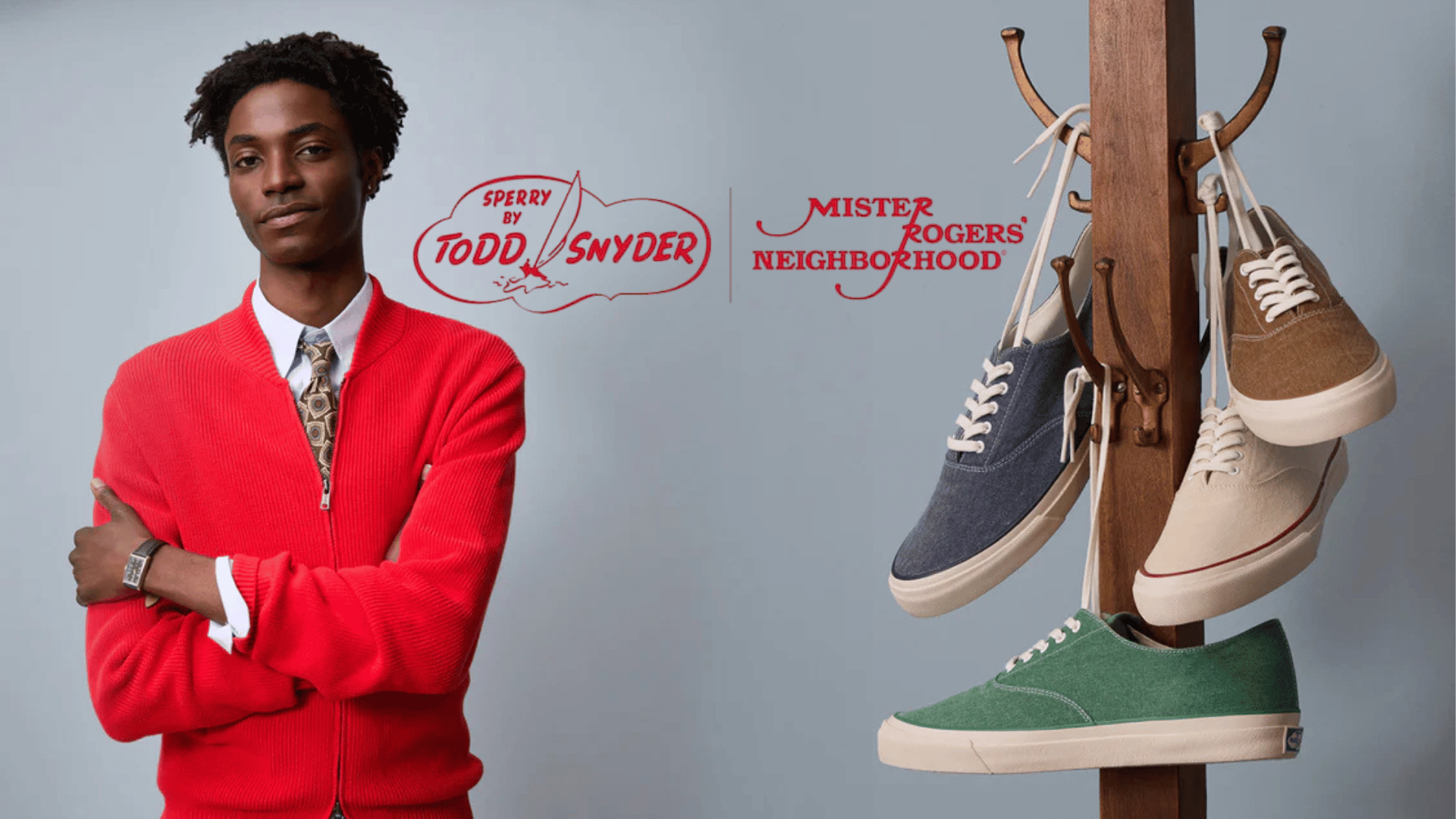
Which brings us to the new Todd Snyder x Sperry x Mister Rogers’ Neighborhood collection that dropped today.
It rules.
The collection pulls from Rogers’ actual off-screen style and iconic on-screen wardrobe, blending Todd Snyder’s refined American sensibility with the timeless charm of Sperry’s classic silhouettes. The result feels nostalgic and timeless. Warm without becoming corny. It’s the rare collaboration that understands the assignment emotionally, not just aesthetically.
The standout piece might be the TS x Sperry x Mister Rogers CVO Sneaker in Vintage Indigo. Inspired by the classic deck shoes Rogers famously wore, the sneaker leans into old-school nautical simplicity with washed indigo canvas, crisp white foxing, and that effortless “I’ve owned these for 15 years” energy. Sperry originally invented the CVO nearly 90 years ago, and Mister Rogers helped make the silhouette iconic for an entirely different generation.
Then there’s the t-shirts featuring different neighborhoods (New York, Boston, LA, Nashville, etc.), which feels less like merch and more like a love letter to old local public television. Minimal, wearable, and understated in the exact way Todd Snyder does best.
But the emotional centerpiece of the collection is the red zip sweater. Because of course it is.
The Todd Snyder x Mister Rogers Zip Sweater doesn’t try to reinvent the cardigan Rogers made famous. It honors it. And that restraint is exactly why it works. The sweater carries all the emotional memory of Mister Rogers’ Neighborhood without feeling gimmicky. You don’t wear it ironically. You wear it because the world could probably use a little more of what it represents.
And maybe that’s why this collection hits harder than most collaborations.
Great style has always been about communication. What you wear tells people who you are before you speak. Fred Rogers understood that instinctively. His clothes weren’t flashy, but they were deeply intentional. Warm. Approachable. Safe. Confident. They reflected the kind of man he wanted to be in the world.
That’s a lesson most modern menswear still struggles to grasp.
Because confidence isn’t always sharp edges and status symbols. Sometimes it’s softness. Sometimes it’s deep sincerity. Sometimes it’s a red sweater and a pair of beat-up sneakers.
Or, as Mister Rogers once put it, “It’s not so much what we have in this life that matters. It’s what we do with what we have.”
Facts Only
* Fred Rogers wrote that one of the greatest dignities of humankind is that each successive generation is invested in the welfare of each new generation.
* Mister Rogers treated emotions seriously and taught that vulnerability was not weakness.
* Fred Rogers’ clothing reflected a style that was warm, approachable, and safe.
* The collection features items inspired by Rogers’ off-screen style and on-screen wardrobe.
* The collection includes a Todd Snyder x Sperry x Mister Rogers CVO Sneaker in Vintage Indigo.
* The collection includes t-shirts featuring different neighborhoods (e.g., New York, Boston, LA, Nashville).
* The Todd Snyder x Mister Rogers Zip Sweater is a key item in the collection.
* Sperry originally invented the CVO silhouette nearly 90 years ago.
* The article discusses the concept of kindness, patience, and emotional intelligence as foundational to dignity.
* The discussion links confidence to softness and sincerity rather than sharp edges or status symbols.
Executive Summary
Full Take
Sentinel — Human
The text demonstrates high qualitative human writing, successfully synthesizing personal philosophy and commercial context with a cohesive, emotionally resonant argument.