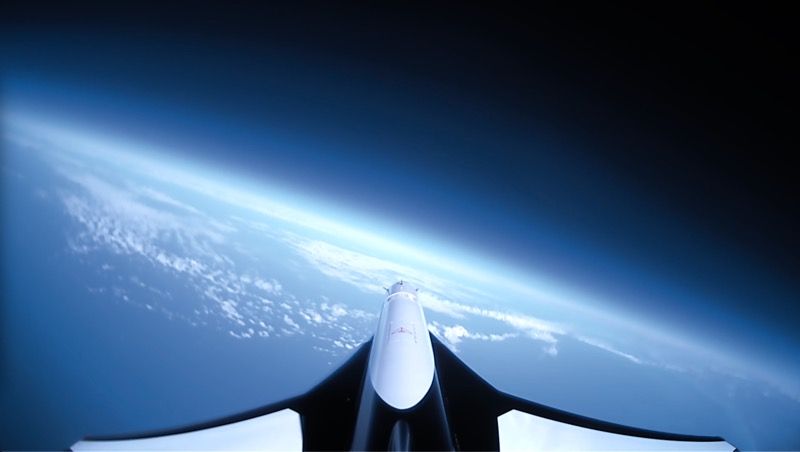
Is it an aircraft? Is it a rocket? No, it’s the Mk-II Aurora…and it’s a spaceplane. Although, Will Austin, the flight operations lead and senior flight test engineer for Aurora at Dawn Aerospace simply describes the aircraft as… an aircraft.
However, an Aurora test flight is not a normal flight. The remotely-piloted, rocket-powered aircraft takes off from a runway in New Zealand and transitions into a vertical position, whereupon it thrusts upwards into the atmosphere. The 16ft (4.8m) long, delta-winged aircraft then glides back down to land horizontally on the runway. A flight lasts about 30 minutes.
Not a regular aircraft then. But Austin’s plain nomenclature is characteristic of the everyday way Aurora’s flight test program is being run. The first aircraft, the Mk-II A, started as a low speed, low altitude technology demonstrator, but is now routinely flying to low supersonic speeds, carrying payloads for customers and flying twice a day. Dawn Aerospace is progressing rapidly toward its ambitious target of producing a reusable spaceplane, capable of carrying payloads to suborbital altitudes multiple times a day.
Cheaper space access
Dawn Aerospace has achieved 62 flights with the first iteration of the Mk-II Aurora since August 2021. The next flight test campaign is planned to start this month and will run for several weeks.
The next version of Aurora under development, the Mk-II B, has concluded the design phase, and production is underway. The Mk-II B’s maiden flight is planned for the end of this year. Speaking from Dawn’s offices in Christchurch / Ōtautahi, Austin says, “The Mk-II B is a significant evolution from the Mk-II A. But the B is still a technology demonstrator. We are using it to take the steps we need to make higher performing spaceplanes and prove capabilities along the way.”
The Mk-II B Aurora has an MTOW of 1,000 lbs (450kg). It can carry a 13 lbs (6kg) payload to the edge of space (100km) at speeds of beyond Mach 3.0. Target applications include scientific research, Earth observation, microgravity experiments, and defense.
Dawn, which also has offices in the Netherlands, wants to provide a low-cost, high-frequency alternative to traditional space access. While a rocket will go high and fast to deliver a payload, it won’t return to Earth in one piece. This single-use nature of most rockets increases costs and mission complexity considerably, holding back the exploitation of space. Dawn Aerospace sees business opportunities in reducing the cost of reaching orbit. Unlike larger firms such as SpaceX, Blue Origin and Sierra Space, it wants to create a niche in delivering smaller payloads.
“Dawn is fundamentally a space transportation company,” says Austin. “To achieve this, we are leveraging a lot from aviation, particularly in terms of frequency and reliability. That drives a lot of our design decision-making.”
Infrastructure’s importance
The Aurora spaceplane is being developed with an emphasis on “reusability, a short turnaround time, and maintainability,” says Austin. Inevitably, this means design decisions have been made that may impact performance but improve operability. The Mk-II Aurora has typical tricycle landing gear undercarriage, which results in additional mass and complexity, but allows for landing on ordinary runways and reusability.
Equal importance is being given to Aurora’s CONOPs and infrastructure considerations. Rockets usually require a lot of specialized ground infrastructure and the closure of airspace when they launch. “Most aerodromes and airports already have everything the Mk-II Aurora needs. If we’ve got the airspace approval from the regulator, we can operate,” says Austin.
Dawn has cultivated a close partnership with the Civil Aviation Authority of New Zealand and the New Zealand Space Agency and operates the Aurora under Part 102 and High-Altitude Vehicle licenses. This enables Aurora to conduct supersonic flights in New Zealand to high altitudes without needing to close large areas of airspace.
“I cannot say enough good things about the regulators here, they have a real enthusiasm for what we are doing,” Austin says.
“Despite there being a rocket engine for propulsion, we pushed hard to be licensed as an aircraft, so we can fly when we like, how we like and integrate with other airspace users. It is a vital part of rapid reusability.”
Jet to rocket propulsion
Early flight testing with the Mk-II A focused on proving the fundamentals with two jet engines fitted, while the rocket engine was being developed in parallel, in-house.
Austin, who joined Dawn in 2021, was part of the spaceplane team from the start: “Early flight testing was about the basics – making sure the airframe won’t fall apart and that the avionics is all communicating properly, with the pilot in the loop controlling it. We had the pilot practice engine-out glide landings, because we knew with rocket engine flying there wouldn’t be a chance to stick the landing a second time. The pilot has to be able to nail it every time.”
The pivotal moment in Aurora’s development so far has been the switch over from jet to rocket-powered flight. For the flight test team this meant working with new propellants and an in-house developed rocket engine.
“The performance of the aircraft went through the roof,” Austin says. “We went from a speed limit of 200 knots to unlimited, with the ability to go supersonic vertically. But the regulator wouldn’t allow that instantly, we had to build up the flight test program incrementally.”
Senior flight test engineer and flight director for the early flights and first rocket-powered flights was Tim Dutton from the UK, an ETPS graduate who Austin acknowledges had a big influence on the program and team. “His contributions from applying principles he had learnt from his previous testing and experience helped guide the testing philosophy, and really set us up for success,” he says.
Controlling the variables
The team uses classic flight test methodologies, expanding the aircraft’s flight envelope and building capability in “bite-sized chunks”. However, Aurora’s rapidity makes controlling variables difficult. “For example, you can’t expand the altitude or test the range of the C2 link without increasing speed, due to the way the rocket engine operates,” Austin says.
“Normally you want to try and constrain as many variables as possible and only alter one at a time, but the nature of how fast Aurora moves means you have to expand many things at once. We do our due diligence early on to make sure that if we expand altitude, speed, g and C2 link range in quick succession, it’s safe to do so. We do analysis before we leave the office – the systems engineering team run Monte Carlo simulations, including factoring in for the different forecast winds on the day.
“Early on, when we were expanding the speed envelope, we went in Mach point-one increments, just to show a decent leap. By taking that step, we knew it would be an altitude leap of about this, and it will be a C2 link range of about this, and so on.”
Surprisingly, the unmanned nature of the aircraft causes challenges. Austin explains: “The risk to personnel is lower, but the complexity of the aircraft is higher, because you have the C2 link in the mix. The latency involved with the uplink and downlink, a pilot on the controls and an FPV camera over the downlink – the complexity of those components requires us to do a lot of planning and make trade-offs.”
Normal benefits
Success in managing the variables and complexities can be seen in the fact that the team has needed just one Aurora prototype – although Austin admits there are a number of unexpected lessons that the team has encountered. He also points to the routine way in which the aircraft now operates, with the team running the first payload flights for customers last summer.
Austin says, “Cracking the sound barrier was a pivotal point, but doing it multiple times means it has become a benign event within the team, which is a good place to be. By the fourth payload flight, it had all become more routine. We just go through what they need to. The team and the vehicle have both matured.”
Austin talks effusively about the people at Dawn and credits the progress being made on the Aurora program to them and the way the company is set up: “The most important thing I’ve learned is to value your team. Investing in the team is key to the success Dawn has seen to date,” he says.
“I can sit here and talk about the technology we are developing, the nature of the rocket engine, the vehicle itself or even the regulatory work that’s been done – it’s all impressive – but it always comes back to the team and talented individuals we have.
“We also don’t have the luxury of having enormous, siloed teams. My airframe lead and avionics team lead double up as safety officers for flight operations. So not only are they in the thick of the design, but I take them out flying and they are supporting from a safety point of view.
“This means people know the entire operation end-to-end. I can go into the office and grab a design engineer and stick them in Mission Control, and do flights with full trust.
“The other benefit is that when it comes to the next vehicle, they’re in the best position to make the right design decisions to achieve a fast turnaround time.
“That’s a super powerful thing. You are not just a design engineer you are an engineer that does design, build, test, operate, even maintain – the full loop.”
Future targets
Looking forward, Austin says breaking the Kármán line into space will be a key milestone for the company. Personally, he is also eagerly anticipating the first flight of the Mk-II B.
The Mk-II B will externally look very similar to the Mk-II A and only be slightly larger. However internally, there are a number of changes. The propellant tanks will be optimized so the aircraft can carry significantly more fuel and oxidizer, so that the engine can produce more thrust. The Mk-II B will also have reaction thrusters for out-of-atmosphere control. “A lot of the improvements are from the Mk-II A,” Austin says.
Once suborbital access to microgravity multiple times a day is flight tested, numerous new opportunities should open. Carrying a payload to suborbital altitudes in the morning, landing and letting the customer make some tweaks and changes, then returning to suborbital altitudes in the afternoon, is a capability Austin says will be unique globally.
Delivery of Aurora to Dawn Aerospace’s first customer, Oklahoma State in the USA, is planned to happen in 2027. This will be another key milestone and proof that an ordinary approach to extraordinary flight testing is the best way.
A flying day out
A typical day for Will Austin, senior flight test engineer for the Mk-II Aurora at Dawn Aerospace starts early in the office, where he does last-minute weather checks before heading out for an hour drive to the Tāwhaki National Aerospace Centre.
On site, a team of up to 15 people will split into smaller groups either pre-flighting the aircraft, or setting up equipment such as the Mission Control. A flight crew briefing is followed by propellant loading
and then towing the Aurora out to the runway.
“The engine starts, there’s ten seconds to rotate from engine start. There’s a two-minute climb to altitude. And then for the remainder of that mission, when we roll out wings level at altitude, we can be airborne for 20 to 25 minutes on the glide coming back, and we’ll be doing test points.
“The pilot performs a glide landing similar to the Space Shuttle. There’s a split rudder on board that is used to control the energy. The Aurora glides in, flares, touches the gear down, and just rolls out on the runway.
“If there is a payload flight it is out of the aircraft and back to the customer within an hour. So they can do whatever analysis they want and have rapid access to both their payload and data.”
This article was first published in the print version of our magazine. For early access as an industry professional, please apply here
Facts Only
Dawn Aerospace is developing the Mk-II Aurora, a reusable, rocket-powered spaceplane.
The Mk-II Aurora takes off and lands horizontally but transitions to vertical ascent during flight.
The aircraft is 16 ft (4.8 m) long, delta-winged, and remotely piloted.
The first iteration, Mk-II A, has completed 62 test flights since August 2021.
The Mk-II A now routinely flies at supersonic speeds and carries payloads for customers.
The next version, Mk-II B, is under development, with a maiden flight planned for late 2024.
The Mk-II B will have a maximum takeoff weight of 1,000 lbs (450 kg) and carry a 13 lbs (6 kg) payload to 100 km at speeds exceeding Mach 3.0.
Dawn Aerospace operates from Christchurch, New Zealand, and has offices in the Netherlands.
The company works closely with New Zealand’s Civil Aviation Authority and Space Agency under Part 102 and High-Altitude Vehicle licenses.
The Mk-II Aurora uses tricycle landing gear, allowing it to land on standard runways.
Early testing used jet engines before transitioning to rocket propulsion.
The team conducts flight tests in incremental steps, expanding speed, altitude, and control capabilities simultaneously.
Dawn Aerospace aims to deliver the Aurora to its first customer, Oklahoma State University, in 2027.
Executive Summary
Dawn Aerospace is developing the Mk-II Aurora, a reusable spaceplane designed to carry small payloads to suborbital altitudes multiple times per day. The aircraft, which takes off and lands horizontally like a conventional plane but transitions to vertical ascent using rocket propulsion, has completed 62 test flights since 2021. The current model, Mk-II A, has demonstrated supersonic speeds and is being used for payload flights, while the next iteration, Mk-II B, is under development with plans for a maiden flight by the end of 2024. The Mk-II B will feature improved fuel capacity, reaction thrusters for out-of-atmosphere control, and the ability to carry payloads to 100 km at speeds exceeding Mach 3.0. Dawn Aerospace emphasizes reusability, rapid turnaround, and integration with existing airport infrastructure, distinguishing itself from traditional rocket-based space access. The company operates under New Zealand’s regulatory framework, which allows for flexible flight testing without extensive airspace closures. The goal is to provide a low-cost, high-frequency alternative for scientific research, Earth observation, and defense applications, with delivery to its first customer, Oklahoma State University, planned for 2027.
The project reflects a blend of aviation and aerospace engineering, leveraging aircraft-like operability while pushing the boundaries of rocket-powered flight. The team’s iterative testing approach, combining jet and rocket propulsion, has enabled rapid progress, with the aircraft now routinely conducting supersonic flights and payload missions. The unmanned nature of the Aurora introduces complexities, such as command-and-control latency, but the company’s integrated team structure—where engineers participate in both design and operations—has streamlined development. Regulatory support in New Zealand has been a key enabler, allowing Dawn Aerospace to test and refine the spaceplane with minimal bureaucratic hurdles. The ultimate vision is to democratize access to space by reducing costs and increasing flight frequency, though challenges remain in scaling the technology for broader commercial use.
Full Take
The Mk-II Aurora represents a compelling convergence of aviation and aerospace, but its narrative warrants scrutiny through the lens of technological feasibility, regulatory exceptionalism, and market positioning. At its strongest, the project demonstrates how iterative testing and regulatory agility can accelerate innovation. Dawn Aerospace’s ability to conduct supersonic flights without extensive airspace closures—thanks to New Zealand’s supportive framework—highlights how flexible governance can enable breakthroughs. The company’s emphasis on reusability and rapid turnaround aligns with broader industry trends toward cost reduction, and its focus on small payloads carves out a niche distinct from heavy-lift competitors like SpaceX.
However, the narrative also invites questions about scalability and risk. The unmanned design introduces complexities, such as command-and-control latency, which could limit operational reliability. While the team’s integrated approach—where engineers double as safety officers—fosters deep expertise, it also raises concerns about burnout and the sustainability of such a lean structure as operations scale. The claim of "routine" supersonic flights, while impressive, glosses over the inherent risks of rocket-powered aircraft, where failure modes are less forgiving than in traditional aviation. Additionally, the business model’s viability hinges on demand for high-frequency suborbital access, which remains unproven outside niche applications like scientific research.
Rooted in the paradigm of "space as infrastructure," Dawn Aerospace’s vision echoes historical efforts to make spaceflight as routine as air travel. Yet, the assumption that regulatory flexibility in New Zealand will translate globally may underestimate geopolitical and safety hurdles. The broader implication is a potential shift in how space access is democratized—but only if the technology can overcome technical and economic barriers. Who stands to benefit? Researchers and defense contractors with urgent, repeatable payload needs. Who bears the costs? Early adopters and investors, should demand fall short of projections.
Bridge questions: How would the Aurora’s safety record compare to traditional rockets if scaled to hundreds of flights annually? What regulatory challenges might arise if Dawn Aerospace seeks to operate in jurisdictions with stricter airspace controls? Could the Mk-II B’s performance claims be independently verified, or are they contingent on proprietary testing methodologies?
Counterstrike scan: A coordinated influence campaign might exaggerate the Aurora’s readiness or downplay risks to attract investment or regulatory favor. However, the article’s focus on incremental testing, regulatory transparency, and acknowledged challenges suggests a genuine technical narrative rather than a manipulative one. No structural alignment with disinformation playbooks is detected.
Patterns detected: none
Sentinel — Human
The text exhibits the characteristics of high-quality, expert-written journalistic or industry reporting. The tone is authoritative, detailed, and nuanced, reflecting deep familiarity with aerospace engineering and project management principles.