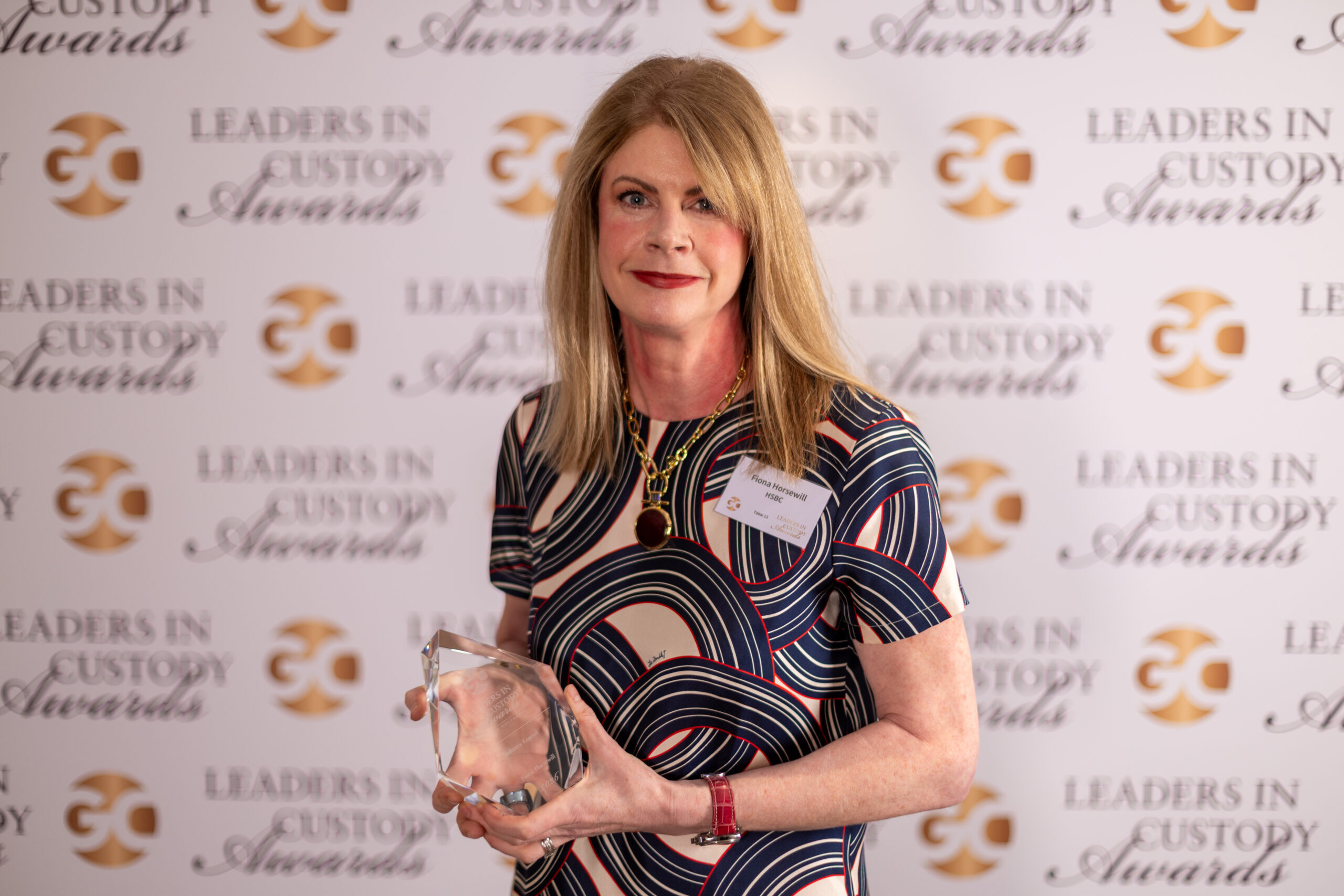
Global Custodian is pleased to reveal the four newest Legends to be inducted into the prestigious GC Hall of Fame.
Our Legends embody the pinnacle of excellence within the securities services industry. The Hall of Fame is made up of stalwarts often amassing decades of experience in leading from the forefront and driving positive change across the market.
Fiona Horsewill
Fiona Horsewill is global head of securities services at HSBC, where she joined in 2023, bringing experience across product leadership, digital transformation and investment operations.
She is responsible for shaping and executing HSBC’s global securities services strategy, with a focus on modernising infrastructure, advancing digital capabilities, and driving long-term transformation across the business.
Prior to HSBC, Horsewill was managing director and global head of data and digital for securities services at Citi, where she focused on enhancing data-driven capabilities and digital solutions across the franchise.
Before that, she spent seven years at Northern Trust, where she held several senior leadership roles, including global head of product for asset servicing.
Earlier in her career, she led investment operations and major transformation programmes at Lehman Brothers Asset Management and Insight Investment, building deep expertise in operational change and post-trade infrastructure.
Under her leadership at HSBC, the securities services business has pursued a multi-year transformation strategy centred on infrastructure build-out and digitalisation, with growing activity across digital assets, private markets, and emerging markets.
The business has also expanded its global footprint through new custody mandates and regulatory milestones.
Ben Challice
Ben Challice is the current CEO of Pirum, where he leads the firm’s strategic direction, with a focus on developing its end-to-end automation capabilities,
enhancing support for T+1 settlement readiness and exploring the application of AI in post-trade infrastructure.
Challice brings over 25 years of capital markets experience across broker-dealers, custodian banks, and financial technology providers, with a career spanning securities finance trading, prime services, and regulatory policy.
He began his career at Goldman Sachs in securities lending and equity finance and was part of the EquiLend design partner group that helped shape early industry trading infrastructure.
He later held senior roles at Lehman Brothers, where he led EMEA financing sales and trading, before joining Nomura following its acquisition of Lehman’s business to serve as head of global prime services.
He then joined JP Morgan’s securities services business as global head of trading services, where he oversaw agency securities finance, collateral management, and tri-party businesses, driving record revenues and leading major transformation initiatives, including the development of tokenised collateral solutions and open-architecture collateral platforms.
He has served on the Bank of England’s Money Markets Committee, contributing to industry policy on liquidity, regulation, and settlement cycle reform, including T+1.
Vicky Kyproglou
Vicky Kyproglou is a managing director at UBS and global head of network and market infrastructure, where she oversees the firm’s post-trade network, including relationships with financial market utilities, central counterparties, and other key providers across all business lines.
She is responsible for bringing together market expertise across provider and market management, regulatory developments, and market infrastructure, supporting UBS’s global securities services and post-trade strategy.
Kyproglou has spent more than three decades at UBS, beginning her career at Paine Webber in the US prior to its acquisition by UBS in 2000.
Over the course of her tenure, she has held a range of senior roles, including leading US funding and treasury operations for the Wealth Management Americas business.
In addition to her business leadership, she has been actively involved in diversity and inclusion initiatives at UBS, with a particular focus on supporting mid-career women within the organisation.
Kyproglou also plays an active role in the broader industry, currently serving as vice chair of the International Securities Services Association (ISSA).
She previously served as a board member of the Association for Financial Markets in Europe (AFME) post-trade division from 2015 to 2019.
Bohdana Yefremova
Bohdana Yefremova is head of GPS at Raiffeisen Bank Ukraine, where she oversees the bank’s global payments and securities services activities, including custody, clearing, and broader post-trade operations across the Ukrainian market.
She is responsible for driving the development and resilience of the bank’s securities services offering, bringing together deep local market expertise with international standards in custody and post-trade infrastructure.
Yefremova has spent more than two decades in the custody and securities services industry, holding a number of senior leadership roles across major international banking institutions operating in Ukraine.
She joined Raiffeisen Bank Ukraine in 2014 as head of global securities services (GSS) Ukraine, where she played a key role in strengthening the bank’s custody franchise and client offering during a period of significant market change. She was later appointed head of GIS in 2021, before taking on her current role as head of GPS.
Prior to joining Raiffeisen, she served as head of custody at Ukrsotsbank, part of the UniCredit Group, and held similar leadership roles at UniCredit Bank Ltd and HVB Ukraine. She began her career in custody at Creditanstalt Ukraine and Bank Austria Creditanstalt Ukraine.
Over the course of her career, Yefremova has built a strong reputation within the Ukrainian market for her expertise in custody and post-trade services, as well as for her long-standing relationships with clients and market participants.
She has played a key role in supporting the continuity and stability of securities services in Ukraine, contributing to the resilience of the local market infrastructure during periods of disruption and uncertainty.
A big congratulations to all our newly inducted GC Legends!
Facts Only
Fiona Horsewill is global head of securities services at HSBC, joining in 2023.
She previously served as managing director and global head of data and digital for securities services at Citi.
Horsewill held senior roles at Northern Trust, including global head of product for asset servicing.
Ben Challice is CEO of Pirum, focusing on post-trade automation and AI applications.
Challice has over 25 years of experience, including roles at Goldman Sachs, Lehman Brothers, Nomura, and JP Morgan.
Vicky Kyproglou is a managing director at UBS and global head of network and market infrastructure.
She has spent over 30 years at UBS, with prior roles in US funding and treasury operations.
Bohdana Yefremova is head of GPS at Raiffeisen Bank Ukraine, overseeing custody and post-trade operations.
Yefremova has held leadership roles at Ukrsotsbank, UniCredit Group, and other Ukrainian financial institutions.
The Global Custodian Hall of Fame inducts industry leaders for excellence in securities services.
Inductees are recognized for decades of experience and contributions to digital transformation and market resilience.
Executive Summary
Four industry leaders have been inducted into the Global Custodian Hall of Fame for their contributions to securities services. Fiona Horsewill, global head of securities services at HSBC, is recognized for her leadership in modernizing infrastructure and advancing digital capabilities, including digital assets and private markets. Ben Challice, CEO of Pirum, is noted for his work in post-trade automation, T+1 settlement readiness, and AI applications in securities finance. Vicky Kyproglou, a managing director at UBS, oversees global market infrastructure and has spent over three decades in post-trade operations, with a focus on diversity and inclusion. Bohdana Yefremova, head of GPS at Raiffeisen Bank Ukraine, is acknowledged for her role in strengthening Ukraine’s custody and post-trade services amid market disruptions. Each inductee brings decades of experience, driving innovation and resilience in their respective domains.
The Hall of Fame highlights professionals who have shaped the securities services industry through strategic leadership, digital transformation, and operational excellence. Their careers span major financial institutions, including HSBC, Citi, Northern Trust, UBS, and Raiffeisen Bank Ukraine, with contributions to regulatory policy, market infrastructure, and crisis resilience. The inductions reflect the industry’s emphasis on modernization, global expansion, and adaptability in challenging environments.
Full Take
The induction of these four professionals into the Global Custodian Hall of Fame underscores a broader industry narrative: the securities services sector is prioritizing digital transformation, operational resilience, and global adaptability. The strongest version of this narrative celebrates their achievements as benchmarks for innovation, particularly in post-trade infrastructure, AI integration, and crisis management. However, the pattern of highlighting individual leadership risks overshadowing systemic challenges—such as regulatory fragmentation or the uneven adoption of digital assets—without deeper critique.
Root cause: The narrative assumes that technological modernization and leadership excellence are sufficient to address industry-wide inefficiencies. Yet, it sidesteps questions about whether these changes benefit all market participants equally or if they exacerbate disparities between large institutions and smaller players. The focus on "legends" may also reinforce a hero-worship dynamic, obscuring the collective labor behind operational resilience.
Implications: For human agency, this framing elevates certain career trajectories as aspirational but may discourage scrutiny of structural barriers. Who bears the costs of rapid digitalization? How do these leaders’ strategies interact with geopolitical risks, as seen in Yefremova’s work in Ukraine? Second-order effects could include increased consolidation in the sector, with fewer firms able to compete on infrastructure investments.
Bridge questions: What metrics would measure the equitable impact of these transformations? How might smaller institutions or emerging markets adapt without the resources of global banks? What trade-offs exist between innovation and stability in post-trade systems?
Counterstrike scan: A coordinated influence campaign might amplify these inductions to promote uncritical trust in financial institutions’ self-regulated modernization. However, the content aligns with standard industry recognition rather than a manipulative playbook. No overt patterns of distortion or evasion are detected.
Patterns detected: none
Sentinel — Human
The content exhibits the highly polished, fact-heavy style of professional corporate biographical reporting, strongly suggesting human authorship or rigorous human editing, rather than pure synthetic generation.