Liv‑ex, the global exchange for fine wine, market data and insight, reports on the resilience of 100 Italian wines traded on its Exchange.
*Any media use of this press release must credit Liv-ex and link back to here.*
Tuscany Underpins Stability in the Italy 100 as Trade Focuses on Leading Wines
London, April 2026 – Liv‑ex, the global exchange for fine wine, market data and insight, reports on the resilience of 100 Italian wines traded on its Exchange. Drawing on twenty five years of pricing and transactional data, this update examines recent price performance, trade dynamics and shifts in value concentration across the Italy 100. Highlighting the role of Super Tuscan wines in supporting index stability amid broader market weakness and where buying interest is beginning to re-engage.
Sophia Gilmour, Market Analyst, provides expert commentary:
‘While we’ve talked at length about the Italy 100’s resilience, it’s largely been the Super Tuscans driving this. When market conditions are tough and cash is in short supply, we should expect demand for higher value, rarer wines, such as the index’s Piedmontese components, to fall, in turn leading to weaker prices. Super Tuscans outperforming the likes of Giacosa and Conterno, then, isn’t surprising. What’s more interesting is the narrowing of concentration on these select few Tuscans. On the one hand, this is a testament to the strength of brands such as Sassicaia and Tignanello; on the other, it highlights the still-cautious mood of the market.’
- Tuscany Strength Underpins Stability in the Italy 100
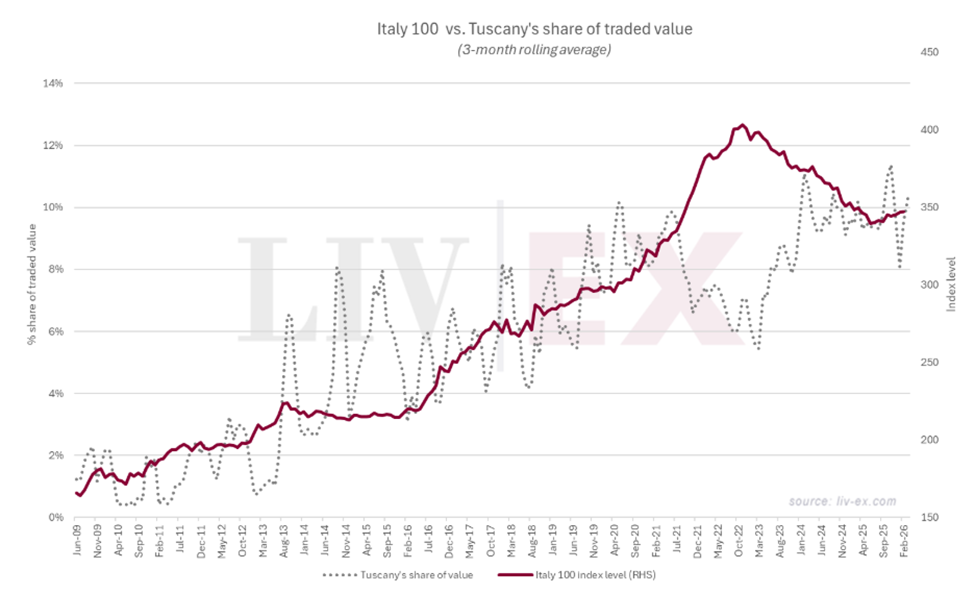
The Italy 100 has remained relatively stable compared with the broader market’s three-year decline, largely driven by the Tuscan components. Strong trade has underpinned the positive performance of these wines. The dip at the peak of the market was driven by increased spending on high value Burgundy.
- Masseto taken the lead vintages up 5% YTD
Of the Italy 100 Tuscan components, Masseto has taken the lead, the 2020, 2022, 2016 and 2014 all up over 5% YTD. Of these, the 2020 has seen the sharpest rise in its mid price (mid point between highest offer and lowest bid on a given wine), while the 2016 remains better-backed with trade.
- Tuscan Value Concentrates as Fewer Wines Drive Trade
So far this year, 157 Tuscan wines, across multiple vintages, have traded on the exchange. Despite this, just nine wines account for over 80% of the region’s traded value, down from 21 wines YTD. By contrast, in the early 2000s it was not uncommon for the key Super Tuscans to represent 100% of Tuscan trade.
Fill in this form to receive our regular press releases including latest market intelligence reports, and market updates.
Facts Only
Liv-ex, a global fine wine exchange, released a report on the performance of 100 Italian wines traded on its platform.
The report focuses on the Italy 100 index, which tracks the resilience of Italian wines over a three-year period.
Super Tuscan wines, particularly Sassicaia and Tignanello, have driven stability in the Italy 100 index.
The broader fine wine market has experienced a three-year decline, while the Italy 100 has remained relatively stable.
Masseto has been the top-performing Tuscan wine, with vintages 2020, 2022, 2016, and 2014 each rising over 5% year-to-date.
The 2020 vintage of Masseto has seen the sharpest increase in mid-price, while the 2016 vintage remains the most actively traded.
So far this year, 157 Tuscan wines across multiple vintages have been traded on Liv-ex.
Nine Tuscan wines account for over 80% of the region’s traded value, down from 21 wines in the previous year.
In the early 2000s, key Super Tuscans often represented 100% of Tuscan trade.
Sophia Gilmour, a Market Analyst at Liv-ex, provided commentary on the trends.
The report notes that demand for higher-value Piedmontese wines, such as Giacosa and Conterno, has weakened.
The dip in the Italy 100 index at its peak was attributed to increased spending on high-value Burgundy wines.
Executive Summary
The fine wine market has shown resilience in Italian wines, particularly those from Tuscany, according to data from Liv-ex, a global fine wine exchange. The Italy 100 index, which tracks 100 Italian wines, has remained stable compared to broader market declines over the past three years, driven largely by Super Tuscan wines like Sassicaia and Tignanello. Masseto has emerged as a standout performer, with several vintages (2020, 2022, 2016, 2014) rising over 5% year-to-date. However, trade concentration has narrowed, with just nine Tuscan wines accounting for over 80% of the region’s traded value, down from 21 wines in previous years. This shift reflects both the strength of top brands and ongoing market caution. Analysts note that while Super Tuscans have outperformed Piedmontese wines like Giacosa and Conterno, this trend aligns with expectations during tougher market conditions, where demand for higher-value wines typically declines. The report highlights a historical contrast: in the early 2000s, key Super Tuscans often represented 100% of Tuscan trade, whereas today’s market is more diversified but still heavily weighted toward a select few.
The data suggests a cautious but stable market, with Super Tuscans acting as a stabilizing force amid broader uncertainty. The narrowing of trade concentration may indicate both brand dominance and lingering hesitance among buyers. While Masseto’s performance is notable, the overall trend underscores the enduring appeal of established Tuscan wines in a challenging economic environment.
Full Take
The Liv-ex report presents a narrative of resilience in the Italian fine wine market, particularly among Super Tuscan wines. At its strongest, the analysis highlights the stabilizing role of brands like Sassicaia and Tignanello, which have outperformed other Italian regions, such as Piedmont, during a period of broader market weakness. The data shows a clear concentration of trade value in a handful of elite Tuscan wines, suggesting both the enduring strength of these brands and a cautious market sentiment. The report’s framing of Super Tuscans as a safe haven amid economic uncertainty is plausible, given historical trends where top-tier wines retain demand even in downturns.
However, the narrative also raises questions about market diversity and potential over-reliance on a few key players. The narrowing of trade concentration—from 21 wines to just nine accounting for 80% of value—could indicate a market increasingly driven by speculation or brand prestige rather than broad-based demand. The comparison to the early 2000s, when Super Tuscans dominated 100% of trade, is striking but lacks deeper exploration of whether this shift reflects healthier diversification or a more fragile, top-heavy market. The report’s focus on Masseto’s performance, while factually supported, could also be seen as reinforcing a narrative of exclusivity, where only the rarest and most expensive wines thrive.
Root cause analysis suggests a paradigm where fine wine markets, like other luxury assets, become more concentrated during economic uncertainty. The unstated assumption is that Super Tuscans are inherently more resilient, but this could also reflect a self-fulfilling prophecy driven by investor behavior rather than intrinsic quality. The implications for smaller producers and less-established regions are significant—if trade continues to narrow, it may squeeze out mid-tier wines, reducing market diversity and potentially increasing volatility.
Bridge questions: What would it take for Piedmontese or other Italian wines to regain market share? Is the concentration of trade in Super Tuscans a sign of market maturity or a warning of over-speculation? How might climate change or shifting consumer preferences disrupt this trend?
Counterstrike scan: If this were part of a coordinated influence campaign, the playbook might involve amplifying the narrative of Super Tuscan dominance to drive investment toward specific brands, potentially at the expense of broader market health. However, the report itself appears to be a straightforward market analysis without signs of manipulation. The data is presented transparently, and the commentary acknowledges market caution rather than overhyping trends.
Patterns detected: none
Sentinel — Human
The text is highly structured, mirroring formal financial reporting. While the synthesis is polished, the specific data and nuanced commentary suggest an underlying human source, likely a journalist or market analyst reporting on factual data.