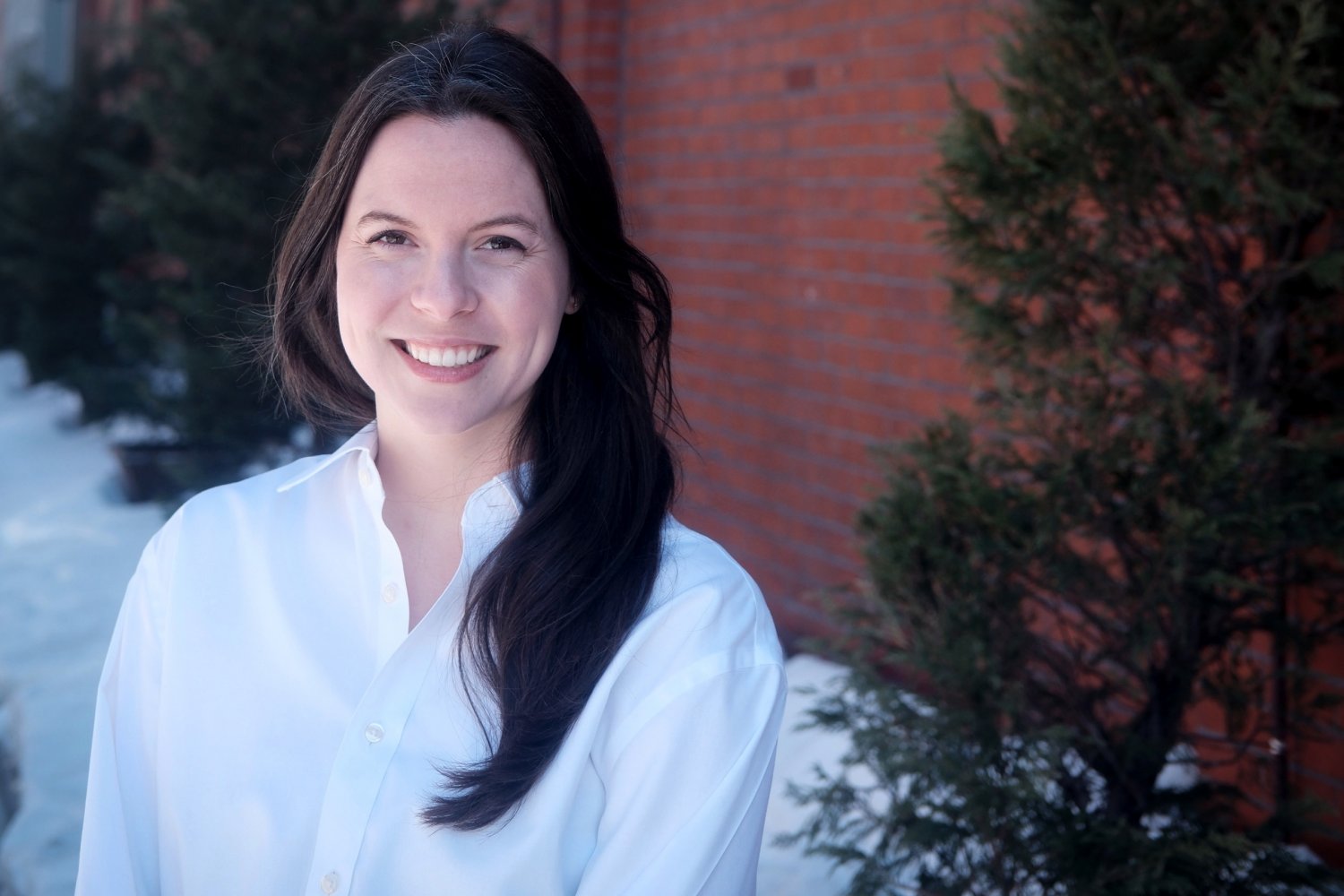
Since her first journalism fellowship covering energy and the environment at the NPR station in Harrisburg, Pennsylvania, Madison Goldberg has been drawn to science communication and audio storytelling. Now, after reporting on topics from solar storms to sewer systems to cryptography, she’s bringing her passions to MIT as the new host of the Institute’s climate change podcast.
Launched in 2019 as TILclimate, the show began its eighth season this year with a new name: Ask MIT Climate. But the podcast’s mission remains the same: teaming up with scientists and subject matter experts to bring listeners clear, accessible information on climate change topics in 15 minutes or less.
In this interview, Goldberg talks about her path to science communication, the ideas she thinks it’s important for climate communicators to convey, and what makes MIT an exciting place to share knowledge with the world.
Q: Did you always know that you wanted to be a science communicator?
A: I didn’t! My first love in science was astronomy. I grew up looking at the stars a lot, and I was very lucky to do an internship in high school at UC Santa Cruz with a professor in their astronomy department. Space kind of puts everything in the biggest possible perspective, and for me, that’s a very calming thing.
And then in college, I wanted to do something closer to home, so to speak. I found that Earth science was very exciting to learn about, because pretty much all the sciences are somehow involved. You know, you’ve got chemistry, biology, physics ... everything all rolled into one. Also, I still got to tap into a lot of what I loved about astronomy, in terms of exploring deep time and big scales. And I was very motivated by a lot of the problems in Earth and climate science, because they tie so closely to people’s lives.
I expected to continue with research, but I discovered that what was especially compelling to me was learning about this stuff and then talking to people about it. And in my senior year of college I learned that science communication, and science journalism, was a field that you could be in.
I took a science podcasting course that year — which I still can’t believe even existed — and I got my first taste of interviewing people and working in audio, which was just incredible. I had loved podcasts for so long, and so the medium felt really familiar.
Q: What is important for science communicators to convey about climate change?
A: One of the ideas that I try to always keep in mind, and that I think is really important to convey, is that climate change affects every single aspect of our lives. And we need to communicate about it accordingly.
I think it’s crucial to consider the ways climate change intertwines with all these other realms of people’s experiences; it affects where we live, it affects what we eat, it affects the economy, it affects our health. Approaching it in isolation doesn’t seem to be the most productive framework. As communicators, we have a responsibility to listen and learn and talk about all these many and varied ways that climate change shows up in people’s lives.
This idea of things intertwining also reminds me of a really central theme in Ask MIT Climate: that working towards climate solutions not only allows us to avoid the worst impacts of climate change, but it can also help make people’s lives better in other ways. And we get to think expansively about the future we want to build.
Q: What makes MIT an exciting place to be engaged in climate communication?
A: The folks that I've talked to at MIT are just so kind and generous with their time. And these people are so busy! They have so much on their plates, and yet, somehow, even when I have a million follow-up questions, extremely prominent researchers will hop on a Zoom or exchange emails to answer them. I feel so lucky to be part of this community.
Related to what I mentioned earlier, I also appreciate the interdisciplinary climate work that happens at MIT. Tackling climate change is a generational challenge, and it requires inputs from all kinds of fields. And at MIT we have, for example, the Climate Project, the Climate Policy Center, the Center for Sustainability Science and Strategy, the Living Climate Futures Lab — all of these ways to approach the issue and bring folks into the conversation who have different expertise, experiences, and perspectives. I think it’s really special to be at MIT, to see that happen in real-time, and to see students, faculty, and staff working to bridge across subject matter boundaries.
Above all, I’ve been shown such generosity, and I’m so grateful. I feel like I can never express enough gratitude for the people inside and outside of MIT who have spoken to me about their work and about their lives. All I can hope to do is to communicate that information faithfully. Because I think there’s a huge number of people who are curious about climate change and what we can do about it, and who want to learn.
Facts Only
Madison Goldberg is the new host of MIT’s climate change podcast, *Ask MIT Climate*.
The podcast was originally launched in 2019 as *TILclimate* and is now in its eighth season.
Each episode features scientists and experts discussing climate change topics in 15 minutes or less.
Goldberg’s background includes an internship in astronomy at UC Santa Cruz and a shift to Earth science during college.
She took a science podcasting course in her senior year of college, which introduced her to audio storytelling.
Goldberg believes climate change affects every aspect of life, including health, economy, food, and housing.
She values MIT’s interdisciplinary climate research and the generosity of researchers who engage with her.
MIT has multiple climate initiatives, including the Climate Project, Climate Policy Center, and Living Climate Futures Lab.
Goldberg aims to communicate climate science faithfully to a broad audience.
Executive Summary
Madison Goldberg, a science communicator with a background in astronomy and Earth science, has joined MIT as the new host of the climate change podcast *Ask MIT Climate* (formerly *TILclimate*). The podcast, now in its eighth season, aims to provide clear, accessible information on climate change in 15-minute episodes, featuring insights from scientists and subject matter experts. Goldberg’s journey into science communication began with an internship in astronomy, followed by a shift to Earth science due to its interdisciplinary nature and direct relevance to human life. She discovered her passion for science journalism during a podcasting course in college, which led her to audio storytelling.
Goldberg emphasizes the importance of communicating climate change as an issue that intersects with all aspects of life—from health and economy to food and housing—rather than treating it in isolation. She also highlights MIT’s collaborative and interdisciplinary approach to climate research, noting the generosity of researchers who engage with her despite their busy schedules. The institute’s various climate initiatives, such as the Climate Project and the Living Climate Futures Lab, reflect its commitment to addressing climate change from multiple angles. Goldberg’s role underscores the need for faithful communication of scientific knowledge to a curious public.
Full Take
This narrative presents a constructive and optimistic view of climate communication, emphasizing collaboration, interdisciplinary problem-solving, and the democratization of scientific knowledge. The strongest version of this story highlights the importance of making climate science accessible and relevant to diverse audiences, while also showcasing MIT’s role as a hub for innovative research and public engagement. Goldberg’s personal journey—from astronomy to Earth science to science journalism—serves as a compelling example of how curiosity and adaptability can lead to meaningful work in addressing global challenges.
However, the narrative leans heavily on the assumption that clear, expert-driven communication alone can bridge the gap between scientific consensus and public action. While this is a worthy goal, it risks underestimating the systemic barriers to climate action, such as political polarization, economic interests, and media fragmentation. The focus on MIT’s interdisciplinary approach is laudable, but it could inadvertently reinforce the idea that technological and academic solutions are sufficient without broader societal change.
The narrative also reflects a pattern of *ARC-0024 Ambiguity* in its framing of climate solutions as universally beneficial, without explicitly addressing trade-offs or conflicts of interest. For example, while climate action may improve lives in many ways, it can also disrupt industries and livelihoods, a tension that deserves acknowledgment.
**Root Cause:** The underlying paradigm here is one of *scientific optimism*—the belief that knowledge dissemination and rational discourse will naturally lead to progress. This echoes historical patterns of Enlightenment-era faith in education and expertise as drivers of societal improvement.
**Implications:** For human agency, this narrative empowers individuals to seek knowledge and engage with climate science, but it may overlook the structural power dynamics that shape climate policy. The beneficiaries are likely to be those already inclined toward scientific literacy, while those most vulnerable to climate impacts may remain underserved.
**Bridge Questions:**
How might climate communication address the emotional and psychological barriers to action, beyond just providing information?
What role should non-experts, such as community leaders or activists, play in shaping climate narratives?
How can we ensure that climate solutions account for the needs of marginalized communities, not just technological or economic efficiency?
**Counterstrike Scan:** A bad actor pushing this narrative might use it to deflect criticism of institutional inaction by framing climate change as a problem that can be solved through better communication and expert collaboration alone. However, the actual content does not exhibit this pattern; it genuinely advocates for broader engagement and interdisciplinary work. No structural alignment with manipulation tactics is detected.
Sentinel — Human
The article exhibits strong human signals, including personal voice, emotional emphasis, and conversational digressions, with no detectable signs of synthetic generation.