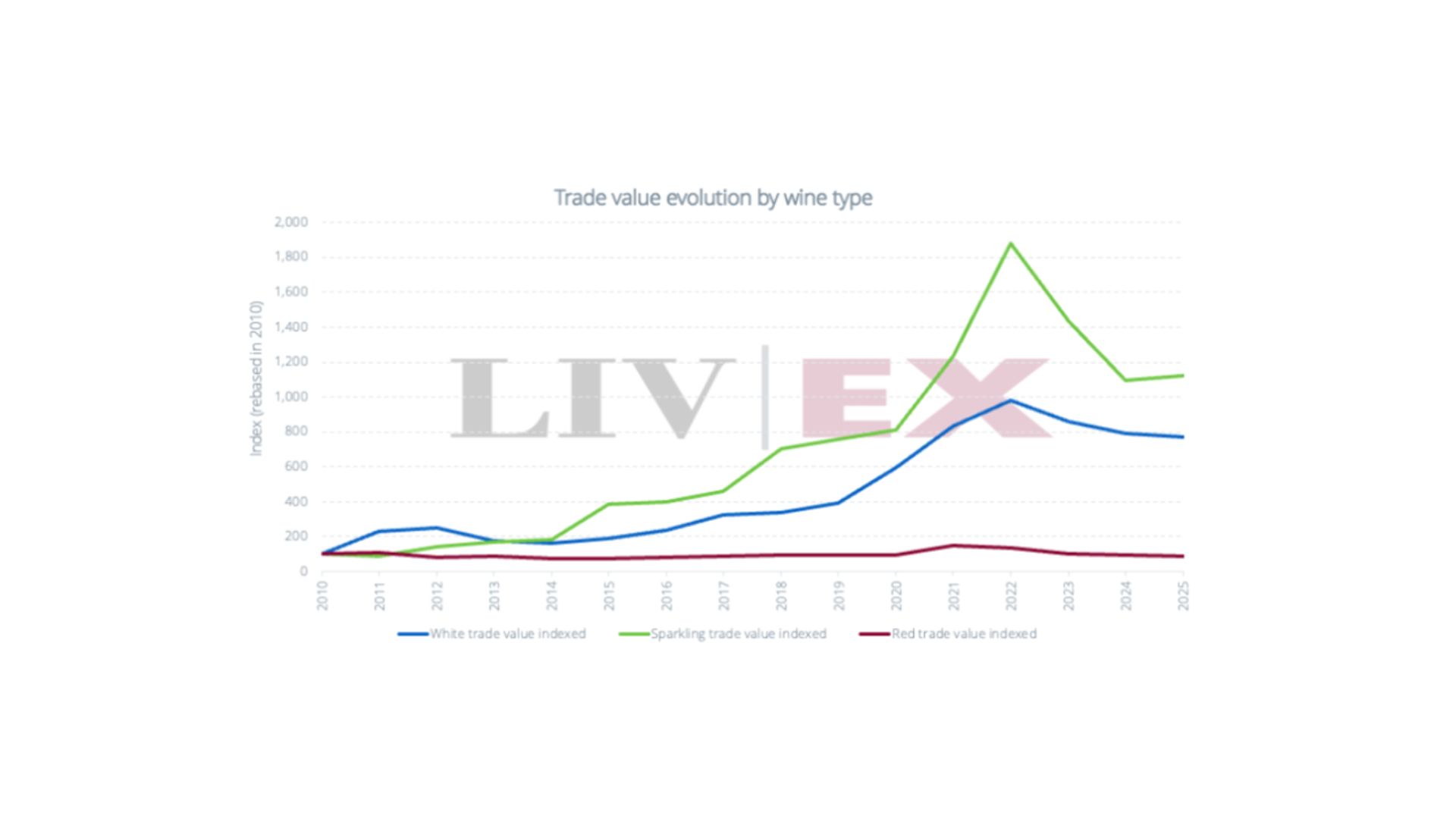
A significant shift in fine wine demand is underway, with sparkling wine trade rising by 1,100% since 2010 and red wine activity falling 15% since…
*Any media use of this press release must credit Liv-ex and link back to here.*
LONDON, May 2026
New data from Liv-ex, the exchange for fine wine, data and insight, shows a sustained surge in demand for white and sparkling wines, even as red wine
trade continues to lag.
Since 2010, the value of white wine traded on Liv-ex has increased by 650%, while sparkling wine trade has risen by 1,100% over the same period. While sparkling wines experienced a sharp boom (and subsequent bust) during the Covid-era bull market, recent data suggests that white wines, having experienced a less dramatic peak, have sustained high demand through the subsequent market downturn.
By contrast, red wine trade has remained relatively flat. In 2025, the total value of red wine traded on Liv-ex was 15.0% lower than in 2010,
underlining a structural shift in buying behaviour rather than a short-term anomaly.
A structural shift, not a seasonal trend
While red wine has traditionally dominated the secondary market, Liv-ex data indicates that buyers are increasingly diversifying where they choose to allocated their capital.
Any coverage referencing this information must attribute and link to Liv-ex White wine, in particular, has demonstrated resilience during recent periods of market uncertainty, maintaining more stable levels of trade value compared to both red and sparkling wines
Which white wines are driving growth?
The most significant growth in white wine trade has been seen in Burgundy, now firmly established as the leading white wine region on Liv-ex. This
growth has been driven by two complementary dynamics: increased trading volumes of lower-priced Burgundy whites and relative price stability at the top end of the market.
Since 2011, the value of Bordeaux white wine traded on Liv-ex has declined by 17.6%, allowing Burgundy to overtake Bordeaux as the dominant white wine category by value.
This shift reflects changing buyer preferences as well as the increasing importance of data-led decision making in the fine wine market. As White Burgundy’s prices and liquidity have surged, buyers have moved away from Bordeaux.
Data-driven insight for a changing market
As the fine wine market adjusts to a more selective buying environment, access to accurate, timely and unbiased data is becoming increasingly critical. Liv-ex analysis highlights how demand patterns are evolving across categories and regions, providing the trade with objective insight into where activity and value are sustained over time.
About Liv-ex
Liv-ex is the exchange for fine wine, market data and insight. They offer a membership that brings wine professionals independent market data and insights, and the ability to price, buy and sell wines through one point of contact.
Liv-ex offers automation services that enable fine wine businesses to streamline buying and selling, and gain operational efficiencies, including the ability to bring critics scores directly into their own systems.
Facts Only
* The value of white wine traded on Liv-ex increased by 650% since 2010.
* The sparkling wine trade rose by 1,100% since 2010.
* The total value of red wine traded on Liv-ex was 15.0% lower in 2025 than in 2010.
* Burgundy is now the leading white wine region on Liv-ex by value.
* The value of Bordeaux white wine traded on Liv-ex declined by 17.6% since 2010.
* White wines demonstrated resilience during recent market uncertainty.
Executive Summary
Full Take
The narrative of a "structural shift" is presented through data points that emphasize a transition in capital allocation within the fine wine sector. The surge in white and sparkling wine activity, particularly the dominance of Burgundy over Bordeaux, suggests that evolving buyer preferences, driven by liquidity and price stability, are overriding traditional market dominance. This implies that the historical structure of the secondary market is being redefined by data-led decision-making rather than seasonal trends. The underlying pattern suggests that the market is moving toward a segmentation where specific regions offer greater value and perceived stability, challenging the long-held status of traditional categories like red wine. The emphasis on data-led insight not only reflects market evolution but also highlights the increased agency of specialized buyers who are leveraging information to optimize their investments.
Patterns detected: ARC-0043 Motte-and-Bailey, ARC-0024 Ambiguity
Sentinel — Human
The text presents factual market data in a structured, analytical manner, consistent with high-quality financial reporting, indicating a likely human origin or highly polished human-assisted output.