The death toll in the Middle East is rising as the U.S.-Israeli air campaign against Iran continues. U.S. forces have hit more than 7,800 targets so far across Iran, and the Israel Defense Forces reports striking more than 7,600 sites.
The campaign cost the United States $11.3 billion in its first six days, according to the Center for Strategic and International Studies, and is estimated to cost $1 billion a day since. At that rate, in another week or so the outlay for the war will exceed the $30 billion price tag the U.S. Congress refused to pick up for the extension of enhanced federal subsidies for health insurance under the Affordable Care Act.
As usual in armed conflict, it is the region’s civilian population that is paying the highest price. According to the news agency for the organization Human Rights Activists in Iran, since the war began on Feb. 28, 1,369 Iranian civilians, including at least 207 children, have been killed. The independent human rights group also reports 1,138 military deaths and 627 deaths that it has not been able to classify.
The war has claimed the lives of 21 people among Persian Gulf states being targeted by Iran, and 13 U.S. service members have died. In Israel, Iranian missiles that managed to pass through the Iron Dome defense shield have claimed 14 lives.
The human suffering of this latest conflict is not limited to Tehran, Tel Aviv or sites hit by Iranian missiles in Iraq and the Gulf states. Crossings into Gaza were shuttered by Israeli officials when the bombing began, cutting off humanitarian aid to the survivors of more than two years of conflict in Gaza.
A ‘desperate need’ for a break from violence
Alistair Dutton, secretary general of Caritas Internationalis, responding to America by email, mourns the much higher toll in the region since the war in Gaza began with an attack by Hamas on Israel in October 2023. “Behind these figures are families and communities that have experienced far too much war,” he writes.
The people of the Middle East, he says, “desperately need an immediate break from war and violence that are rapidly increasing the hatred between different communities.”
In southern Lebanon, the Iran-supported Hezbollah militia joined the conflict on March 2, retaliating for the assassination of Ayatollah Ali Khamenei. The Israeli military, in turn, began a massive bombing campaign across southern Lebanon and on targets in southern and central Beirut.
Lebanon stands to become the hardest-hit collateral casualty of the Iran war. After years of economic turmoil, ineffectual governance, refugee crises and a devastating port explosion, this latest conflict between Israel and Hezbollah fighters in the south pushes Lebanon closer to collapse or, worse, a return to civil war.
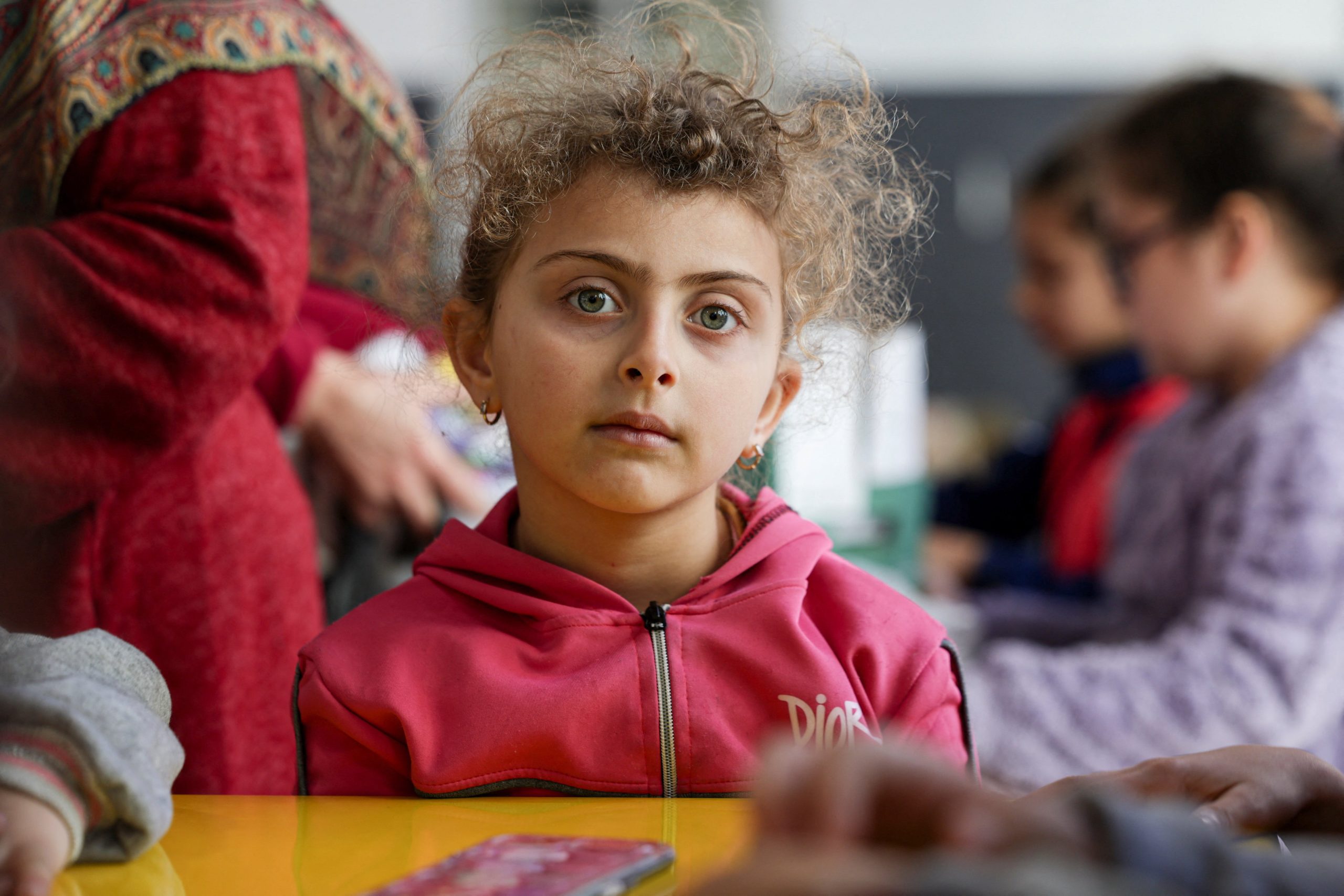
More than 1 million Lebanese, including more than 367,000 children, have been displaced by the fighting, according to the United Nations, and 968 people have been killed, including 116 children, according to Lebanon’s Ministry of Public Health. At least 31 health care workers were killed in 27 Israeli strikes on health care facilities, including 12 doctors, nurses and paramedics killed in one missile strike on a health care center in Bourj Qalaouiyeh on March 14.
Speaking from Beirut, Dan Corrou, S.J., regional director for Jesuit Refugee Service in the Middle East and North Africa, describes watching missile strikes in central Beirut from the rooftop of JRS’s offices. The dull buzz of Israeli surveillance and targeting drones overhead is constant, he says.
Beirut residents have no bomb shelters, and the city has no air raid alert system. If residents receive any advance warning at all about an incoming strike, Father Corrou explains, it is courtesy of a phone call from the Israeli military. No one knows when they may be unfortunate enough to be in the vicinity of an Israeli target, whether that Hezbollah weapons or ammunition hidden in a basement or a member of Hezbollah at a cafe in Beirut.
Among the Lebanese displaced by the conflict are hundreds of Christian families from villages along the border with Israel. But some have decided to stay in the conflict zone, mindful of the devastation visited on their villages after they had been abandoned in past conflicts.
Israeli forces have already launched incursions to expand a buffer zone inside Lebanon. Now Lebanese worry that Israel is preparing to seize and hold Lebanese territory up to the Litani River, reviving a Zionist vision of a greater Israel that would include southern Lebanon.
Father Corrou reports that is part of the reason some Christians elected to stay in their villages as the fighting intensified, concerned that if they left now, they would never be allowed to return. That decision to remain has proved mortally costly for some.
On March 9, Father Pierre al-Rai, parish priest of the Christian-majority village of Qlayaa, was killed after what appears to be a “double-tap attack,” hitting the same target twice, from an Israeli tank. He had decided to join other villagers of Qlayaa who refused to comply with an Israeli evacuation order.
Israel has occupied southern Lebanon in the past. “It always…ended in a quagmire for them,” Father Corrou says. One of those quagmires, in 1982, led directly to the emergence of Hezbollah as a significant fighting force.
The hard, focused work of diplomacy, not bombs
Leaflets from the Israeli Defense Forces have been scattered over Beirut, urging Lebanese to disarm the Iran-backed Hezbollah and reminding residents of Israel’s “remarkable success” in Gaza. Many in Israel acknowledge that success measured as ending Hezbollah or reversing the Islamic Revolution in Iran is not on the table. They are content to expand Israel’s “mowing the grass” strategy, once focused on periodically reducing Hamas capacity in Gaza, into a regional campaign.
With the Trump administration walking back regime change as a goal in its operations over Iran, it appears the U.S. military may be engaged in its own grass-mowing operation against Iran’s Islamic revolution.
Father Corrou rejects that approach as immoral and futile. The fact that quagmire has indeed been the outcome of so many “excursions” in the Middle East, as President Donald Trump recently described the air campaign over Iran, leaves him wondering about the point of an overwhelming military success that terminates in strategic failure.
“They’ve been able to demolish huge sections of Gaza, huge sections of southern Lebanon, but they’ve never been able to end the resistance—the work of Hezbollah and the work of Hamas.”
“If this is only going to cause suffering for the mass civilian population, then what is the point of invasion?” Father Corrou asks.
Lebanese have grown weary in the face of so much tribulation, exhausted by their nation’s status as a battleground for forces beyond their control.
Under the terms of the now-broken cease-fire that brought an end to the fighting between Hezbollah and Israel in 2024, the Lebanese army was given the task of disarming the Shiite militant group. Some fragile progress toward that goal had been made before this latest cascade of violence. Father Corrou wonders how that process can be revived now.
After the suffering engendered by Lebanon’s long civil war, few Lebanese have a desire for a new intrastate confrontation, but most did support neutralizing Hezbollah’s armed wing before the American and Israeli bombs started to fall. Now Lebanese leaders are unlikely to press for further Hezbollah disarmament, Father Corrou says, “when Israel is invading, when Israel is destroying civilian homes and hospitals and churches and killing priests.” The current fight may in the end provide more justification for Hezbollah’s claim that it is the only force capable of standing off an Israeli threat.
While the political mire deepens, Mr. Dutton reports that Caritas Lebanon and Caritas Jerusalem have stepped up efforts to respond to the humanitarian crisis, supporting families and individuals displaced by the fighting.
“Caritas Lebanon is helping thousands of people in temporary shelters in schools, temporary housing and convents, and they are risking their lives on a daily basis,” he says, noting that Father al-Rahi had been the chaplain for Caritas Lebanon in Qlayaa.
In Beirut, JRS and Beirut’s St. Joseph Church are providing shelter to a kind of invisible population in Lebanon—migrant and guest workers and refugees who have come to Lebanon from other countries and conflicts, among them Filipinos, Sudanese, Sri Lankan, Bangladeshi people. They often are at the end of the line when the hard-pressed Lebanese government struggles to provide shelter and assistance to displaced people.
As the conflict grinds on with no easy end in sight, Mr. Dutton insists that the processes of international law, badly undermined by the Trump administration, still offer the best path out.
“At a time when the risk of wider conflict is real,” he says, “the international community must do everything possible to ensure that international law remains alive, credible and respected, so that it can continue to protect civilians and limit the immense suffering caused by war.”
“What we need here,” Father Corrou agrees, “are caring, compassionate people to meet with other caring, compassionate people to do the very real work of building a civil society that can sustain itself across borders and work with one another. That only happens through the very hard, long-focused, smart work of diplomacy.”
Dropping bombs on an enemy may provide a visceral satisfaction to some political leaders, but “that won’t bring real peace,” Father Corrou says. Today’s violence, he argues, only lays the groundwork for more violence in the future.
“I would echo what Pope Leo has said, that real peace can only come through diplomacy, and that comes from the ability to compromise, the ability to work with one another, the ability to know that we live on the same planet here together.”
More from America
- Pope Leo to warring nations in the Middle East: ‘Cease fire!’
- Against Unjust and Unjustified War with Iran
- Archbishop Warda on Iran war: A refuge for Christians in Iraq is now under threat
- A Catholic guide to understanding the war with Iran
- I regret supporting the Iraq War. We shouldn’t repeat our mistakes in Iran now.
A deeper dive
- Iran War Cost Estimate Update: $11.3 Billion at Day 6, $16.5 Billion at Day 12
- Food shortages return to Gaza as Israel tightens aid restrictions under the cover of its war on Iran
- JRS-USA
- Iran’s War With Israel and the United States
- Most Lebanese Say Only Army Should Have Weapons
The Weekly Dispatch takes a deep dive into breaking events and issues of significance around our world and our nation today, providing the background readers need to make better sense of the headlines speeding past us each week. Last week: Archbishop Warda on Iran war: A refuge for Christians in Iraq is now under threat.
For more news and analysis from around the world, visit Dispatches. This week: Bishop Seitz urges ICE agents not to follow illegal deportation orders and Catholicism in Ireland has been declining for decades. Are young people coming back?
Facts Only
* U.S. forces have hit over 7,800 targets in Iran.
* Israeli forces have struck over 7,600 sites.
* The U.S. campaign has cost $11.3 billion in its first six days.
* An estimated $1 billion is projected to be spent daily.
* 1,369 Iranian civilians have been killed since the start of the war.
* 207 of the civilian deaths are children.
* 1,138 military personnel have been killed.
* 21 people have died in Persian Gulf states.
* 13 U.S. service members have been killed.
* 14 Israelis have died due to Iranian missiles.
* Over 1 million people have been displaced in Lebanon.
Executive Summary
Full Take
Sentinel — Uncertain
This article exhibits characteristics consistent with AI-generated content, primarily through excessive hedging, a lack of distinct stylistic voice, and a reliance on vague sourcing. While offering a broad overview of the conflict, the overall presentation feels formulaic and lacks the nuanced understanding typically associated with human journalism.