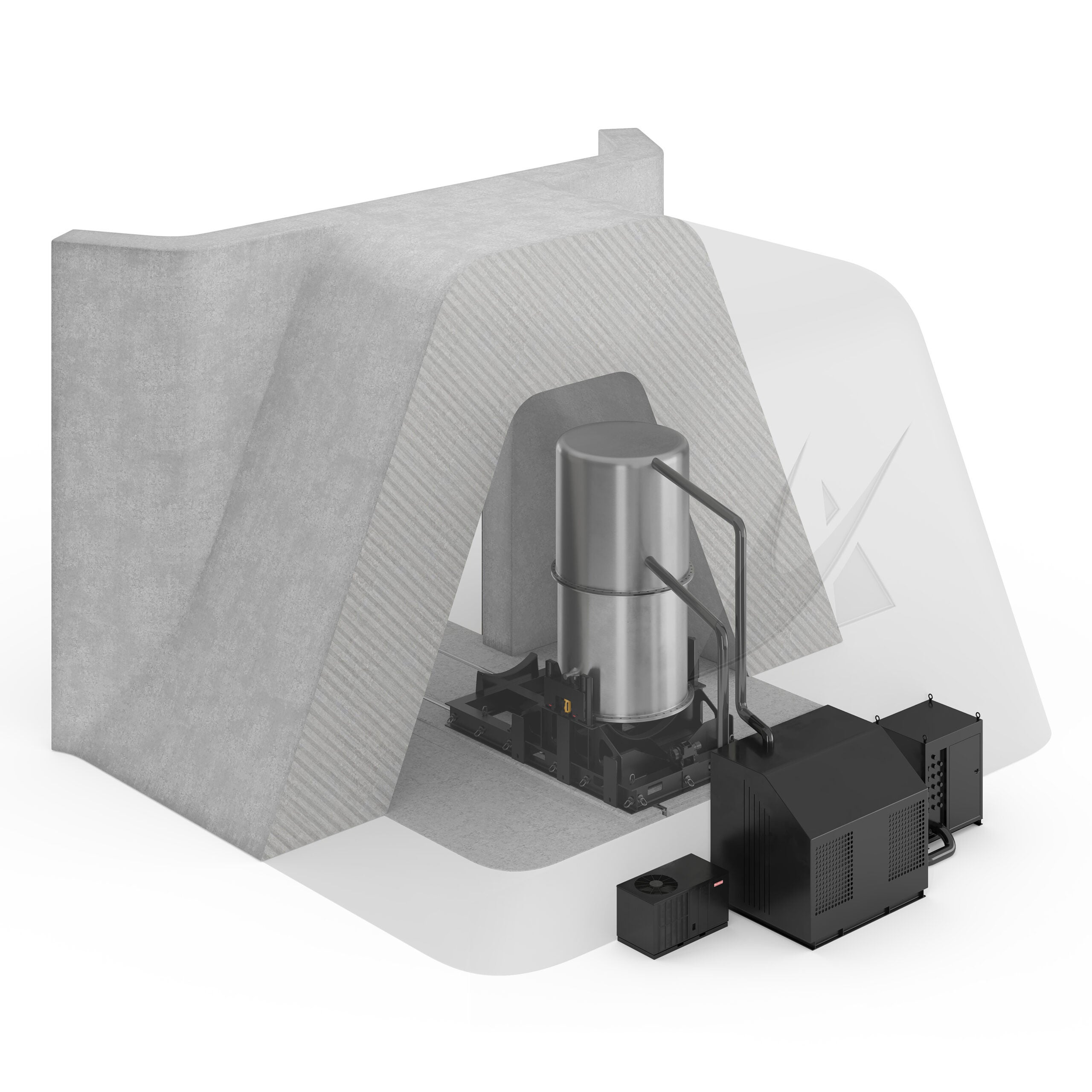
Antares Nuclear Inc.’s Mark-0—a sodium heat-pipe-cooled microreactor fueled by high-assay low-enriched uranium (HALEU) tri-structural isotropic (TRISO) fuel compacts—has achieved zero-power criticality at Idaho National Laboratory’s (INL’s) Reactor and Critical Experiment (RACE) facility, becoming the first advanced reactor to reach that milestone under the Department of Energy’s (DOE’s) Reactor Pilot Program.
The development, announced on June 4, also marks the 53rd reactor built at the INL site since 1951 and the first novel reactor design to achieve criticality at the laboratory in more than 50 years, according to INL Laboratory Director John Wagner. The much-watched DOE Reactor Pilot Program, established under President Trump’s May 2025 Executive Order 14301, directs the DOE to accelerate reactor testing and to target at least three advanced-reactor criticalities by July 4, 2026.
“Criticality is the condition at which a nuclear fission chain reaction becomes self-sustaining,” Wagner explained in a LinkedIn post. “What Antares achieved is specifically zero-power criticality—the chain reaction was sustained at essentially no measurable energy output. This is not electricity generation. It is not full-power operation. It is proof that the system works: the scientific and engineering validation that every subsequent step depends on,” he wrote. “That distinction matters for context. It should not diminish what happened.”
From Startup to Criticality in Two Years
The zero-power criticality milestone marks a significant step for Torrance, California–headquartered Antares, which was founded in 2023 and has raised more than $140 million in private capital, including a $96 million Series B round that closed in December 2025. The company announced Jan. 26 that DOE had approved its Preliminary Documented Safety Analysis for Mark-0, calling the approval a key step toward fabrication, assembly, installation, and operation under the Reactor Pilot Program.
Antares began machining the Mark-0 graphite core on Jan. 12 at its Antares Prime facility, and fuel fabrication for its first reactors has been underway through BWX Technologies since October 2025 using HALEU secured through a DOE allocation. Antares says it holds agreements with the U.S. Air Force, Space Force, NASA, and the Defense Innovation Unit, and is advancing toward initial deployments for defense and space customers in 2028.
“Now that Mark-0 is critical, the real work is just beginning,” said Antares CEO Jordan Bramble in a LinkedIn post on June 4. “I want to reiterate how this fits into our larger roadmap to mature our technology to its commercial potential. This should be obvious, but the goal of a reactor is to sell electricity to customers.”
Following reactor physics experiments, Antares will execute “the next phase of our roadmap—sustained electricity production,” Bramble said. Antares is “able to move fast towards this milestone because we’ve already completed over 6 months of full-power thermal testing in an electrical prototype. We will perform version 2.0 of this in 2026. This is an easier, more iterative way to test, because there is no regulatory process, and you can disassemble to examine material effects.”
He added: “All of our iterative testing sets us up to produce electricity for 6+ months. Hundreds of days, not hundreds of hours. We’re able to test for longer and faster because we’ve designed our reactor around a proven, fully qualified fuel spec developed under Project Pele.”
From Mark-0 to Mark-1 to Power Warfighter in 2028
The Mark-0 is a small, high-temperature, sodium heat-pipe reactor configured specifically for zero-power criticality testing, according to a DOE Idaho Operations Office categorical exclusion determination. Unlike a power-producing prototype, the Mark-0 version, while “not equipped with power conversion or heat removal systems,” is designed to serve as a platform for validating reactor physics, reactivity control behavior, and system-level safety performance in operation, while producing no measurable thermal output.
But Mark-0 is only Antares’ first iterative step. Speaking during a March 31 American Nuclear Society webinar, Antares CEO Jordan Bramble said the first criticality test was “a stepping stone” toward the company’s “North Star” of an electricity-producing prototype reactor. He said the test would provide “a huge validation of the performance of our control systems as well as our reactor physics,” while also testing the company’s DOE authorization pathway, supply chain, fueling approach, and assembly techniques.
The work is crucial to feed development of its commercial product, the R1 microreactor, a modular, transportable unit rated at 100 kWe to 1-MWe, designed to operate for six or more years between refueling without connection to the commercial grid. The R1 is slated to use a TRISO-fueled prismatic graphite core, passive sodium heat pipes for primary heat transport, a fin-and-tube primary heat exchanger, and a simple recuperated nitrogen-closed Brayton cycle for power conversion operating at less than 300 psi. As pivotally, Antares has designed the system to ship in an integrated transport cradle that includes shielding, and to condition electricity through a power management and distribution node designed to connect directly to installation microgrids. Antares suggests the architecture is optimized for reliability, uptime, and manufacturability rather than maximum power density.
The Mark-0 test reactor is installed inside Building MFC-793, the Sodium Components Maintenance Shop at INL’s Materials and Fuels Complex, below grade inside a pit on the east side of the high bay. Given that the Mark-0 is not anticipated to produce thermal energy or power, commissioning was limited to less than six months, the operational phase to less than one month, and decommissioning to less than six months, the DOE filing suggests.
After operations, the DOE said the Mark-0 test reactor will cool on site for 30 to 180 days before defueling. The fuel and moderator blocks are expected to be removed, packaged into standard DOE canisters, and transferred to appropriate storage or disposal locations. The filing, however also notes that Antares plans to retain the HALEU TRISO fuel after Mark-0 activities and to use the same fuel in the Antares R1 Mark-1 reactor, the next iteration.
Mark-1, which Antares plans to operate at the same MFC-793 test facility at INL in 2027, will be a full-power operation integrated with the nitrogen-closed Brayton cycle power conversion system. It will validate temperature-dependent reactor effects, reactivity feedback, and the coupled behavior between the reactor core and the power conversion system. Mark-1, Antares’ “ultimate development milestone,” will effectively be its first full-scale, commercially viable, electricity-producing version of the reactor.
Meanwhile, running in parallel through 2026, Antares is conducting a second campaign of electrically heated demonstration units at its Antares Prime facility in Torrance, California, to incorporate an updated heat pipe design and control system. That non-nuclear testing program, which requires no regulatory process and allows disassembly for material inspection between runs, is likely intended to close out heat pipe, heat exchanger, and power conversion system qualifications and, crucially, to set the technical conditions for electricity production in 2027.
The iterative steps are set to establish a pathway for initial production deployments. In April 2026, the Department of the Air Force and the Defense Innovation Unit selected Antares under the Advanced Nuclear Power for Installations (ANPI) initiative to deploy a prototype microreactor at Joint Base San Antonio. While the INL tests are being executed under a DOE authorization pathway using a dedicated test setup, the ANPI effort involves a separate regulatory track. Antares anticipates siting, licensing, constructing, operating, and decommissioning its R1 microreactors at JBSA, with systems targeted for deployment by 2028 or earlier, subject to environmental review and regulatory approvals.
“Hitting our commitments is everything to us. Nuclear in America has been defined for too long by delays, by companies that said they would and then didn’t,” Bramble said on June 4. “We said criticality in 2026, electricity production in 2027, and power to the warfighter in 2028. Today is the first of those commitments delivered on the schedule we set. The President and DOE set an ambitious timeline for reactor testing, and we met that challenge. I want to thank our partners at the Department of Energy, Idaho National Lab, BWXT, and the U.S. Army. This is what happens when industry and government work together to accomplish big things.”
Fuel Chain: BWXT and Project Pele
The Mark-0 operates on HALEU—uranium enriched to less than 20% U-235—in TRISO fuel compacts, loaded to less than 120 kilograms total for the reactor’s operational life. TRISO particles coat uranium kernels in successive layers of carbon and silicon carbide, which contain fission products under high temperature and irradiation. Most advanced non-light-water designs require HALEU because their neutron physics demand higher enrichment than the roughly 4% U-235 used in conventional light-water reactor fuel.
However, no U.S. commercial enricher currently produces HALEU at commercial scale yet. While Centrus Energy’s 16-machine demonstration cascade in Piketon, Ohio, has produced just over 920 kilograms under a DOE contract—enough for early demonstration work—DOE and the National Nuclear Security Administration (NNSA) will cover the Mark-0’s feedstock requirement by providing government-held scrap material, which BWX Technologies (BWXT) processed at its Specialty Fuels Fabrication facility in Lynchburg, Virginia, and fabricated into finished TRISO compacts.
For longer-term supply, Antares signed what Urenco described as “the world’s first multi-year” commercial HALEU supply contract in May 2026, under which Urenco will supply enrichment services from its Advanced Fuels Facility at Capenhurst in the UK. As POWER reported earlier this week, Urenco’s Advanced Fuels Facility is planned to come online in 2031 at an initial output of up to 27 metric tons per year—enough to supply up to 30 advanced reactors.
Antares, notably, modeled its fuel on TRISO compacts BWXT developed for Project Pele—the U.S. Army’s Strategic Capabilities Office program to build a 1.5-MW transportable microreactor. BWXT said that TRISO fuel specification was developed within DOE’s Advanced Gas Reactor program over several decades and, paired with BWXT’s “decades of TRISO development” in Lynchburg, helped accelerate Antares’ path to criticality.
“BWXT’s TRISO fuel supported our path to criticality,” Bramble confirmed in a press release. “Building on a proven fuel specification developed through Project Pele let our team focus on what we had to prove ourselves: our control system and reactor physics. We’re grateful for a partnership that continues as we move from neutrons to electrons.”
BWX Technologies President and CEO Rex D. Geveden said the milestone underscores the company’s role in advanced fuel fabrication. “Our skilled workforce, advanced manufacturing technologies and nuclear-qualified supply chain are driving a new generation of reactor demonstrations across the country,” he said. Joe Miller, BWXT’s president for Government Operations, added that Antares is “moving quickly to progress from concept to criticality,” and BWX Technologies said it will continue supporting Antares with ongoing TRISO fuel manufacturing as the program advances.
Tracking the Reactor Pilot Program
According to DOE, Antares is the first, but just one of “multiple advanced reactors anticipated to go critical by the July 4 deadline set by President Trump in his May 2025 executive order.” As POWER reported in February, 11 projects from 10 companies selected under the DOE’s Reactor Pilot Program had announced notable progress toward criticality by early 2026. Since then, the field appears to have narrowed to a small group with credible paths to the deadline.
Squarely in the running for a criticality achievement is Valar Atomics, which has been developing the Ward 250, a high-temperature gas reactor rated at 100 kWt initial test power (scalable to 5 MWe) at Utah’s San Rafael Energy Lab with Kiewit Nuclear Solutions as engineering, procurement, and construction contractor.
Valar received preliminary DSA approval in February 2026 and final DSA approval on April 23, which cleared the last design checkmark before the DOE Operational Readiness Review. In November 2025, Valar reported its NOVA Core reached zero-power criticality at Los Alamos National Laboratory’s National Criticality Experiments Research Center in a week-long campaign that produced 10 critical configurations, 26 subcritical tests, and 100 GB of experimental data, including foil activation measurements and helium-3 detector readings used to validate neutronics codes and control rod worth calculations. NOVA’s assembly, however, was a zero-power physics experiment that ran under NNSA oversight at LANL rather than under the DOE Reactor Pilot Program authorization pathway. Unlike NOVA, Valar says its July 4 target is power operations, not zero-power criticality—”a massive leap in capability and complexity,” the company said in May. “In the coming weeks, the Department of Energy will conduct an Operational Readiness Review, auditing our policies and procedures to ensure that we are ready to make power in America’s first Gen IV power reactor.”
Aalo Atomics completed construction of its Critical Test Reactor—dubbed “Project First Light”—at INL and received DOE-Idaho DSA approval on April 30, advancing into the DOE-led Operational Readiness Review—the final pre-operations phase in which DOE verifies that the people, facility, and programs are cleared to operate as documented. The Critical Test Reactor is a sodium-cooled, UO2-fueled thermal-spectrum reactor limited to below 20 MWth under DOE authorization, engineered to reflect the complexity and function of the commercial Aalo-1. Its fuel load is sufficient for 10 MWe. Startup will validate the nuclear core, control rod system, sodium behavior under thermal loads, and instrumentation systems that are direct analogs of what will operate in the full-power Aalo-X demonstration reactor being built on the same INL parcel. Aalo says the DSA process “laid the foundation for regulatory success during commercial scaleup” toward fleet deployment of Aalo-1 microreactors for AI data centers. Following zero-power criticality, Aalo plans to progressively add functionality through the second half of 2026, with full-power demonstration targeted in the Project Ascension phase.
Radiant Nuclear took possession of INL’s DOME facility—the repurposed Experimental Breeder Reactor-II containment structure, capable of handling up to 20 MWth—on April 1, 2026, for a one-year fueled test campaign. DOE approved Radiant’s Authorization Request for Kaleidos (DARK)—the second of three safety submittals in DOE’s authorization pathway, designed to meet the intent of a preliminary DSA—in February 2026, the first full-power test approval granted under the program. Radiant’s Kaleidos Demonstration Unit is a 1-MWe helium-cooled, TRISO-fueled high-temperature gas reactor packaged in a single shipping container, designed for deployment without refueling for years. Radiant’s test plan targets at least 150 continuous full-power hours without operator intervention, followed by 60 effective full-power days. On the commercial side, along with Antares, the Air Force selected Radiant to deliver Kaleidos reactors to Buckley Space Force Base to support critical national security and intelligence missions. The NRC accepted Radiant’s 10 CFR Part 70 license application for its R-50 factory in Oak Ridge, Tennessee, in May 2026, targeting a December 2026 review completion. The factory, notably, is designed to produce 50 reactors per year ahead of first commercial deliveries in 2028.
Oklo is pursuing two separate Reactor Pilot Program assets on different timelines. On the nearer-term track, Oklo’s subsidiary Atomic Alchemy signed the Groves Other Transaction Agreement (OTA) in January 2026 and received Nuclear Safety Design Agreement (NSDA) approval on March 17—the OTA being the contractual vehicle through which DOE authorizes a company to begin the safety basis development process, and the NSDA being the first formal design approval under that pathway. The Groves isotope test reactor in Lockhart, Texas, reached construction substantial completion in 229 days from greenfield. According to the company’s Q1 2026 earnings call on May 12, the PDSA was in review and the DSA had been submitted, with July 4 criticality as the stated target.
Separately, Oklo reported it had also signed the Aurora-INL OTA, received an NSDA, and a PSDA was in review. “The next milestones are approval of the documented safety analysis, completion of the readiness review and start-up approval,” said Oklo CEO Jacob Dewitte. “The DOE pathway allows us to continue advancing construction, procurement and system integration, while the project moves through authorization. At the same time, and as we have noted in previous updates, we continue to work with the NRC in parallel as demonstrated by the NRC’s approval of the principal design criteria topical report for the Aurora INL.”
To retain the Reactor Pilot Program’s momentum and establish a successor initiative, the DOE established the Nuclear Energy Launch Pad in March 2026. The Launch Pad extends the DOE authorization pathway to projects beyond the initial program cohort, such as those at other DOE sites, national laboratories, and non-federal locations. The Launch Pad now also covers reactors, fuel fabrication, recycling, and enrichment infrastructure. The DOE named its first four Launch Pad developers on April 27: Deployable Energy, General Matter, NuCube Energy in partnership with Idaho State University, and Radiant Nuclear.
While much more is clearly on the horizon, Antares’ news was widely shared and celebrated. “It is fitting that on the eve of our nation’s 250th anniversary, we are witnessing a historic moment for American energy,” U.S. Energy Secretary Chris Wright said. “For the first time in more than four decades, a new privately developed non-light-water reactor has reached criticality in the U.S.”
“The skeptics didn’t believe President Trump’s Reactor Pilot Program could achieve criticality in less than a year,” noted Assistant Secretary of Nuclear Energy Ted Garrish. “Today, we celebrate the first of the pilot projects to reach criticality and the people who rolled up their sleeves to shape the future of nuclear energy in the U.S.”
—Sonal Patel is a POWER senior editor (@sonalcpatel, @POWERmagazine).
Facts Only
Antares Nuclear Inc. achieved zero-power criticality with its Mark-0 microreactor at Idaho National Laboratory’s (INL) Reactor and Critical Experiment (RACE) facility on June 4.
The Mark-0 is a sodium heat-pipe-cooled reactor fueled by high-assay low-enriched uranium (HALEU) TRISO fuel compacts.
This milestone is the first under the DOE’s Reactor Pilot Program, established by Executive Order 14301 in May 2025.
The Mark-0 is the 53rd reactor built at INL since 1951 and the first novel reactor design to achieve criticality at the laboratory in over 50 years.
Antares, founded in 2023, has raised over $140 million in private capital, including a $96 million Series B round in December 2025.
The DOE approved Antares’ Preliminary Documented Safety Analysis for Mark-0 on January 26, 2026.
BWX Technologies fabricated the HALEU TRISO fuel for Mark-0, using government-held scrap material processed at its Lynchburg, Virginia facility.
Antares plans to use the same fuel in its next iteration, the Mark-1 reactor, slated for full-power testing at INL in 2027.
The Mark-1 will integrate a nitrogen-closed Brayton cycle power conversion system to validate temperature-dependent reactor effects and power production.
Antares has agreements with the U.S. Air Force, Space Force, NASA, and the Defense Innovation Unit, targeting initial deployments for defense and space customers in 2028.
The DOE’s Reactor Pilot Program aims to achieve at least three advanced reactor criticalities by July 4, 2026.
Other companies in the program, such as Valar Atomics, Aalo Atomics, Radiant Nuclear, and Oklo, are progressing toward criticality and power operations with varying timelines.
The DOE established the Nuclear Energy Launch Pad in March 2026 to extend support for advanced nuclear projects beyond the initial program cohort.
Executive Summary
Antares Nuclear Inc. has achieved zero-power criticality with its Mark-0 microreactor at Idaho National Laboratory (INL), marking the first advanced reactor to reach this milestone under the Department of Energy’s (DOE) Reactor Pilot Program. The Mark-0, a sodium heat-pipe-cooled reactor fueled by high-assay low-enriched uranium (HALEU) TRISO fuel, is a non-power-producing prototype designed to validate reactor physics and safety systems. This achievement is part of a broader DOE initiative to accelerate advanced reactor testing, with a goal of at least three criticalities by July 4, 2026. Antares, founded in 2023, has raised over $140 million in private capital and is advancing toward commercial deployments for defense and space applications by 2028. The company plans to follow this milestone with sustained electricity production tests in 2027, leveraging iterative testing and partnerships with BWX Technologies for fuel fabrication. Other companies, including Valar Atomics, Aalo Atomics, Radiant Nuclear, and Oklo, are also progressing under the Reactor Pilot Program, with varying timelines for criticality and power operations. The DOE has expanded support for advanced nuclear projects through the Nuclear Energy Launch Pad, aiming to sustain momentum beyond the initial program cohort.
The Mark-0’s success reflects a collaborative effort between private industry and government, with Antares emphasizing rapid development and regulatory compliance. While the achievement is significant, it represents an early step in a longer process toward commercial viability. The broader context includes challenges in HALEU fuel supply, regulatory pathways, and the need for sustained testing to demonstrate reliability and safety. The DOE’s Reactor Pilot Program and subsequent initiatives highlight a strategic push to revitalize U.S. nuclear innovation, with implications for energy security, defense applications, and commercial energy markets.
Full Take
The achievement of zero-power criticality by Antares Nuclear Inc.’s Mark-0 reactor is a significant technical milestone, but it also reflects broader patterns in the resurgence of nuclear innovation in the U.S. The strongest version of this narrative highlights a successful public-private partnership, rapid development timelines, and a strategic push to revitalize advanced reactor technology. Antares’ progress is notable for its speed—achieving criticality in just over two years—and its iterative testing approach, which prioritizes learning and validation over immediate commercial deployment. The DOE’s Reactor Pilot Program, framed as a response to executive mandates, underscores a policy shift toward accelerating nuclear energy development, with implications for energy security, defense applications, and commercial markets.
However, the narrative also invites scrutiny of the underlying assumptions and potential manipulation patterns. The emphasis on speed and milestones could risk overshadowing the complexities of nuclear safety, regulatory compliance, and long-term viability. For instance, the use of government-held HALEU scrap material for Mark-0’s fuel raises questions about scalability and supply chain dependencies, given that commercial HALEU production is not yet operational. Additionally, the framing of this achievement as a "historic moment" might be seen as an appeal to authority or novelty, potentially downplaying the challenges ahead, such as sustained power production and commercial deployment. The parallel regulatory tracks for defense and commercial applications further complicate the landscape, as different standards and timelines may apply.
The root cause of this narrative appears to be a convergence of technological ambition, national security priorities, and energy policy goals. The DOE’s Reactor Pilot Program and subsequent initiatives reflect a paradigm shift toward faster, more flexible nuclear development, but they also echo historical patterns of government-driven innovation in energy and defense sectors. The implications for human agency and dignity are mixed: while advanced reactors could provide reliable, low-carbon energy, the focus on defense applications and rapid deployment raises questions about transparency, public engagement, and the distribution of risks and benefits.
Bridge questions to consider: What are the trade-offs between speed and safety in nuclear reactor development? How might the dual-use nature of these technologies (civilian and defense) shape their regulatory and ethical frameworks? What perspectives are missing from the current discourse, particularly regarding community impacts and long-term waste management?
Counterstrike scan: If this narrative were part of a coordinated influence campaign, the playbook might emphasize technological nationalism, urgency, and the framing of nuclear energy as a solution to energy security and climate challenges. The actual content aligns with this pattern to some extent, particularly in its focus on milestones and government-industry collaboration. However, the inclusion of technical details, regulatory processes, and multiple company perspectives suggests a more balanced presentation. No overt manipulation patterns are detected, but the framing of "historic" achievements warrants critical attention to avoid overclaiming.
Patterns detected: none