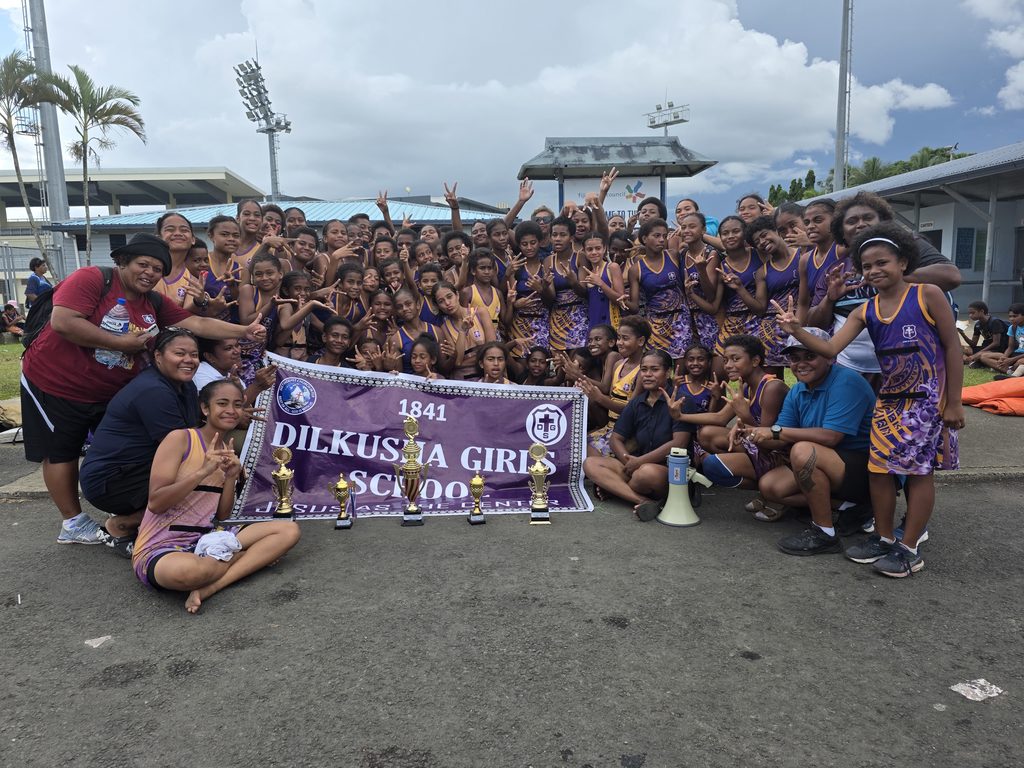
Dilkusha Girls School (DGS) was crowned the overall winners of the Tailevu South Primary Schools Netball Association zone meet, which concluded yesterday at the National Netball Centre in Suva.
The school competed strongly over the three-day tournament fielding two teams in each grade from under 9 to under 14, thanks to their large student population and strong netball culture.
Assistant head teacher Tarusila Tawake expressed pride in the students’ achievements, highlighting the school’s depth and skill across age groups.
“Over the three days, we have been competing well against all the 16 schools in Tailevu South. We managed to come up with two titles, which are U11 and U12, and runners-up for U10 and U11. So that is basically our achievement for these three days,” she said.
Looking ahead to the next stage of competition, Tawake shared that several students have progressed to the trials to represent Tailevu South at the national meet in Labasa on week 14 of term 1.
“When they called out the names, we have an average of five to six girls for each grade that will attend the trials. They have picked 20 to 25 students for each grades to attend the trials, and they will cut that list down to 12 for the national meet,” she said.
DGS has long been recognised as a dominant force in the zone..
“We always live by the motto of our school. The motto is ‘Jesus as the centre’.
“So, everything we do, we always put Jesus first. We also have very good students with abilities and capabilities in netball,” she said.
“Some learn these skills from an early age, others join clubs, and when they come to our school, being an all-girls school, netball is the dominant sport we play.”
Beyond the court, Tawake emphasised the holistic benefits of sport for the girls.
“When we teach them about sports, we’re not only teaching physical abilities. Sports come with discipline, time management, and balancing extracurricular activities with schoolwork,” she explained
“We have seen girls who leave school achieving well academically because we give them the chance to play. When we give them the freedom and space to showcase their skills, they also become disciplined academically.”
The school’s strong performance at the Tailevu South Netball competition underscores their dedication to fostering both sporting excellence and academic achievement among their students.
Facts Only
Dilkusha Girls School (DGS) won the overall title at the Tailevu South Primary Schools Netball Association zone meet.
The tournament took place over three days at the National Netball Centre in Suva.
DGS fielded two teams in each grade from under 9 to under 14.
The school secured titles in the U11 and U12 categories.
DGS was runners-up in the U10 and U11 categories.
Sixteen schools from Tailevu South participated in the competition.
Assistant head teacher Tarusila Tawake expressed pride in the students’ achievements.
Several DGS students advanced to trials for the national meet in Labasa.
The school’s motto is "Jesus as the centre."
DGS emphasizes discipline, time management, and academic balance through sports.
The school is recognized as a dominant force in the zone.
Netball is the dominant sport at DGS due to its all-girls environment.
Executive Summary
Dilkusha Girls School (DGS) emerged as the overall winner of the Tailevu South Primary Schools Netball Association zone meet, held over three days at the National Netball Centre in Suva. The school fielded two teams in each grade from under 9 to under 14, showcasing its strong netball culture and large student population. DGS secured titles in the U11 and U12 categories and achieved runners-up positions in U10 and U11. Assistant head teacher Tarusila Tawake highlighted the school’s consistent performance, noting that several students have advanced to trials for the national meet in Labasa. The school attributes its success to a holistic approach, emphasizing discipline, time management, and academic balance alongside sporting excellence. DGS’s motto, "Jesus as the centre," underscores its values-driven approach, with netball serving as a key extracurricular activity that fosters both athletic and academic achievement.
The competition involved 16 schools from Tailevu South, with DGS standing out due to its depth of talent and structured development of players, many of whom join clubs or develop skills from an early age. The school’s all-girls environment further reinforces netball as a dominant sport. Beyond the court, DGS emphasizes the broader benefits of sports, including discipline and academic performance, with Tawake noting that students who engage in sports often excel academically as well. The school’s success reflects its commitment to nurturing well-rounded students, blending sporting prowess with educational rigor.
Full Take
The narrative presents Dilkusha Girls School’s netball success as a product of its strong institutional culture, disciplined approach, and values-driven education. The strongest version of this story highlights how structured extracurricular programs can foster both athletic and academic excellence, particularly in single-gender environments where sports like netball become central to student development. The emphasis on holistic growth—discipline, time management, and academic performance—aligns with broader educational philosophies that advocate for balanced student development.
However, the pattern scan reveals a subtle appeal to authority and institutional prestige. The repeated references to DGS’s dominance and its motto ("Jesus as the centre") could be interpreted as a form of borrowed credibility, where the school’s success is framed as inherently virtuous due to its religious and cultural values. While this may resonate with stakeholders who share those values, it risks overshadowing the tangible factors behind the success—such as coaching quality, student recruitment, or resource allocation. Additionally, the narrative leans on anecdotal evidence (e.g., students excelling academically due to sports) without broader data, which could be seen as a form of selective framing.
The root cause of this narrative appears to be a celebration of institutional identity and the belief that structured extracurricular activities can drive broader student success. The unstated assumption is that DGS’s model is replicable or inherently superior, which may not account for contextual factors like socioeconomic advantages or community support. Historically, this echoes patterns where elite institutions attribute success to internal culture rather than external privileges.
For human agency and dignity, the implications are mixed. On one hand, the story empowers students by showcasing their achievements and the school’s investment in their growth. On the other, it risks reinforcing a narrative where success is tied to institutional affiliation rather than individual effort or systemic support. Second-order consequences could include increased pressure on other schools to adopt similar models without the same resources, potentially widening disparities.
Bridge questions to consider: How much of DGS’s success is due to its culture versus material advantages like facilities or funding? What perspectives from other schools in the zone might challenge this narrative? Would the same model work in coeducational or less resourced environments?
Counterstrike scan: If this were part of a coordinated influence campaign, the playbook might involve amplifying institutional prestige to attract funding or students, while downplaying structural advantages. However, the content does not exhibit overt manipulation—it remains a straightforward celebration of achievement. No concerning alignment with hypothetical attack patterns is detected.
Sentinel — Human
The article shows strong indicators of human authorship, with natural language variation, direct quotes, and personal voice. No significant signs of synthetic generation were detected.