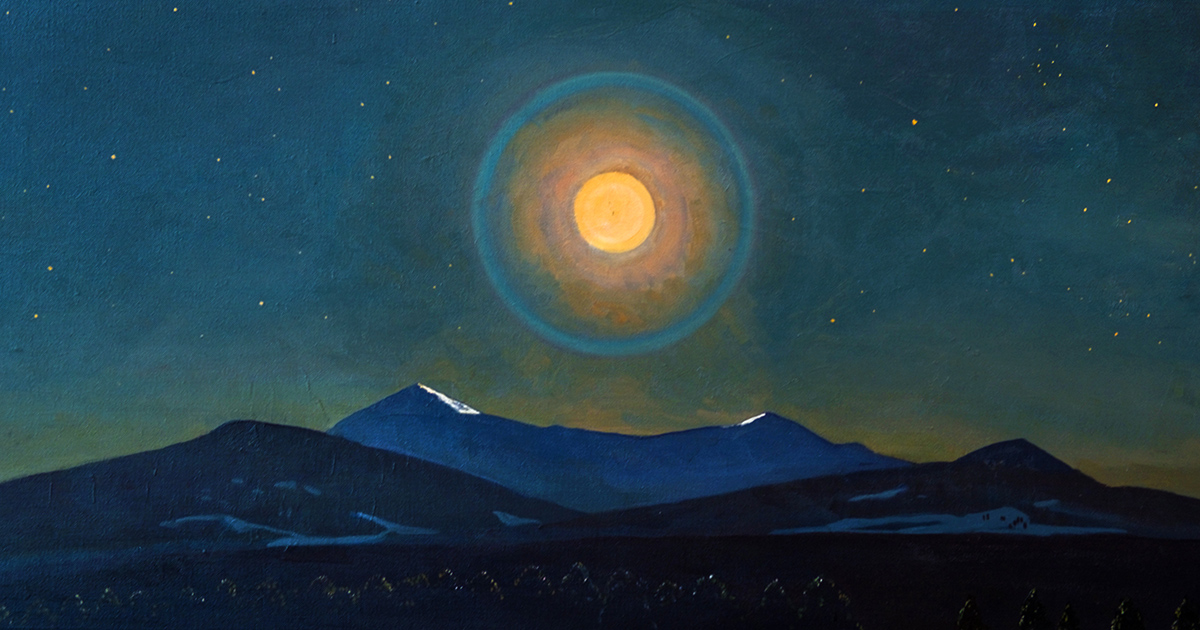
By Maria Popova
Every night, for every human being that ever was and ever will be, the Moon rises to remind us how improbably lucky we are, each of its craters a monument of the odds we prevailed against to exist, a reliquary of the violent collisions that forged our rocky planet lush with life and tore from its body our only satellite with its miraculous proportions that render randomness too small a word — exactly 400 times smaller than the Sun and exactly 400 times closer to Earth, so that each time it passes between the two, the Moon covers the face of our star perfectly, thrusting us into midday night: the rare wonder of a total solar eclipse.
It is impossible to know this and not see the miraculous in its nightly light.
Moonlight transforms the landscapes of daytime, dusts them with the numinous.
“The sky was a strange royal-blue with all but the brightest stars quenched, while on either side the mountains were transformed into silver barricades, as their quartz surfaces reflected the moonlight,” Dervla Murphy wrote in Pakistan.
“We found many pleasures for the eye and the intellect… in the play of intense silvery moonlight over the mountainous seas of ice,” Frederick Cook wrote in Antarctica.
“All the bay is flooded with moonlight and in that pale glow the snowy mountains appear whiter than snow itself,” Rockwell Kent wrote in Alaska.
I remember being small and lonely, those infinite summers in the mountains of Bulgaria, waiting for nightfall, waiting for the Moon to cast its soft light upon the sharp edges of tomorrow and give the bygone day something of the eternal.
Moonlight transforms the landscapes of the soul: It transported Leonard Cohen to where the good songs come from; Sylvia Plath found in it a haunting lens on the darkness of the mind; for Toni Morrison, loving moonlight was a measure of freedom; for Virginia Woolf, it was a magnifying lens for love as she beckoned her lover Vita to “dine on the river together and walk in the garden in the moonlight.”
I have encountered no more beautiful account of this dual transformation than a passage from Watership Down (public library) — the marvelous 1973 novel that began with a story Richard Adams dreamt up to entertain his two young daughters on a long car journey. Nested midway through his allegorical adventure tale of rabbits is Adams’s serenade to moonlight:
The full moon, well risen in a cloudless eastern sky, covered the high solitude with its light. We are not conscious of daylight as that which displaces darkness. Daylight, even when the sun is clear of clouds, seems to us simply the natural condition of the earth and air… We take daylight for granted. But moonlight is another matter. It is inconstant. The full moon wanes and returns again. Clouds may obscure it to an extent to which they cannot obscure daylight.
Adams exults in moonlight as one of those unbidden graces that give ordinary life a “singular and marvelous quality” — a grace that didn’t have to exist and is in this sense unnecessary, like many of the loveliest things in life, which C.S. Lewis captured in asserting that “friendship is unnecessary, like philosophy, like art, like the universe itself [and] has no survival value; rather it is one of those things which give value to survival.”
A century after Walt Whitman exulted that the Moon “commends herself to the matter-of-fact people by her usefulness, and makes her uselessness adored by poets, artists, and all lovers in all lands,” Adams writes:
Water is necessary to us, but a waterfall is not. Where it is to be found it is something extra, a beautiful ornament. We need daylight and to that extent it is utilitarian, but moonlight we do not need. When it comes, it serves no necessity. It transforms. It falls upon the banks and the grass, separating one long blade from another; turning a drift of brown, frosted leaves from a single heap to innumerable flashing fragments; or glimmering lengthways along wet twigs as though light itself were ductile. Its long beams pour, white and sharp, between the trunks of trees, their clarity fading as they recede into the powdery, misty distance of beech woods at night. In moonlight, two acres of coarse bent grass, undulant and ankle deep, tumbled and rough as a horse’s mane, appear like a bay of waves, all shadowy troughs and hollows. The growth is so thick and matted that even the wind does not move it, but it is the moonlight that seems to confer stillness upon it. We do not take moonlight for granted. It is like snow, or like the dew on a July morning. It does not reveal but changes what it covers.
These passages from Watership Down reminded me of a kindred reverie Aldous Huxley composed half a century before Adams in his music-inspired meditation on the universe and our place in it, contemplating the Moon as a mirror not of the Sun but of the soul. In a splendid counterpart to Paul Goodman’s spiritual taxonomy of silence, Huxley offers a spiritual taxonomy of moonlight:
The moon is a stone; but it is a highly numinous stone. Or, to be more precise, it is a stone about which and because of which men and women have numinous feelings. Thus, there is a soft moonlight that can give us the peace that passes understanding. There is a moonlight that inspires a kind of awe. There is a cold and austere moonlight that tells the soul of its loneliness and desperate isolation, its insignificance or its uncleanness. There is an amorous moonlight prompting to love — to love not only for an individual but sometimes even for the whole universe.
Complement with the story of the first surviving photograph of the Moon, which changed our relationship to the universe, then savor this lovely picture-book about the Moon.
—
Published May 24, 2026
—
https://www.themarginalian.org/2026/05/24/moonlight/
—
ABOUT
CONTACT
SUPPORT
SUBSCRIBE
Newsletter
RSS
CONNECT
Facebook
Twitter
Instagram
Tumblr
Facts Only
* The Moon is 400 times smaller than the Sun and 400 times closer to Earth.
* Moonlight transforms landscapes, turning surfaces into silver reflections.
* Dervla Murphy noted mountains were transformed into silver barricades by moonlight.
* Frederick Cook noted pleasures in the play of intense silvery moonlight over mountainous seas of ice.
* Rockwell Kent noted that moonlight made snowy mountains appear whiter than snow itself.
* The full moon was described as covering high solitude.
* The author remembers waiting for nightfall to cast soft light upon sharp edges.
* The text cites literary references by Leonard Cohen, Sylvia Plath, Toni Morrison, and Virginia Woolf regarding moonlight's effect on the mind and love.
* The novel Watership Down features a passage exalting moonlight as an unbidden grace.
* The Moon is described as a highly numinous stone that inspires various emotional states (peace, awe, loneliness, love).
Executive Summary
Full Take
Sentinel — Human
The text demonstrates a highly personal, lyrical, and idiosyncratic style, strongly suggesting human authorship focused on contemplative reflection rather than pure informational delivery.