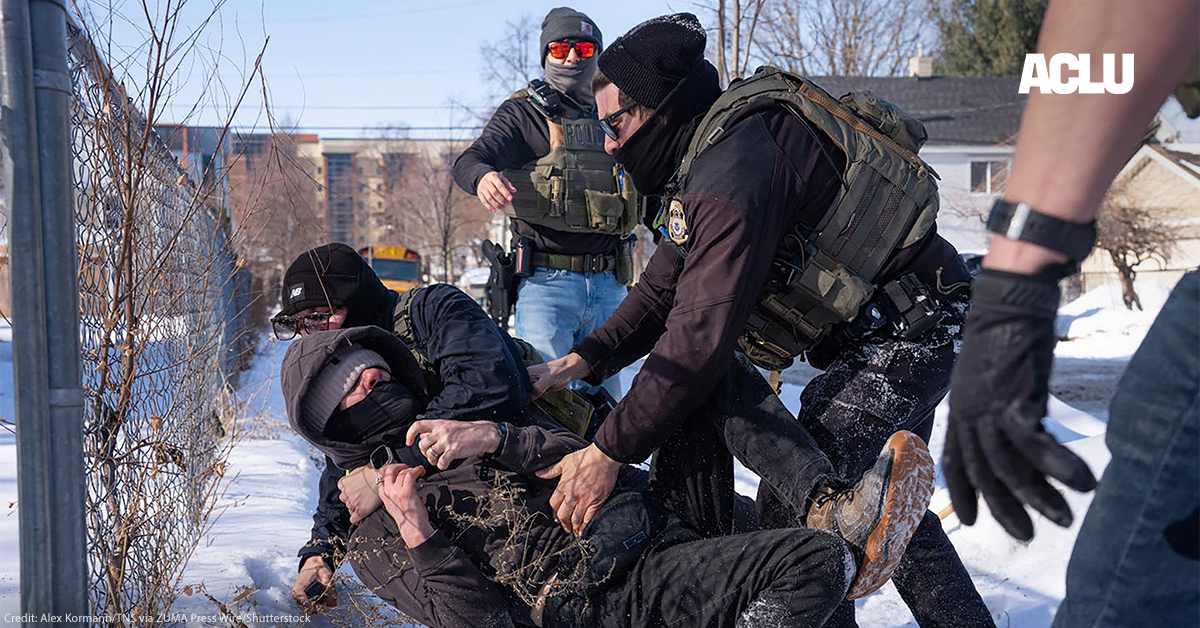
Teyana Gibson Brown was home with her husband, 9-year-old daughter, and 11-year-old cousin in January when ten masked and heavily-armed federal agents stormed into her house. The federal agents smashed through her front door with a battering ram. They pointed their rifles at Teyana and her family members as she stood in the doorway repeatedly demanding a warrant. The federal agents never provided any judicial warrant. After they flooded into her home, they pushed her to the ground.
Keep Our Communities Safe: Hold Federal Agents Accountable | American Civil Liberties Union
Teyana’s story is part of a growing pattern of unchecked abuse from federal law enforcement that has devastated families and communities across the country. From Maine to California, federal agents have masked up, demanded to see people’s papers, scanned their faces, and taken people off the street in explicit acts of racial profiling. People who record federal agents, peacefully protest, offer mutual aid in their communities, or even pray in front of ICE facilities are being sprayed directly in the face with tear gas and pepper spray, shot with pepper balls, subjected to invasive surveillance equipment, and harassed and followed home by agents.
The Trump administration has fueled this abuse by insisting that federal agents operate with "absolute immunity." The killings of Renee Good, Alex Pretti, Ruben Ray Martinez, Keith Porter Jr, and countless others show the devastating and predictable consequences of Trump’s reckless immigration agenda.
Congress should listen to the American people, who overwhelmingly believe that federal agents should be subject to the same constitutional limits as everyone else. Ninety-three percent of voters across ideological lines agree that no one — including federal agents — should be above the law and that government officials who violate people’s rights must be held accountable.
The ACLU, joined by leaders from affiliates across the country, were on Capitol Hill this week for the ACLU’s third annual Community Safety Week, urging members of Congress to pass legislation that will restore pathways to accountability when federal law enforcement violates our rights. When government officials abuse their power, there must be a clear way for people to seek justice.
Crucial Legislation Can Open Doors for Victims of Rights Violations
Right now, civil rights laws leave little room for people to hold federal officers accountable when their constitutional rights are violated. Congress has the power to change that. The ACLU and its partners are urging lawmakers to pass two pieces of legislation: the Bivens Act and the Constitutional Accountability Act.
Currently, there is often no clear pathway to sue federal officers for constitutional violations. The Supreme Court once upheld people's right to hold federal officers accountable in court — but has steadily dismantled that right, decision by decision. For many victims of federal misconduct, the courthouse door is simply shut.
Abuse by federal law enforcement has become all too common under the Trump administration, but the accountability gap that enables them has existed for decades. Take Cathy George, for example, who joined us on the Hill this week with her lawyers at the Institute for Justice. In 2023, federal officers violently raided Cathy’s home in search of a man who had no connection to her whatsoever. Cathy was asleep and alone with her small dog when officers came storming in. As she opened her bedroom door, she found herself covered in lights from laser-equipped firearms pointed at her body. Officers grabbed her and pulled her into the hallway. They held her there — cold, exposed, confused, and terrified — while more officers ransacked her home. After they realized their mistake, the entire team quickly left, leaving behind a home turned upside down and a deeply shaken resident. They did not show her a warrant or give her any explanation of what had gone wrong.
When abuse goes unchecked, reckless and aggressive conduct becomes more likely. It creates a culture in agencies where public officials may feel empowered to violate people’s rights, knowing they will face few – if any – consequences.
The Bivens Act and Constitutional Accountability Act would create meaningful pathways for people to seek justice when federal law enforcement violates their constitutional rights. Specifically, they would allow people to take federal officers and federal agencies to court when they violate our rights. For families like Teyana Gibson Brown’s and Cathy George’s, these barriers are not abstract legal debates: they determine whether people harmed by federal agents can have their day in court.
Congress Must Act Amid Trump Administration’s Continued Push for Immigration Enforcement Funding and Reckless Policing
Throughout Community Safety Week, the ACLU made that clear to lawmakers. At a congressional briefing, we shared firsthand stories of abuse with lawmakers to show the need for reforms that protect constitutional rights and public safety. Additionally, ACLU affiliates met with lawmakers about the need for reforms.
The stakes right now could not be higher. At the same time that we were meeting with lawmakers, President Trump and his Congressional allies were pushing a reconciliation bill that would fund ICE and Border Patrol without any reforms, any accountability, or any guardrails. This would give ICE and Border Patrol $70 billion in additional funding, on top of the $170 billion in immigration enforcement they received last summer.
Congress must decide whether it will continue enabling unchecked abuses or finally put meaningful limits on federal police power. Passing the Bivens Act and the Constitutional Accountability Act would restore a measure of accountability, strengthen constitutional protections, and help ensure that people harmed by federal agents are not denied justice before they even step into a courtroom.
Facts Only
Teyana Gibson Brown’s home was raided by ten masked federal agents in January; agents used a battering ram, pointed rifles at her family, and pushed her to the ground without presenting a warrant.
Federal agents have conducted operations involving racial profiling, invasive surveillance, and harassment of individuals recording protests or offering community aid.
The Trump administration has advocated for "absolute immunity" for federal agents, contributing to a culture of unchecked enforcement.
The ACLU and partners are urging Congress to pass the Bivens Act and the Constitutional Accountability Act to allow lawsuits against federal officers for constitutional violations.
Cathy George’s home was raided in 2023 by federal officers searching for an unrelated individual; officers pointed firearms at her, detained her, and left without explanation or a warrant.
The Supreme Court has progressively limited the ability to sue federal officers for misconduct, leaving many victims without legal recourse.
The Trump administration and Congressional allies are pushing a reconciliation bill to provide $70 billion in additional funding to ICE and Border Patrol without accountability measures.
The ACLU hosted Community Safety Week on Capitol Hill, presenting firsthand accounts of federal abuse to lawmakers.
Polling shows 93% of voters across ideological lines believe federal agents should not be above the law.
The ACLU argues that unchecked federal enforcement creates a culture where rights violations go unpunished.
Executive Summary
Full Take
The ACLU’s narrative presents a compelling case for federal accountability, grounded in vivid personal testimonies and a clear legal argument. The strongest version of this narrative highlights systemic failures—Supreme Court rulings eroding accountability, Trump-era policies emboldening aggressive enforcement, and a lack of congressional oversight—while proposing concrete legislative solutions. The emotional weight of stories like Teyana Gibson Brown’s and Cathy George’s serves to humanize abstract legal debates, making the call for reform urgent and relatable.
However, the framing risks oversimplifying complex legal and political dynamics. The focus on the Trump administration, while justified by policy shifts, could obscure bipartisan contributions to federal enforcement overreach. Additionally, the emphasis on legislative fixes assumes Congress’s willingness to act, which may not align with political realities. The appeal to a 93% voter consensus, while powerful, could be seen as an appeal to popularity rather than a nuanced legal argument.
Root cause analysis suggests this narrative reflects a broader tension between national security imperatives and civil liberties, a paradigm that predates Trump but has been amplified by his administration’s rhetoric. The implications extend beyond individual cases: unchecked federal power erodes public trust in institutions and normalizes rights violations, particularly in marginalized communities. Second-order consequences could include increased polarization over law enforcement’s role and a chilling effect on civic engagement.
Bridge questions: How might accountability mechanisms balance the need for effective law enforcement with constitutional protections? What historical precedents exist for successfully reforming federal enforcement without compromising public safety? Would alternative oversight structures, such as independent review boards, be more effective than litigation-based approaches?
Counterstrike scan: If this were part of a coordinated campaign, the playbook might involve amplifying emotional testimonies to galvanize public support while framing opponents as defenders of unaccountable power. The actual content aligns with this strategy but does not cross into manipulation, as the ACLU’s advocacy is consistent with its long-standing mission. No structural alignment with bad-faith tactics is detected.
Patterns detected: none
Sentinel — Human
This text is strongly grounded in specific, emotionally resonant examples and functions as a human-driven advocacy piece focused on legislative action and accountability.