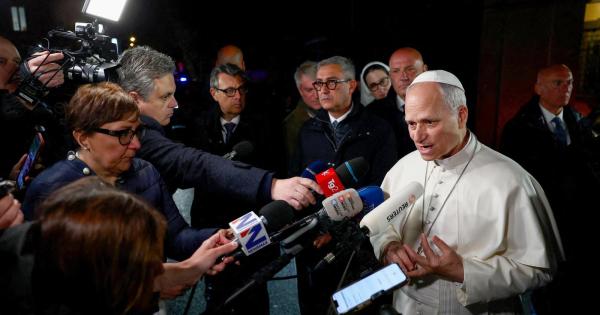
Pope Leo XIV’s encyclical Magnificas humanitas is about more than artificial intelligence, in the same way that Pope Francis’ Laudato si’ was about more than the environment and Pope Leo XIII’s Rerum novarum—the foundational document of modern Catholic social teaching—was about more than labor and work. The newest missive may be “On Safeguarding the Human Person in the Time of Artificial Intelligence,” but it also touches on war and peace, the role of education, truth and democracy, new and old forms of slavery, and the need for multilateralism. The forty-five-thousand-word document also deftly traces the history and highlights of Catholic social teaching, which the pope reminds us is “doctrine.”
Like several previous papal encyclicals, Magnificas humanitas is addressed to “all the Catholic faithful, to all Christians and to all men and women of goodwill,” and its relevant topic is likely to catch the attention of even those unfamiliar with the term “encyclical.” The timing couldn’t be better, especially in the United States, where so many are frustrated and discouraged by political, economic, and social systems that favor the few and leave too many behind. In a culture where profit and productivity are valued over people, Leo writes about the grandeur and magnificence of the human person and insists that technology must serve people, not the other way around.
It is a hopeful, helpful message from an institution with wisdom to share at a time when some of the scariest science-fiction stories of generations past are about to come true. And it is a positive move for the Church, engaging with science and scientists rather than pontificating from on high (as it has when it comes to, say, sexuality). The release of the document on Memorial Day came with a press conference that included, for the first time, remarks from the pope himself, as well as some slick videos and infographics.
Magnifica humanitas deserves the widest possible reading and consideration. Leo’s call to “disarm” AI is not just directed at the powerful heads of industry and government, although it has a specific charge for them to practice restraint and collaborate on regulation. The encyclical also challenges the consciences of all people to resist technology’s dehumanization and preserve what makes humans unique. Its success in reaching those consciences will depend, in part, on the Church’s broader credibility.
Leo acknowledges this in a section titled “An examen for the Church,” at the conclusion to the chapter on social doctrine, in which he poses these questions: Does the Church work for the common good? Does it practice solidarity and subsidiarity? Does it share “ecclesial goods” and live out social justice, “purifying ecclesial relationships and structures from distortions that give rise to inequality, lack of transparency and abuse of power”? Only when the Church applies these principles in its own structures, the pope writes, will it “be able to bear credible witness to society.”
Can the Church bear a credible witness on technology, on just war, on what it means to be human? No other earthly institution is better positioned to lead this charge, I would argue, yet it is hampered by its own “structures that give rise to inequality, lack of transparency and abuse of power,” which Leo himself admits can hinder openness to and acceptance of its teaching. If the Church itself does not recognize the full humanity of half its own members—by insisting, for example, that they cannot image Christ because of their gender—how can it expect Silicon Valley and heads of state to respect its sermon on human dignity?
Just days before Magnifica humanitas was released, Catholics gathered to mark a half century of working for equality for women in the Church at the Women’s Ordination Conference’s fiftieth anniversary gathering. Longtime activists celebrated successes attained in the past decade or so, but also had to acknowledge that after fifty years, they are no closer to having women priests than they were in the 1970s. Restoration of the female diaconate also seems to have stalled, despite much discussion and advocacy from Catholics across the globe during the recent Synod on Synodality. Unequal treatment of women, as well as a lack of recognition of the full humanity of LGBTQ persons, is frequently cited by those who leave the Church—a number much larger than those who join, despite recent reports of increased conversions.
The encyclical does touch on the issue of gender discrimination, acknowledging the growing recognition of “minority rights” in a section on human rights. “It is, therefore, not enough to state simply that men and women have equal dignity and rights; it is necessary that this be reflected in concrete decisions, such as in laws, access to employment, education, social and political responsibilities, and the way society listens to and values women’s contributions,” Leo writes. “As long as this gap persists, we cannot say that society truly and fully recognizes that women have the same dignity as men.”
Of course, ordination is not the only criterion for evaluating whether women are fully included in the Church. Women have been elevated to previously unattainable leadership positions in the Vatican under the late Pope Francis and now Leo. Today, women’s voices are part of most Church gatherings, although, of course, they were absent in the most prominent one: the conclave that elected Chicago-born Cardinal Robert Prevost to lead the universal Church. Two women theologians were on the dais for the encyclical’s press conference: Anna Rowlands, professor of Catholic social thought and practice at Durham University, England; and Léocadie Lushombo, a professor of theological ethics at the Jesuit School of Theology at Santa Clara University.
But the document itself includes very few female voices; of the 224 footnotes, only one—from political theorist Hannah Arendt—is from a woman. (This could be seen as progress, since Pope Francis’s Laudato si’ cited no women in its footnotes). Memes are already celebrating the quote from Gandalf in J.R.R. Tolkien’s The Lord of the Rings, but most of the footnotes in Leo’s encyclical are from other popes and Vatican documents, which is appropriate, especially in the lengthy section that summarizes Catholic social teaching. And to be fair, Magnifica humanitas references other women without citing them. A paragraph about how people have changed history by taking the dignity of everyone seriously mentions “many courageous and generous women,” including St. Laura Montoya, St. Teresa of Calcutta, Dorothy Day, Marie Skłodowska-Curie, Maria Montessori, Elisabeth Elliot, Wangari Maathai, and Benazir Bhutto. The encyclical ends with reference to Mary’s Magnificat, although again we’re given three men’s reflections on her, rather than her words. Still, she is invoked as the “poet and prophetess of Redemption” whose transformative vision can inspire people to become “weavers of hope in our world.”
The future is frightening, and AI is “armed and dangerous,” as ethicist John Slattery has written, with some of the scariest consequences already underway: large-scale unemployment, mass surveillance, autonomous weapons systems with few or no human safeguards. Even more terrifying are transhuman and posthuman ideologies, with their false promises of a humanity without limits or finitude. Pope Francis began the critique of the technocratic paradigm, and now Pope Leo offers an alternative one, a worldview grounded in the principles of human dignity and solidarity, while also engaged with the reality of technology in the world. But until the Church practices what it preaches, its messages might not get the welcome reception they deserve.
We welcome your comments about this article. Please send your response to [email protected].
Facts Only
Pope Leo XIV released the encyclical *Magnificas humanitas*, titled "On Safeguarding the Human Person in the Time of Artificial Intelligence."
The document is 45,000 words long and addresses AI, war, education, democracy, slavery, and multilateralism.
It is addressed to "all the Catholic faithful, all Christians, and all men and women of goodwill."
The encyclical was released on Memorial Day, accompanied by a press conference featuring Pope Leo XIV, videos, and infographics.
The document includes an "examen for the Church," questioning whether the Church practices solidarity, subsidiarity, and social justice.
Two female theologians, Anna Rowlands and Léocadie Lushombo, participated in the encyclical’s press conference.
Of the 224 footnotes, only one cites a woman (Hannah Arendt).
The encyclical mentions women like St. Teresa of Calcutta, Dorothy Day, and Wangari Maathai but does not cite their works directly.
The Women’s Ordination Conference recently marked 50 years of advocating for women’s equality in the Church.
The document critiques gender discrimination but does not address women’s ordination or the female diaconate.
The encyclical references Mary’s Magnificat but uses male theologians’ interpretations.
The Church has elevated women to leadership roles in the Vatican but excludes them from key decision-making bodies like the papal conclave.
Executive Summary
Full Take
The strongest version of this narrative highlights the Church’s attempt to engage with modern technological and social challenges while grappling with its own institutional contradictions. The encyclical’s call for human-centered AI and global cooperation is commendable, as is its acknowledgment of systemic inequalities. However, the document’s limited inclusion of female voices—despite its critique of gender discrimination—reveals a persistent blind spot. This tension underscores a broader pattern: institutions advocating for justice often struggle to embody it internally.
The root cause here is the Church’s historical resistance to structural reform, particularly regarding gender and authority. While the encyclical nods to women’s contributions, its reliance on male-dominated citations and the exclusion of women from priestly roles signal a reluctance to fully embrace equality. This mirrors broader societal struggles where progressive rhetoric outpaces institutional change.
The implications are significant. If the Church cannot reconcile its teachings with its practices, its moral authority on issues like AI ethics and human dignity may weaken. The encyclical’s success hinges on whether the Church can move beyond symbolic gestures to meaningful reform.
Bridge questions: How might the Church’s credibility on AI ethics be strengthened by addressing its own gender inequalities? What would it take for the Church to fully integrate women’s voices into its doctrinal and leadership structures? Could the encyclical’s principles on human dignity be applied more rigorously within the Church itself?
Patterns detected: ARC-0024 Ambiguity (critiquing gender discrimination while maintaining exclusionary practices), ARC-0043 Motte-and-Bailey (broad principles on dignity vs. narrow application in Church governance).
Counterstrike scan: A coordinated influence campaign might exploit the Church’s internal contradictions to undermine its moral authority—e.g., highlighting its gender policies to dismiss its AI ethics stance. However, the encyclical’s self-critical tone and calls for reform suggest a genuine, if incomplete, effort rather than a manipulative strategy.
Sentinel — Human
The text is a coherent, highly argumentative piece written in a specific, critical voice, showing strong human authorship focused on moral and institutional analysis.