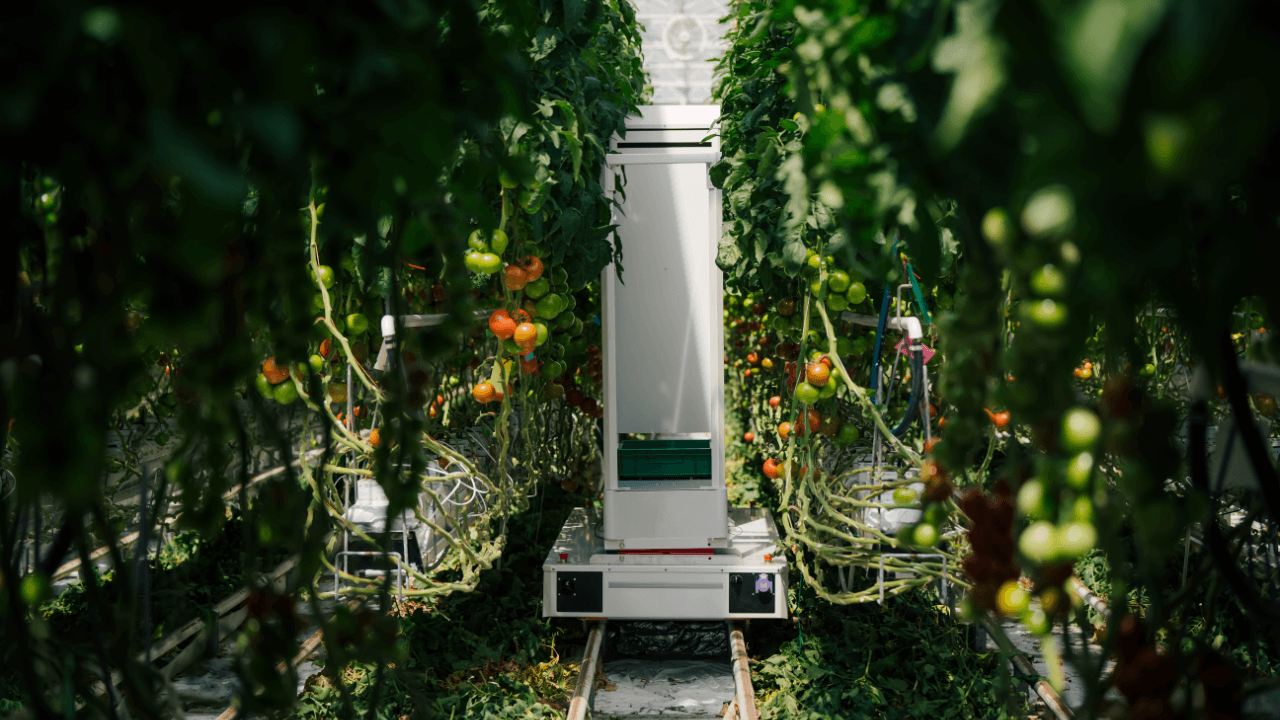
Eternal.ag, a startup building autonomous harvesting robots for greenhouses, today announced it has raised €8 million in funding from Simon Capital, Oyster Bay Venture Capital, EquityPitcher Ventures and Backbone Ventures.
Eternal.ag is developing fully autonomous robots that perform greenhouse crop work without human operators.
Greenhouses are increasingly essential for securing the year-round supply of fresh fruit and vegetables, being far more resilient to seasonal weather, climate change, land shortages and pests than outdoor farming. However, greenhouse labour availability is falling rapidly — in Europe, by as much as 30 per cent since 2010 — and forecasts say this trend will continue, leaving growers with structural staffing shortages.
By automating physically demanding harvesting work, eternal.ag’s robots enable greenhouses to operate reliably and continuously, even when labour is unavailable or inconsistent. By 2040, the company envisions fully automated greenhouse operations powered by robotics, requiring no manual operations.
Eternal.ag’s first commercial product to launch is Harvester, a fully autonomous harvesting robot designed for tomato greenhouses. Harvester operates up to 22 hours a day consistently and works as part of an intelligent AI-powered system to ensure the quality of produce and cut.
Built as a modular system, the platform is designed to expand over time with additional robotic functions to better serve broader greenhouse operations.
“Autonomous robots only work if they can handle real-world variability between plants, layouts, and daily operations,” said Renji John, CEO and co-founder of eternal.ag.
“We develop and validate our robots using simulation-first development. That allows us to train, test, and fail safely in virtual greenhouses — cutting iteration cycles from months to days.
Once deployed, every robot action feeds data back into the system, which is designed to learn, improve and scale.”
“Climate change, labour shortages, and rising demand are pushing food production to its limits,” said Niklas Leske, Principal at Simon Capital.
“Greenhouse horticulture is one of the most efficient and sustainable ways to grow fresh produce year-round.
Yet, labour shortages put the industry at risk, and robotics is the only future-proof solution to build a decentralised, resilient food supply chain for the next generation. eternal.ag’s experienced team has a deep understanding of what growers are up against and has developed a solution to tackle this in a sustainable and measured way.”
Founded by Renji John and Sherry Kunjachan, eternal.ag has built a team of 26 employees so far, working across Europe and India, with headquarters in Cologne and offices in Bengaluru.
The new funding will be used to accelerate product development, expand commercial deployments across Europe, and extend to additional crop types.
Would you like to write the first comment?
Login to post comments
Facts Only
* Eternal.ag received €8 million in funding.
* Simon Capital, Oyster Bay Venture Capital, EquityPitcher Ventures, and Backbone Ventures invested.
* Eternal.ag is developing autonomous harvesting robots for greenhouses.
* The Harvester robot is designed for tomato greenhouses.
* The robot operates up to 22 hours per day.
* Greenhouse labor availability has decreased by up to 30% since 2010 in Europe.
* The company envisions fully automated greenhouse operations by 2040.
* The company is based in Cologne and Bengaluru.
* Renji John and Sherry Kunjachan founded Eternal.ag.
* The company has 26 employees.
* The funding will support product development, commercial deployments and additional crop types.
Executive Summary
Full Take
Eternal.ag’s narrative operates through a classic Motte-and-Bailey strategy – highlighting a desirable (automated food production) while downplaying inherent risks (potential job displacement, reliance on complex AI). The framing emphasizes “resilience” and “sustainability,” powerful emotional hooks that resonate with anxieties about climate change and food security, yet the underlying premise – complete automation – leans heavily on technological optimism without adequately addressing the potential downsides of such a radical shift. The “simulation-first” development approach, while efficient, reflects a common tech startup bias: prioritizing speed of development over robustness, potentially creating a system vulnerable to unforeseen real-world variability— a classic example of building for the ideal while neglecting the messy reality of agricultural environments. The repeated emphasis on “no manual operations” feels somewhat utopian, bordering on a cynical attempt to sidestep questions about workforce transitions, invoking a future that may not be economically or socially viable. Patterns detected: ARC-0043 Motte-and-Bailey, ARC-0024 Ambiguity.
The deeper narrative being promoted here isn’t simply about robotics in agriculture; it’s about reimagining the entire concept of food production. The implicit assumption is that “efficiency” – measured solely in terms of productivity – is the ultimate good, neglecting the significant social and cultural value of human labor in agriculture and the potential disruption of rural communities. The investment firms’ framing— positioning robotics as the “only future-proof solution”— is a deliberate attempt to create a technological imperative, leveraging anxieties about labor shortages to push forward a specific agenda. This echoes a systemic pattern of “sanewashing” extreme technologies – presenting them as inherently good while obscuring the potentially negative consequences for human livelihoods and the ecological impact of intensive, automated agriculture. Root cause: The narrative is driven by a neoliberal obsession with efficiency and technological determinism, obscuring the ethical and societal dimensions of food production. Implications: The narrative risks further decoupling food production from human labor, potentially exacerbating social inequalities and undermining the resilience of local food systems. It’s a framing that prioritizes profit over people and planet. Patterns detected: none.
Sentinel — Likely Human
The article presents a plausible, if somewhat promotional, account of Eternal.ag’s funding and technology. While the text’s structure and reliance on attributed experts raise a moderate level of concern regarding potential AI influence, the overall presentation and specific details lean towards human-generated content.