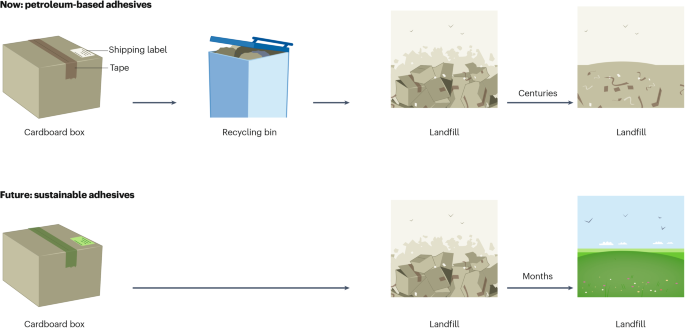
Adhesives are hard to see when in use, but they force most products to reside in landfills for centuries. Ongoing research is creating opportunities in materials design and market impact, thereby helping society move towards a more sustainable future.
This is a preview of subscription content, access via your institution
Access options
Access Nature and 54 other Nature Portfolio journals
Get Nature+, our best-value online-access subscription
$32.99 / 30 days
cancel any time
Subscribe to this journal
Receive 12 digital issues and online access to articles
$119.00 per year
only $9.92 per issue
Buy this article
- Purchase on SpringerLink
- Instant access to the full article PDF.
USD 39.95
Prices may be subject to local taxes which are calculated during checkout
References
Onusseit, H. Resour. Conserv. Recycl. 46, 168–181 (2006).
Mulcahy, K. R., Kilpatrick, A. F. R., Harper, G. D. J., Walton, A. & Abbott, A. P. Green Chem. 24, 36–61 (2022).
Milbrandt, A., Zuboy, J., Coney, K. & Badgett, A. Waste Manag. Bull. 2, 21–28 (2024).
Böhm, M., Salem, M. Z. M. & Srba, J. J. Hazard. Mat. 221–222, 68–79 (2012).
Dunky, M. in Handbook of Adhesive Technology 3rd edn (eds Pizzi, A. & Mittal, K. L.) Ch. 47 (CRC Press, 2017).
Gomes, S., Lopes, J. M. & Nogueria, S. J. Cleaner Prod. 390, 136092 (2023).
Pal, S. et al. Science 385, 877–883 (2024).
Zhang, Z. et al. Science 387, 297–303 (2025).
Liu, X. et al. Nat. Sustain. https://doi.org/10.1038/s41893-026-01776-0 (2026).
Walter, K. et al. Adv. Mat. 37, e10463 (2025).
Stamp, C.-H., Stumpp, J. & Calvino, C. Adv. Mat. 37, 2414308 (2025).
Schmidt, G. et al. Adv. Sustain. Syst. 3, 1900077 (2019).
Wilson, M. C. et al. Adv. Mat. 34, 2308790 (2024).
Westerman, C. R., McGill, B. C. & Wilker, J. J. Nature 621, 306–311 (2023).
Chamas, A. et al. ACS Sustain. Chem. Eng. 8, 3494–3511 (2020).
Author information
Authors and Affiliations
Corresponding author
Ethics declarations
Competing interests
J.J.W. has a financial interest in Mussel Polymers Inc., which has licensed adhesive technologies from Purdue University. J.J.W. is a co-inventor on five patent applications for bio-based adhesives for a variety of applications.
Rights and permissions
About this article
Cite this article
Wilker, J.J. The invisible sustainability problem of glues and how to solve it. Nat Sustain 9, 340–342 (2026). https://doi.org/10.1038/s41893-026-01789-9
Published:
Version of record:
Issue date:
DOI: https://doi.org/10.1038/s41893-026-01789-9
Facts Only
Adhesives contribute to products residing in landfills for centuries
Ongoing research is being conducted to create sustainable alternatives
J.J.W. has a financial interest in Mussel Polymers Inc., which licenses adhesive technologies from Purdue University
Executive Summary
Full Take
The article presents an opportunity for pattern analysis and deeper implications, focusing on the role of adhesives in waste management and sustainable materials design. The discussion around adhesives' long-term impact on landfills underscores the need for more sustainable alternatives to reduce waste and promote a greener future. The involvement of scientists like J.J.W., who have a financial stake in companies developing bio-based adhesives, raises questions about potential conflicts of interest and the objectivity of research findings.
Patterns detected: ARC-0024 Ambiguity (the article does not explicitly state whether the research conducted by J.J.W. is independent or biased due to financial interests)