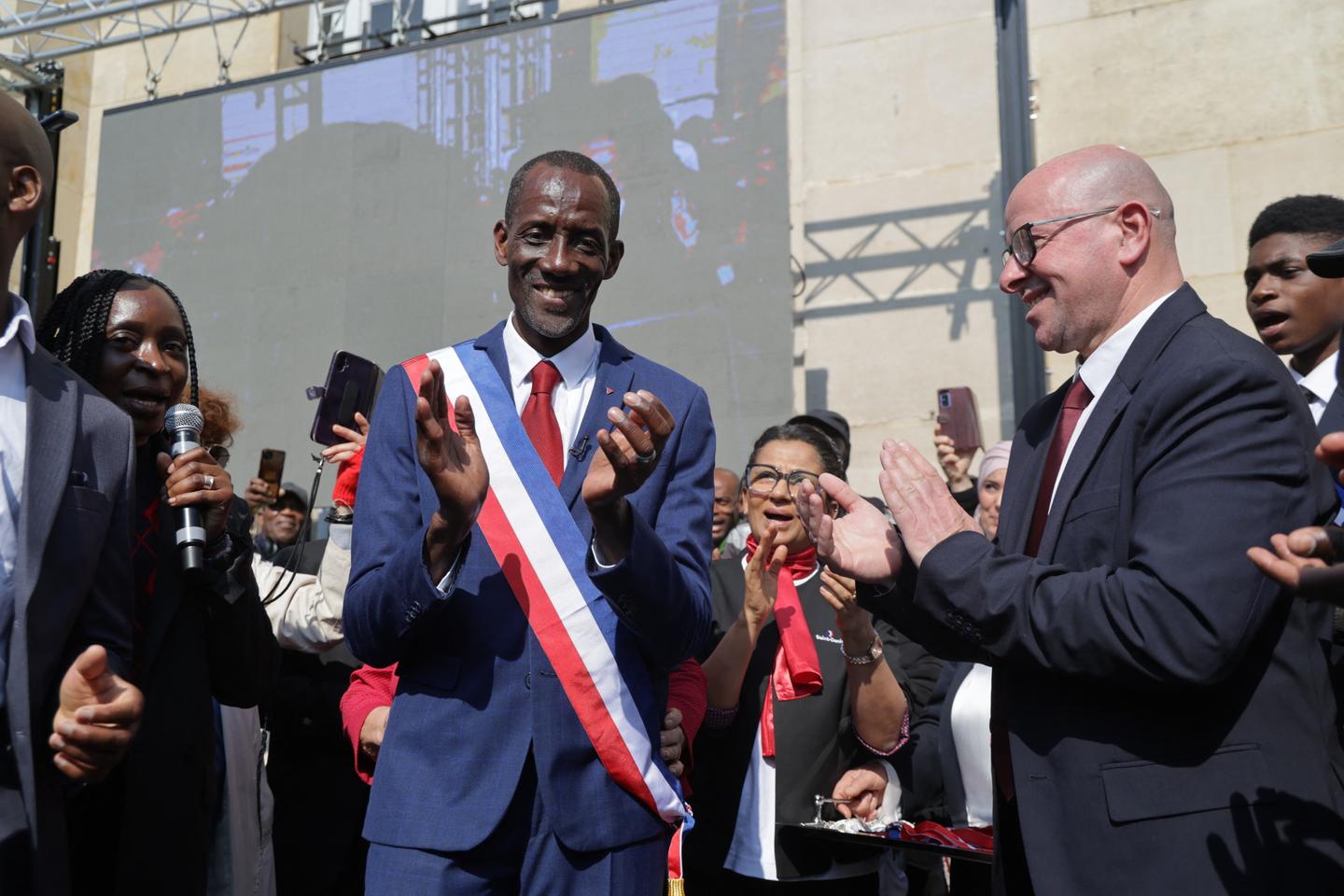
Plusieurs parlementaires ont annoncé, samedi 28 mars, saisir l’Arcom pour des propos jugés racistes tenus sur CNews par un intervenant interrogé sur le nouveau maire LFI de Saint-Denis, Bally Bagayoko. Ce dernier a annoncé à l’Agence France-Presse (AFP) avoir déposé plainte et souhaité un « grand rassemblement » antiraciste.
« Il y aura dépôt de plainte (…) Je prendrai très prochainement l’initiative d’un grand rassemblement et je voudrais que tout le monde soit là (…) contre le racisme et contre le fascisme », explique celui qui a été élu dès le premier tour le 15 mars à Saint-Denis (Seine-Saint-Denis), deuxième ville d’Ile-de-France après Paris.
Vendredi soir, le psychologue Jean Doridot était sur un plateau lors d’un débat portant sur les premiers jours de mandat de M. Bagayoko à Saint-Denis, ville que la chaîne qualifie de « laboratoire » de La France insoumise.
Le maire « essaye de pousser les limites ? », lui demande-t-on. « Sûrement qu’il y a un peu de ça. Maintenant c’est important de rappeler que l’Homo sapiens, nous sommes des mammifères sociaux et de la famille des grands singes. Et par conséquent, dans toute collectivité, dans toute tribu – nos ancêtres chasseurs-cueilleurs vivaient en tribus –, il y a un chef qui a pour mission d’installer son autorité », a affirmé M. Doridot.
« Et là, ce qui se révèle avec l’élection de M. Bally Bagayoko à Saint-Denis, c’est que ça rappelle quand même qu’un maire dans une commune a énormément de pouvoir », a-t-il poursuivi. « Maintenant, (…) personne ne peut décider comme ça, le fait du prince, à l’époque des rois, je destitue tel maire », a-t-il ajouté alors que la question de sanctions était évoquée en plateau à l’encontre de M. Bagayoko. « Notre système est tout à fait apte à porter aux responsabilités des personnes qui ne sont pas des amis de la République traditionnelle. »
Des réactions politiques indignées
Un peu plus tard dans l’émission, la parole avait été redonnée à ce psychologue pour clarifier ses propos. Jean Doridot avait alors récusé toute intention raciste. « Nous avons tous deux bras, deux jambes, 23 paires de chromosomes par cellule. Et c’est ça que j’ai voulu dire. J’ai voulu universaliser mon propos. Peut-être [que] ça n’était pas suffisamment clair », avait-il déclaré. « J’ai la conviction que nous sommes tous semblables et nous partageons tous un lien de parenté universelle », avait-il ajouté.
Mathilde Panot a dénoncé sur X un racisme « crasse et décomplexé » envers ce maire né dans les Hauts-de-Seine de parents maliens. « Sur CNews, le maire de Saint-Denis Bally Bagayoko est comparé à un singe et à un “chef de tribu” », s’est-elle insurgée.
« Enième confirmation que cette chaîne est un cloaque raciste », a abondé le sénateur communiste Ian Brossat, en annonçant également un « nouveau signalement » à l’Arcom, le régulateur de l’audiovisuel et du numérique.
« Poubelle-news encore en boucle dans son racisme contre les nouveaux maires et précisément contre Bally Bagayoko », a aussi écrit sur X la députée Ecologiste Léa Balage El Mariky. « Signalement à l’Arcom immédiat. Soutien, Monsieur le Maire, face à ce racisme crasse. » Auprès de l’AFP, la direction de CNews a estimé que les propos de Jean Doridot avaient été « délibérément déformés sur les réseaux sociaux, alimentant une polémique infondée ».
Facts Only
Parliamentarians announced on March 28 their intention to file complaints with Arcom regarding remarks made on CNews.
The remarks were made by psychologist Jean Doridot during a debate about Bally Bagayoko, the newly elected mayor of Saint-Denis.
Bagayoko, a member of La France Insoumise (LFI), was elected on March 15 in the first round.
Doridot stated that humans are "mammals from the great ape family" and referenced tribal leadership in the context of Bagayoko’s election.
He later clarified his comments, denying racist intent and emphasizing human universality.
Bagayoko has filed a legal complaint and called for a large anti-racism rally.
Mathilde Panot (LFI) accused CNews of "crass and unapologetic racism" for comparing Bagayoko to a "monkey" and "tribal chief."
Senator Ian Brossat (Communist Party) and MP Léa Balage El Mariky (Ecologist) also announced Arcom complaints.
CNews stated that Doridot’s remarks were "deliberately distorted" on social media.
The debate occurred on a CNews program that framed Saint-Denis as an LFI "laboratory."
The controversy involves accusations of racial insensitivity and media bias.
Executive Summary
Several French lawmakers have announced plans to file complaints with the Arcom media regulator over remarks made by psychologist Jean Doridot on CNews regarding Bally Bagayoko, the newly elected mayor of Saint-Denis from La France Insoumise (LFI). Doridot’s comments, which compared Bagayoko’s election to tribal leadership and referenced humans as "great apes," sparked accusations of racism. Bagayoko, who won in the first round on March 15, has filed a legal complaint and called for a large anti-racism rally. While Doridot later clarified his remarks, denying any racist intent and emphasizing human universality, politicians like Mathilde Panot (LFI) and Ian Brossat (Communist Party) condemned the segment as overtly racist. CNews defended the broadcast, claiming Doridot’s words were misrepresented on social media. The controversy highlights tensions around media representation, political discourse, and racial sensitivity in France.
The incident reflects broader debates about the boundaries of free speech, the role of media in shaping public perception, and the responsibility of public figures in addressing systemic racism. While Doridot’s defenders argue his comments were taken out of context, critics see them as part of a pattern of racially charged rhetoric on CNews. The Arcom complaints and Bagayoko’s legal action suggest this case may become a flashpoint in France’s ongoing reckoning with racial and political polarization.
Full Take
The strongest version of this narrative centers on a legitimate concern: the use of dehumanizing language in public discourse, particularly when directed at a Black elected official. Doridot’s invocation of "great apes" and "tribal chiefs" in a discussion about a Black mayor carries historical weight, given the long-standing racial stereotypes linking Black people to primitivity. Even if unintentional, such framing risks reinforcing harmful narratives. The backlash from politicians and Bagayoko’s legal response underscore the seriousness with which these remarks are being treated. CNews’s defense—that the comments were "deliberately distorted"—is a classic example of the **ARC-0024 Ambiguity** pattern, where plausible deniability is used to deflect accountability. The channel’s framing of Saint-Denis as an LFI "laboratory" also hints at **ARC-0043 Motte-and-Bailey**, where a controversial claim (e.g., "this town is a radical experiment") is softened into a more defensible position (e.g., "we’re just discussing governance").
The root cause here is the tension between free expression and the responsibility to avoid perpetuating racial harm. The assumption that "universalizing" human biology absolves one of racial connotations ignores the contextual power of language. Historically, such rhetoric has been weaponized to justify exclusionary politics, echoing colonial-era justifications for hierarchy. The implications are significant: if media platforms normalize ambiguous racialized language, it erodes trust in public discourse and disproportionately burdens marginalized groups with the labor of calling out bias. The second-order consequence is a chilling effect on diverse political representation, as elected officials face not just policy scrutiny but personal attacks veiled as "scientific" or "neutral" commentary.
Bridge questions: How should media outlets balance provocative debate with the risk of amplifying harmful stereotypes? What standards should apply when evaluating intent versus impact in public speech? Would this controversy have unfolded differently if the mayor in question were not Black?
Counterstrike scan: A coordinated influence campaign would likely amplify the most inflammatory interpretations of Doridot’s remarks while ignoring his clarification, using the incident to paint CNews as irredeemably racist or, conversely, to frame critics as oversensitive censors. The actual content does not fully match this pattern—while the remarks are problematic, the response has been organic, not orchestrated. However, the rapid politicization by figures like Panot and Brossat suggests that both sides are leveraging the moment for broader ideological battles, which could escalate into a self-sustaining outrage cycle.
Patterns detected: **ARC-0024 Ambiguity**, **ARC-0043 Motte-and-Bailey**