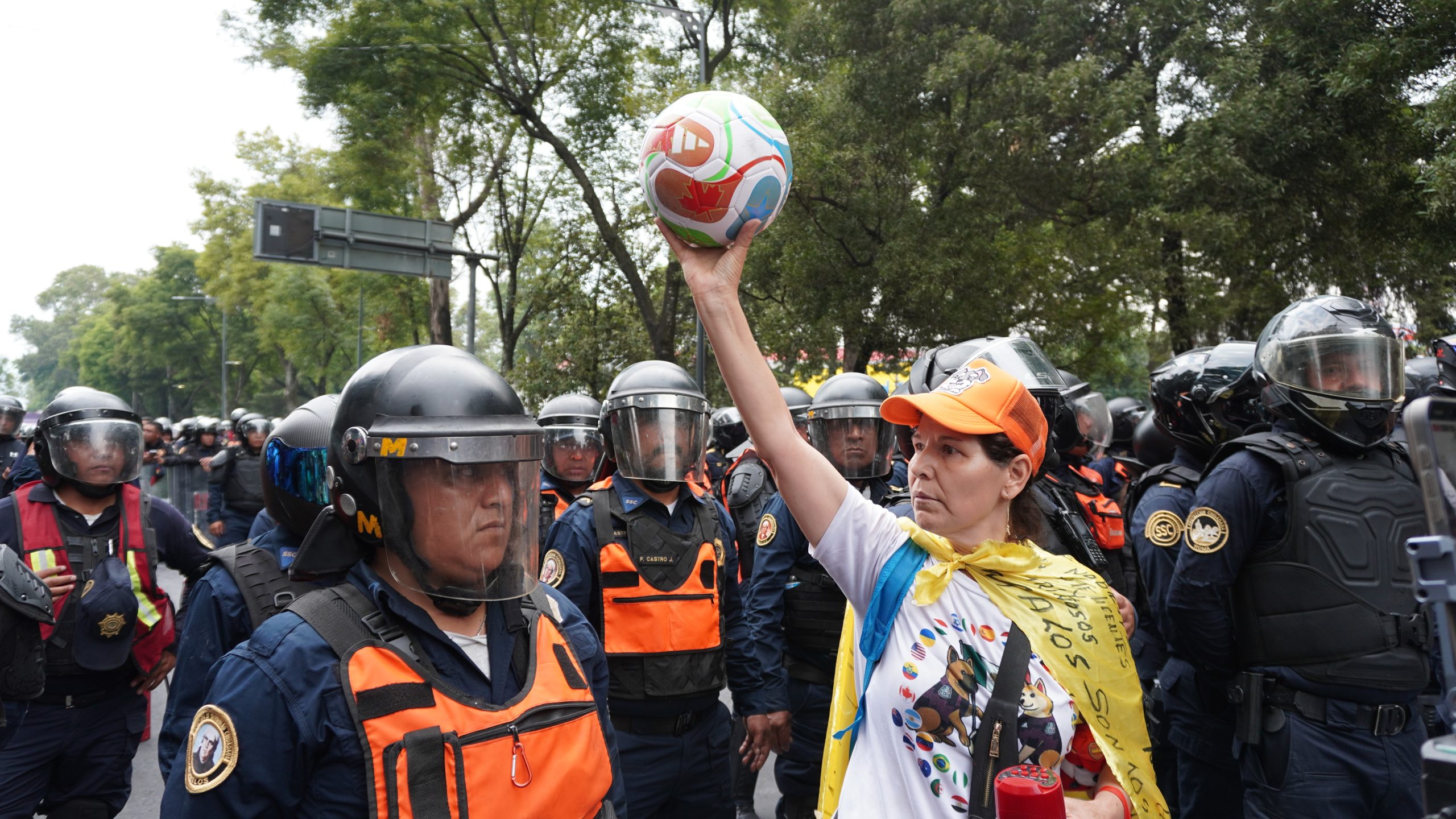
Mexico City, Mexico – As FIFA’s opening ceremony kicked off inside the Azteca Stadium on Thursday afternoon, a parallel scene played out on the streets surrounding it.
Several social movements converged on Mexico City to protest what many activists are calling the “World Cup of Dispossession”, a tournament they say has been built on the backs of the country’s poorest citizens, while their most urgent demands go unmet.
Among the most prominent were the CNTE teachers’ union, collectives of searching mothers of the disappeared, and parents of the 43 Ayotzinapa students – trainee teachers who were forcibly disappeared in 2014.
The protesters mobilized mainly near the Azteca Stadium, blocking all major access routes to the venue and the Zócalo, where a massive fan fest had been programmed.
Security forces deployed what city authorities called “the last mile” – a security perimeter extending roughly one mile around the Estadio Azteca, designed to prevent anyone without a ticket from accessing the grounds. But even before reaching that cordon, some protest groups were surrounded and blockaded by police to prevent them from advancing.
Several protesters were wounded during clashes with police and journalists detained during the day, among them independent reporter Axel Hernández, who was stopped while walking to the protests, his equipment searched under the pretext of an explosives check. “When they found nothing but posters, they claimed they were going to arrest us for putting up posters,” he told Latin America Reports.
Police drove Hernández and a colleague 10 km from the point of detention before releasing them.
Aaron Gardúñez Jiménez, Director General of the Human Rights System Implementation Agency of Mexico City, acknowledged monitoring eight to ten simultaneous protest actions — some peaceful, some “complex” — but maintained that “despite the difficulties, freedom of expression was guaranteed throughout the day.”
Erika, a member of the feminist collective “We exist because we resist,” who asked her last name to be anonymous for security reasons, had a personal reason to march: her daughter was murdered in 2023. From her perspective, the government is not merely failing to meet protesters’ demands, it is actively trying to silence them. “We want her [Sheinbaum] to listen to us, to put herself in our shoes and make a commitment,” she demanded.
Alejandro Gutiérrez, a Mexico City secondary school teacher and active CNTE member, said negotiations with the government were advancing but only superficially, with proposals that fail to address the union’s core demand: the repeal of the 2007 ISSSTE Law reform that dismantled handed pensions over to private capital management.
Sheinbaum between the global stage and the street
President Claudia Sheinbaum navigated the World Cup opening day under considerable political pressure. She had already announced she would not attend the opening match, gifting her ticket to a girl from a low-income family. When the Zócalo encampment threatened the fan fest, she acknowledged there were 18 alternative venues where people could watch for free.
Her tone throughout the week has been deliberately restrained. Sheinbaum invoked the spectre of historical repression directly: “They want us to fall into repression on the eve of the World Cup. We are not going to fall into that provocation. We are not Díaz Ordaz.” The reference is to Gustavo Díaz Ordaz, who ordered the massacre of student protesters at Tlatelolco in October 1968 — just days before Mexico City hosted the Olympic Games. As heirs of the left that emerged from those protest movements, Sheinbaum’s government is acutely aware of what any misstep would mean.
The World Cup as an amplifier
The president had initially denied there was any social unrest ahead of the tournament — a position that became increasingly untenable as the week progressed. Mexico is already navigating a deteriorating relationship with the United States ahead of July trade negotiations, political scandals, and lingering security concerns following a burst of cartel violence in Guadalajara in February.
While the World Cup presents an enormous economic opportunity for the country, projected to generate US$3 billion for hotels, restaurants and sports venues, it also provides a platform for social and political movements to take their battle to the world stage.
With stagnant teacher salaries, decades of impunity in the Ayotzinapa case, and a crisis of forced disappearances that has left over 100,000 people missing across the country, the stakes of the tournament in Mexico go far beyond the fulltime score.
Featured image description: A protestor holds a football next to a riot police officer.
Featured image credit: Jorge Alfonso.
Facts Only
* Several social movements converged on Mexico City to protest the World Cup.
* Protesters included the CNTE teachers’ union, collectives of searching mothers, and parents of the 43 Ayotzinapa students.
* Protesters blocked access routes to the Azteca Stadium and the Zócalo.
* Security forces deployed a perimeter around the Estadio Azteca.
* Several protesters were wounded during clashes with police.
* Independent reporter Axel Hernández was detained and subsequently released.
* The Director General of the Human Rights System Implementation Agency acknowledged monitoring simultaneous protest actions.
* A feminist collective member marched citing the murder of her daughter in 2023.
* Negotiations with the government regarding the ISSSTE Law reform were ongoing.
* President Sheinbaum invoked references to historical repression in her statements.
Executive Summary
Full Take
The narrative frames the World Cup not merely as a sporting event but as a critical juncture where latent social and political tensions are amplified. The deployment of security forces, defining a "last mile" perimeter, establishes a clear pattern of controlling public space and limiting expression, juxtaposed against the stated guarantee of freedom of expression. This spatial tension—between the massive public spectacle and the physical restraint of protesters—highlights the dynamic between state authority and dissent.
The strategic use of historical memory, specifically invoking the shadow of Díaz Ordaz and the Ayotzinapa disappearances, serves to frame contemporary political failure within a historical context of systemic repression. This functions to shift the focus from immediate demands to a broader claim of historical justice, creating an intellectual framework where current grievances are understood as part of a continuous narrative of state failure.
The implication is that economic opportunities, like the World Cup, are leveraged not just for commercial gain but also as a platform upon which marginalized groups can force recognition of their demands. The repeated pattern of state restraint against public assembly, despite claims of guaranteed rights, suggests a systemic tension where freedom of expression is conditional upon political expediency, revealing the underlying paradigm of control and the costs borne by human agency and dignity.
Sentinel — Human
The text exhibits the characteristics of well-researched, human-authored political journalism, successfully synthesizing event details with complex socio-political context.