Kelly McParland: Doug Ford's build build build ethos runs into Canadian obstructionism
Ontario's premier is the king of 'build, baby, build,' but the courts, municipalities and the haters are continually standing in his way
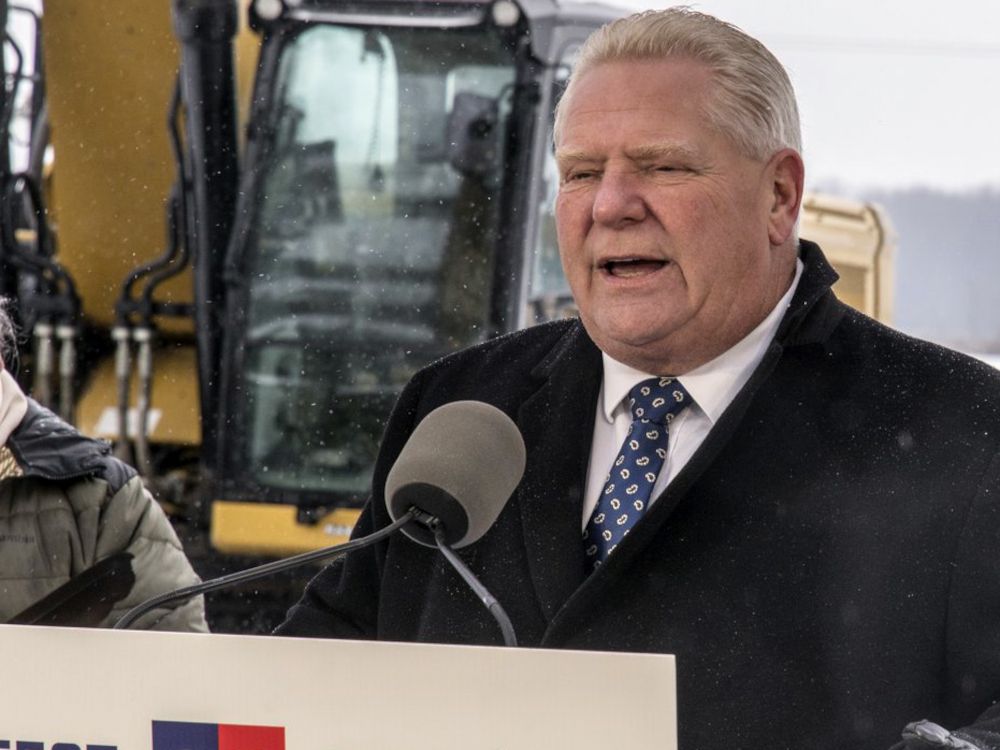
Ontario Premier Doug Ford has big ideas. Bigger than big. Like, Mega Big. He loves to build — the more ambitious, the better. Probably no politician in Canada is more intent on meeting Prime Minister Mark Carney’s call to “build, baby, build” than the Conservative leader.
Is the premier getting praise for all this construction activity? In Canada, are you joking? The moaning is enough to drown out the backhoes. A new highway with all those cars? An expanded airport with all that noise? More high-rises with all those shadows? And nuclear … aren’t we supposed to hate nuclear, like we used to hate coal? Windmills is what we want, people, windmills!
The premier gets impatient when he hears this stuff. His response to complaints about his sudden enthusiasm for expanding runways at the smallish Billy Bishop airport on Toronto Island, enabling it to handle jets, was typical. “I know Mayor (Olivia) Chow wants to expand it,” he said. “She may disagree with the jets, but those jets are coming in there, one way or another.”
Chow says she’s against jets so close to a shoreline forested with condos. Too bad. Ford’s already declared plans to take over the airport, which the province doesn’t currently control. In Ford’s Ontario, you snooze, you lose. Build baby build waits for no one.
Much as his plans jibe with federal strategy, there are legitimate concerns when it comes to the premier’s projects. Ford has a tendency to announce first and plan later. A scheme to build housing in the protected Greenbelt was halted by a public backlash.
His call for a gigantic new “world class convention centre” seemed to catch everyone off guard. The existing hall was busy hosting an enormous annual mining event with attendees from around the globe when he denounced the site as “one of the worst in the world,” maintaining that the city is losing conventions to bigger, grander facilities elsewhere.
Keen to start on a replacement, he said he’d already picked out a location, “unlike any other location in the entire world.… Wait until you see the design.” The site, it turned out, doesn’t yet exist, but is to be created by dumping landfill along Toronto’s lakefront. That brought the usual hoots of derision from regular Never-Forders. “It’s just another idiotic idea,” griped Ontario NDP Leader Merit Stiles. “Nothing about this makes life easier for people in Ontario.”
The lack of immediate practical benefits is a regular complaint about Ford’s big projects. Adding jets to Billy Bishop, which is currently limited to turbo-props, won’t do anything for the homeless or the price of gas. The $1 billion he’s ready to spend on a blingy new science centre won’t help the province’s struggling universities or pacify critics angry at the closing of the old science centre.
A new convention facility might attract more business, but won’t it just add to downtown Toronto’s chronic gridlock? And don’t even mention the revamp going on at Ontario Place, the lakefront park and playground, with its $400-million taxpayer-financed parking garage and its privately-run luxury spa, or the tunnel the premier swears he’ll dig under Ontario’s grossly overburdened Highway 401, which almost nobody other than Ford believes will ever be built.
It’s all grist for criticism, objections, red tape and the debilitating Canadian resistance to big ideas that both Carney and Conservative Leader Pierre Poilievre blame for Canada’s economic constipation. “In the middle of a massive price hike for oil, our industry is not expanding, it’s retreating,” Poilievre asserted as the Iran war affected global supplies. Carney takes regular flak for jetting around the world signing trade deals and investment agreements, rather than spending his days taking questions in Parliament.
Carney and Poilievre both insist the country needs to tear down barriers, speed up permitting, expand infrastructure and find new markets outside the United States. But just try and put up some infrastructure or cut through the layers of bureaucratic obstructionism without finding yourself a target for well-honed delaying tactics.
Canada’s largest city may have a critical housing crisis, yet forfeited millions in federal funds rather than allow construction of six-unit buildings in other than a few locations. When a developer attempted to build an innovative structure with 10 units in six stories, local residents succeeded in having it blocked even though it met regulations.
Provincial leaders have spent a year now seeking ways to reduce their own barriers, only to find few changes that are even remotely acceptable. The courts are happy to help with impediments: when Ford tried to remove bike lanes from some major arteries, a judge ruled it unconstitutional. If you can’t close a bike lane without a constitutional roadblock, what hope is there for more ambitious quests?
Ford has nonetheless managed some victories despite the barriers. Construction is set to begin on a much-debated, much-delayed all-season road to the Ring of Fire, a mineral-rich region in northern Ontario. An array of hospital projects is underway, including a $14-billion expansion turning a Mississauga facility into Canada’s biggest teaching hospital.
Someone has to build those homes, of course, yet there’s little sign of progress on that front. A deal was reached with Ottawa in June after tense negotiations, but municipal barriers remain formidable and relations with local leaders are often fraught. Condo sales have all but ceased and home purchases hit a 45-year low in 2025. There are properties available but while prices have eased, they remain out of reach for many. Ford calls the situation a “massive inferno.”
Cue the Fordian fire department. The premier is nothing if not determined. Barely a year into his third term, he’s already announced plans to seek a fourth. Big plans will no doubt be forthcoming. Complaints are sure to follow.
National Post
Our website is the place for the latest breaking news, exclusive scoops, longreads and provocative commentary. Please bookmark nationalpost.com and sign up for our newsletters here.
Postmedia is committed to maintaining a lively but civil forum for discussion. Please keep comments relevant and respectful. Comments may take up to an hour to appear on the site. You will receive an email if there is a reply to your comment, an update to a thread you follow or if a user you follow comments. Visit our Community Guidelines for more information.
Facts Only
Ontario Premier Doug Ford is advancing multiple large-scale infrastructure projects, including highway expansions, airport upgrades, and a proposed new convention center.
Ford aims to expand Billy Bishop Airport in Toronto to handle jets, despite opposition from Toronto Mayor Olivia Chow.
The premier has announced plans to build a "world-class convention center" on landfill along Toronto’s lakefront, though the site does not yet exist.
A previous plan to develop housing in Ontario’s Greenbelt was abandoned after public backlash.
Ford has criticized Toronto’s existing convention center as inadequate, claiming the city loses business to larger facilities elsewhere.
The province is investing $1 billion in a new science center and $400 million in a parking garage and luxury spa at Ontario Place.
Ford has proposed a tunnel under Highway 401, though skepticism about its feasibility persists.
Construction is set to begin on an all-season road to the Ring of Fire, a mineral-rich region in northern Ontario.
A $14-billion hospital expansion in Mississauga is underway, aiming to create Canada’s largest teaching hospital.
Ontario’s housing market faces severe challenges, with condo sales at a 45-year low in 2025 and high prices persisting.
Municipal and legal barriers, including court rulings, have delayed or blocked some of Ford’s initiatives, such as the removal of bike lanes.
Federal and provincial leaders, including Mark Carney and Pierre Poilievre, advocate for faster infrastructure development to address economic stagnation.
Executive Summary
Full Take
The strongest version of this narrative frames Doug Ford as a decisive leader breaking through Canada’s notorious bureaucratic inertia to deliver much-needed infrastructure. His "build, baby, build" ethos resonates with those frustrated by slow permitting, NIMBYism, and regulatory gridlock—issues that figures like Mark Carney and Pierre Poilievre argue are stifling economic growth. Ford’s willingness to override local objections (e.g., Billy Bishop Airport, Ontario Place) could be seen as necessary boldness in a system where even bike lane removals face constitutional challenges. The pattern here aligns with **ARC-0024 Ambiguity**—the tension between framing Ford as a visionary or a bulldozer—where the same actions are either "cutting red tape" or "ignoring democratic process" depending on perspective.
Yet the narrative also reveals deeper systemic patterns. The resistance to Ford’s projects isn’t just obstructionism; it reflects legitimate conflicts over urban planning, environmental trade-offs, and community autonomy. The article highlights how Canada’s layered governance—municipal, provincial, federal, judicial—creates friction by design, not just malice. The **ARC-0043 Motte-and-Bailey** tactic appears when critics dismiss projects like the convention center as "idiotic" without engaging with the underlying argument about economic competitiveness. Meanwhile, Ford’s own rhetoric ("those jets are coming in there, one way or another") risks **ARC-0018 Preemptive Dismissal**, shutting down debate rather than addressing concerns.
Root cause: This is a clash between two Canadian paradigms—the technocratic impulse to "get things done" and the liberal-pluralist tradition of consensus-building. The unstated assumption is that growth and development are inherently good, even if the costs (displacement, environmental impact, public debt) are unevenly distributed. Historically, this echoes mid-20th-century nation-building projects (e.g., St. Lawrence Seaway, Trans-Canada Highway), which also faced resistance but were ultimately framed as inevitable progress.
Implications: Human agency is constrained by structural inertia. While Ford’s approach may accelerate some projects, it risks eroding trust in institutions when decisions feel imposed. The second-order consequences—such as deepening municipal-provincial tensions or normalizing executive overrides—could further polarize governance. Who benefits? Developers, construction unions, and long-term economic planners. Who bears costs? Local communities, taxpayers funding megaprojects, and future generations inheriting the environmental tab.
Bridge questions: If Canada’s regulatory system is indeed broken, what safeguards should remain to protect marginalized voices? Can infrastructure be built at scale without centralizing power, or is some friction necessary for democratic accountability? What metrics would convince you that Ford’s projects are succeeding—or failing—beyond partisan talking points?
Counterstrike scan: A coordinated influence campaign pushing this narrative would amplify the "Canada is broken" framing, portraying opponents as elitist NIMBYs while downplaying environmental and equity concerns. It would use **ARC-0030 False Binary** ("build or stagnate") and **ARC-0005 Authority Games** (citing Carney/Poilievre as validation). The actual article leans into this framing but includes enough counterpoints (e.g., Greenbelt backlash, court rulings) to avoid full alignment with a manipulative playbook. The tone is provocative but not systematically deceptive.
Sentinel — Human
The article exhibits strong human stylistic markers, including erratic sentence structure, idiosyncratic phrasing, and a clear editorial voice, with no significant indicators of synthetic generation.