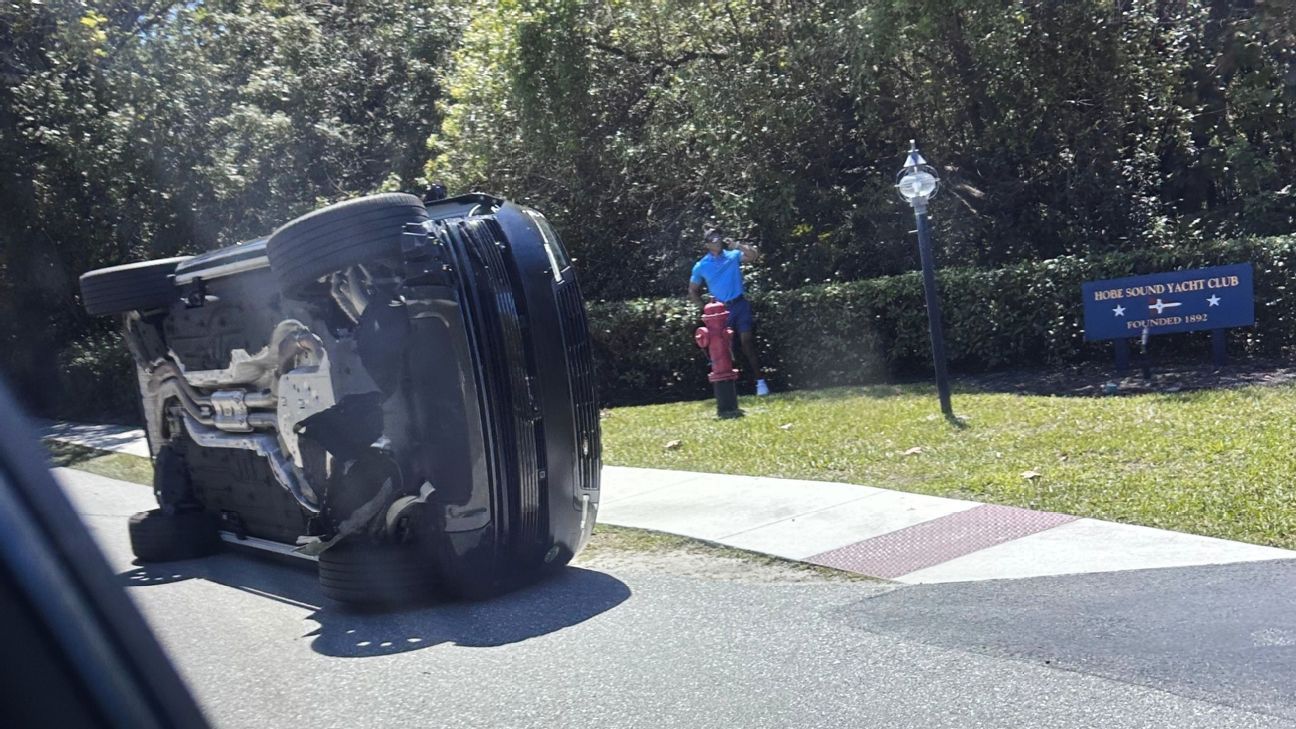
Fifteen-time major champion Tiger Woods was arrested on suspicion of DUI on Friday after he was involved in a car crash not far from his home on Jupiter Island in Florida, according to Martin County Sheriff John Budensiek.
The sheriff said Woods was driving a Land Rover northbound on South Beach Road at a high speed when he attempted to pass a truck hauling a pressure cleaner, which had slowed to turn into a driveway.
Woods' SUV swerved to avoid the truck but clipped the back of the trailer. The Land Rover flipped on its side and slid down the road. Woods climbed out of the passenger's window to get out, Budensiek said.
Budensiek said Woods and the other driver weren't injured. The accident occurred around 2 p.m. ET.
Woods, 50, was arrested on suspicion of misdemeanor DUI with property damage and refusal to submit to a lawful test. He arrived at the jail at 3 p.m. and was released on bail later Friday, according to Christine Weiss, a spokesperson for the Martin County Sheriff's Office. Florida law required that he spend at least eight hours in jail before he could post bail.
Martin County Sheriff's Office DUI investigators on the scene determined that Woods had shown signs of impairment.
"They did several tests on him," Budensiek said. "Of course, he did explain the injuries and the surgeries that he had. We did take that into account, but they did do some in-depth roadside tests."
The investigators arrested Woods and transported him to the Martin County Jail. The sheriff said Woods' breathalyzer test didn't show signs of alcohol. Woods refused to submit to a urinalysis test for other drugs, according to the sheriff.
"He is cooperative, but he was not trying to incriminate himself," Budensiek said. "So he was careful in what he said and didn't say."
DUI investigators believed at the scene that Woods wasn't impaired by alcohol. Budensiek said investigators believed Woods had used a medication or drug and that no medications or drugs were found in his SUV.
The sheriff didn't know how fast Woods was driving.
"But I can tell you this: It's a 30 mph speed limit," Budensiek said. "And when I show you the photos, they kind of speak for themselves.
"You can see where he clipped the back of the trailer. You can see where he rolled. And then as he decelerates, sliding down on the driver's door of the vehicle. You can see that he slid for a pretty decent space before he came to a stop."
According to Budensiek, the outcome might have been different if another vehicle had been traveling southbound at the time of the crash.
"We would not be having a conversation saying there was no injuries," he said.
President Donald Trump, who said he is a "close friend" to Woods, reacted to the news, telling reporters during a gaggle in Miami on Friday, "I feel so badly. He's got some difficulty. There was an accident, and that's all I know. Very close friend of mine.
"He's an amazing person, amazing man. But some difficulty," he added, according to ABC News.
It's not the first time Woods has been suspected of DUI. In May 2017, he was arrested in Jupiter after police found him asleep at the wheel in his running car, which had two flat tires and damage on the front and rear bumpers.
Woods said he had taken a bad mix of painkillers. He later pleaded guilty to reckless driving.
In February 2021, Woods suffered significant leg injuries in a one-car crash outside of Los Angeles in which his SUV rolled several times and left him trapped inside. He later had surgery to deal with "open fractures" to his lower right leg, had a rod placed in a tibia and had screws and pins inserted in his foot and ankle during emergency surgery. Woods was hospitalized for three weeks following the surgery.
Woods' vehicle had been traveling between 84 and 87 mph in an area with a 45 mph speed limit, Los Angeles County Sheriff Alex Villanueva said at the time.
At the 2021 Hero World Challenge in the Bahamas, Woods said, "I'm lucky to be alive and also have a limb." He said it was 50-50 as to whether part of his right leg could have been amputated.
He had at least one more surgery related to injuries from the crash in April 2023.
Woods had spent the past several months recovering from a ruptured Achilles tendon and another back surgery in October. He competed for the first time in more than a year during Tuesday's TGL finals, where his Jupiter Links GC team lost to the Los Angeles Golf Club.
He had been weighing whether to return to the PGA Tour at the Masters at Augusta National Golf Club, the first major of the season, which begins April 9.
Woods last competed on the PGA Tour in July 2024 when he missed the cut at the Open Championship at Royal Troon Golf Club in Scotland. He last played four rounds in a PGA Tour event at the 2024 Masters.
While Woods has been sidelined from competition for much of the past six years, he has been heavily involved in shaping the future of the PGA Tour as chairman of the future competition committee. He is also a player director on the PGA Tour policy board and PGA Tour Enterprises, the tour's for-profit entity.
Information from The Associated Press was used in this report.
Facts Only
Tiger Woods was arrested on suspicion of DUI with property damage on Friday in Florida.
The crash occurred around 2 p.m. ET on South Beach Road near Jupiter Island.
Woods was driving a Land Rover northbound at high speed when he attempted to pass a truck.
His SUV clipped the truck's trailer, flipped, and slid down the road.
Woods exited through the passenger window and was uninjured.
The other driver was also uninjured.
Woods was arrested for refusing to submit to a lawful test and showed signs of impairment.
His breathalyzer test showed no alcohol, but he refused a urinalysis for other drugs.
He was released on bail after eight hours in jail, as required by Florida law.
Woods has a prior DUI-related arrest in 2017, where he pleaded guilty to reckless driving.
He has a history of severe injuries, including a 2021 crash that required multiple surgeries.
Woods recently competed in a golf event after recovering from Achilles tendon and back surgeries.
Executive Summary
Tiger Woods, a 50-year-old fifteen-time major champion, was arrested on suspicion of DUI with property damage after a car crash near his Jupiter Island, Florida home. The incident occurred around 2 p.m. ET when Woods, driving a Land Rover northbound on South Beach Road, attempted to pass a truck at high speed, clipped its trailer, and flipped his SUV. Both Woods and the other driver were uninjured, though Woods was arrested after refusing a urinalysis test for drugs. Investigators noted signs of impairment but found no alcohol in his breathalyzer test. Woods was released on bail after spending eight hours in jail, as required by Florida law.
This is not Woods' first DUI-related incident; in 2017, he was arrested for reckless driving after being found asleep in his car with painkillers in his system. His history of injuries, including a 2021 crash that nearly cost him his leg, adds context to his current physical condition. Woods has been recovering from recent surgeries and had just competed in a golf event after a long hiatus. The arrest raises questions about his health, judgment, and potential substance use, though no drugs were found in his vehicle. The situation is further complicated by his high-profile role in shaping the PGA Tour's future.
Full Take
The strongest version of this narrative presents Woods' arrest as a concerning pattern of reckless behavior, compounded by his history of injuries and prior DUI incidents. The report acknowledges his physical struggles and recent surgeries, which may contextualize his actions, but it also highlights his refusal to cooperate fully with investigators. The inclusion of Trump's sympathetic remarks adds a layer of public perception, framing Woods as a flawed but admired figure.
Pattern scan: The article avoids overt emotional exploitation but leans into Woods' celebrity status to amplify the story's significance. The framing of his prior DUI and injuries could subtly reinforce a narrative of decline, though it stops short of explicit moralizing. The lack of confirmed substance use (beyond refusal to test) leaves room for speculation, which could be weaponized by bad actors to either vilify or defend him.
Root cause: The narrative assumes Woods' actions stem from either impairment or poor judgment, but it doesn't explore systemic factors like pain management in professional sports or the pressures of his public persona. The focus on his physical condition and past incidents may overshadow broader questions about athlete health and accountability.
Implications: Woods' arrest could impact his PGA Tour leadership role and public image, but the immediate consequences are legal and personal. The second-order effects may include renewed scrutiny of his fitness to compete or influence golf's governance.
Bridge questions: How might Woods' injuries and recovery process have influenced his decision-making? What role does celebrity culture play in how such incidents are reported and perceived? Would this story receive the same attention if the subject weren't a high-profile athlete?
Counterstrike scan: A coordinated influence campaign might exaggerate Woods' impairment to undermine his credibility or, conversely, downplay the incident to protect his legacy. The actual content doesn't match this pattern, as it presents facts without overt bias. However, the emphasis on his prior DUI and Trump's comments could be leveraged by partisan actors to frame the story politically.
Patterns detected: none