In a hotel lobby on Hong Kong Island, a delivery robot pauses outside one of the lifts as the doors open, and a guest steps out. The robot waits, and then rolls neatly inside.
The move looks simple, but it isn't. To work in the busy hotel, owned by an international chain, the robot must navigate a building that won't slow down for it.
People are often getting in the way, and it must be able to take the lift to the correct floor, and then find the right room.
The company behind the robot, Yunji, is a mainland Chinese tech business that is aiming to use Hong Kong as a springboard for successful overseas expansion.
"We aim to make our product succeed in Hong Kong, and then expand outward," says the firm's vice-president, Xie Yunpeng.
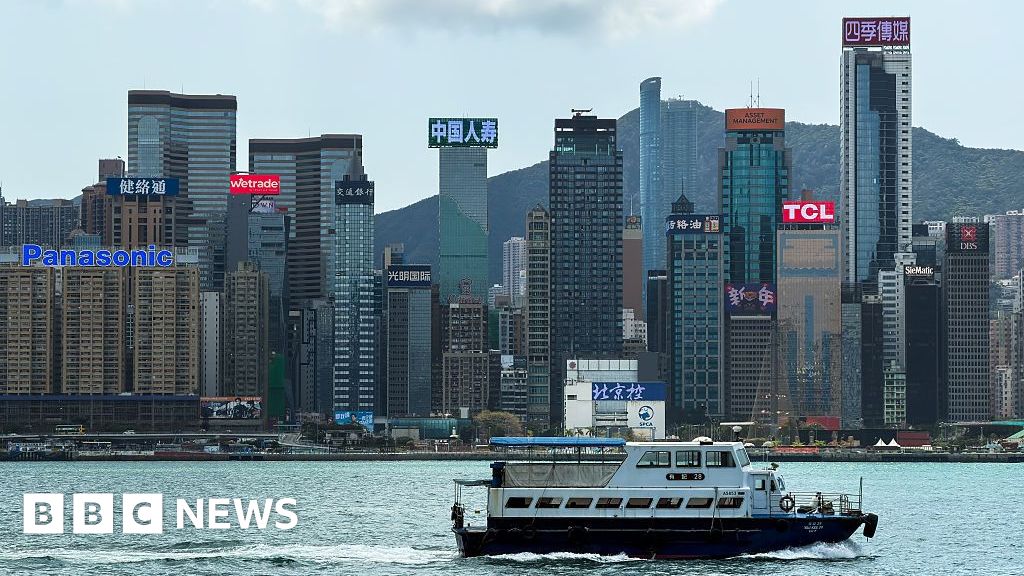
Hong Kong is becoming increasingly important to such mainland Chinese tech companies as a place to raise money, test products with international clients, and build credibility for overseas expansion.
This matters because US and European nations have grown more wary of such Chinese companies. Dubbed "China risk" by some commentators, countries fear state-led espionage and excessive Chinese domination of their tech sectors.
For mainland Chinese tech firms it means they are finding access to capital, customers and trust harder to secure in some international markets. So, they are instead looking to Hong Kong in the first instance.
Last year, the number of mainland Chinese firms listing on the Hong Kong Stock Exchange increased to 76, up from 30 in 2024, an increase of 153%, according to a report by accountancy giant PricewaterhouseCoopers.
Invest Hong Kong, the investment promotion agency for the special administrative region, has also reported a rise in the number of mainland firms it has helped to set up or expend in the territory, with innovation and technology among the biggest sectors.
Xiaomeng Lu, a director at political consultancy Eurasia Group, says mainland Chinese tech firms are "shifting to Hong Kong" for their primary share listing as "geopolitical headwinds dampen their dreams" to float in New York.
"These days Hong Kong is their best hope to attract global investors and position themselves as a player not fully constrained by the boundary of the mainland market," she adds.
Meanwhile, Wendy Chang of the Mercator Institute for China Studies, a Germany-based think tank, says Hong Kong is "fashioning itself as a connector to the outside world for Chinese companies", with policies to speed up share flotations and help mainland firms set up operations in the city.
This increased focus on Hong Kong comes as the Chinese government in Beijing is aiming for the country to achieve more "technology self-reliance".
Significantly reducing its need for foreign hardware and software is now at the centre of its economic policy, especially regarding artificial intelligence and semiconductors.
This is a key focus of the country's new 15th Five-Year Plan, which sees technology not just as an economic priority but as a strategic one given tensions with the US.
In this context, the "strategic value of Hong Kong for high-tech Chinese companies" has increased, says Paul Triolo, a Washington-based partner of global business consultancy DGA Group.
Alicia Garcia-Herrero, chief economist for Asia-Pacific at French investment bank Natixis, says that Hong Kong offers mainland firms a place where they can show that they can meet international standards while building trust with global investors and clients.
For Yunji, that means proving its robots can operate in real-world international settings. The company, which builds its service robots for hotels, hospitals and factories, listed in Hong Kong in October of last year, as it sought to widen its investor base beyond the mainland.
MiningLamp Technology, a Chinese AI software company set up its operation in Hong Kong the same month. Its founder, Wu Minghui, calls Hong Kong a "data compliance transfer station", where mainland Chinese firms like his can test how to handle cross-border data flows and build compliance processes before moving into other markets.
But even if a mainland Chinese firm is successful in Hong Kong, it can still face barriers overseas.
Governments in the US and Europe have tightened national security reviews of Chinese investments and technology, citing concerns over data access and critical infrastructure. Some countries, like the US and UK have also moved to restrict or phase out Chinese suppliers from telecoms networks.
Western nations also have broader concerns about Chinese firms' governance and transparency. The Luckin Coffee scandal remains a cautionary tale for many international investors after the Chinese company admitted fabricating sales.
The revelation saw its shares being delisted from New York's Nasdaq stock market in 2020.
Meanwhile, Hong Kong is not as appealing to international companies and investors as it once was. Since mass pro-democracy protests in 2019, authorities have imposed a sweeping national security law and new local security legislation.
Dozens of activists, opposition politicians and journalists have been arrested or jailed under security or related laws. Beijing and Hong Kong officials say the measures were necessary to restore stability and order, but critics say this has sharply curtailed political freedoms.
And Triolo says that even with a Hong Kong base, many mainland companies remain bound by evolving rules set in Beijing, from cybersecurity and data controls, to requirements for public-facing AI.
"Hong Kong is not really a geopolitical shield [for such firms]", he says, adding that it "only partially mitigates" their risks.
Facts Only
Yunji, a mainland Chinese tech company, uses Hong Kong as a base to expand its delivery robots internationally.
The robot operates in a Hong Kong hotel, navigating lifts and avoiding obstacles.
Yunji's vice-president, Xie Yunpeng, states the company aims to succeed in Hong Kong before expanding outward.
Hong Kong is increasingly used by mainland Chinese tech firms to raise capital, test products, and build credibility.
The number of mainland Chinese firms listing on the Hong Kong Stock Exchange rose to 76 in 2023, up from 30 in 2024.
Invest Hong Kong reports a rise in mainland firms setting up or expanding in the territory, particularly in innovation and technology.
Xiaomeng Lu of Eurasia Group notes mainland firms are shifting to Hong Kong for listings due to geopolitical challenges in New York.
Wendy Chang of the Mercator Institute for China Studies describes Hong Kong as a "connector" for Chinese companies, with policies to speed up share flotations.
China's 15th Five-Year Plan prioritizes technology self-reliance, particularly in AI and semiconductors.
MiningLamp Technology, a Chinese AI firm, set up operations in Hong Kong in October 2023 to handle cross-border data compliance.
Western governments have tightened restrictions on Chinese tech investments, citing national security concerns.
Hong Kong's political environment has changed since 2019, with new security laws and arrests of activists and journalists.
Paul Triolo of DGA Group states that Hong Kong only partially mitigates risks for mainland firms due to Beijing's evolving regulations.
Executive Summary
Mainland Chinese tech companies are increasingly using Hong Kong as a strategic hub for international expansion, capital raising, and credibility-building amid growing geopolitical tensions. Firms like Yunji, which develops service robots, and MiningLamp Technology, an AI software company, have established operations in Hong Kong to access global investors, test products in international settings, and navigate cross-border data compliance. The Hong Kong Stock Exchange saw a 153% increase in mainland Chinese listings in 2023 compared to 2024, reflecting this trend. Invest Hong Kong reports a rise in mainland firms setting up or expanding in the territory, particularly in innovation and technology sectors.
However, challenges persist. Western governments, wary of "China risk," have tightened national security reviews and restricted Chinese tech firms' access to critical infrastructure. Hong Kong's appeal has also diminished due to political crackdowns following the 2019 protests, raising concerns about freedoms and governance. While Hong Kong offers a bridge to global markets, mainland firms remain subject to Beijing's evolving regulations, limiting its effectiveness as a geopolitical shield. The push for "technology self-reliance" in China's Five-Year Plan further underscores Hong Kong's role as a testing ground for firms aiming to reduce dependence on foreign tech.
Full Take
**STEELMAN:** The narrative presents a compelling case for Hong Kong's role as a strategic intermediary for Chinese tech firms facing geopolitical headwinds. It acknowledges both the opportunities (access to capital, compliance testing) and limitations (Beijing's control, Western skepticism) without oversimplifying the dynamics. The inclusion of multiple expert perspectives—from consultancies to think tanks—adds credibility, and the article avoids overt emotional manipulation or distortion.
**PATTERN SCAN:** The piece leans toward a balanced framing but subtly reinforces a "China vs. West" binary, which could risk false equivalence if not contextualized. The focus on "China risk" and national security concerns, while factually grounded, may inadvertently amplify a narrative of inevitability around tech decoupling. No overt manipulation patterns are detected, but the framing could nudge readers toward a deterministic view of geopolitical tensions.
**ROOT CAUSE:** The underlying paradigm is the clash between China's push for tech sovereignty and Western efforts to contain its influence. The unstated assumption is that Hong Kong's hybrid status—part of China but with international financial systems—can indefinitely bridge this divide. Historically, this echoes Cold War-era proxy dynamics, where neutral territories became battlegrounds for ideological and economic competition.
**IMPLICATIONS:** For human agency, the trend highlights how firms navigate constraints: Chinese companies use Hong Kong to signal compliance, while Western governments tighten controls. The costs fall on investors and consumers, who face reduced transparency and potential market fragmentation. Second-order effects include accelerated tech bifurcation and Hong Kong's evolving identity as a financial hub under Beijing's shadow.
**BRIDGE QUESTIONS:**
How might Hong Kong's role change if Beijing further tightens control over data and AI governance?
Could alternative hubs (e.g., Singapore, Dubai) emerge as competitors to Hong Kong for Chinese tech firms?
What evidence would challenge the assumption that Hong Kong can remain a neutral bridge amid escalating U.S.-China tensions?
**COUNTERSTRIKE SCAN:** A coordinated influence campaign would exaggerate Hong Kong's independence from Beijing, downplay Western restrictions, or frame Chinese tech as universally benign. This article does not match that pattern; it presents constraints and risks transparently. The closest alignment is the implicit framing of Hong Kong as a "last hope" for Chinese firms, which could be exploited to normalize tech decoupling—but the piece stops short of advocacy.
Patterns detected: none
Sentinel — Human
This article is likely human-written. The writing style exhibits variation in sentence length, includes a personal voice, and provides specific sources for statistics and quotes, reducing the likelihood of coordinated synthetic production.