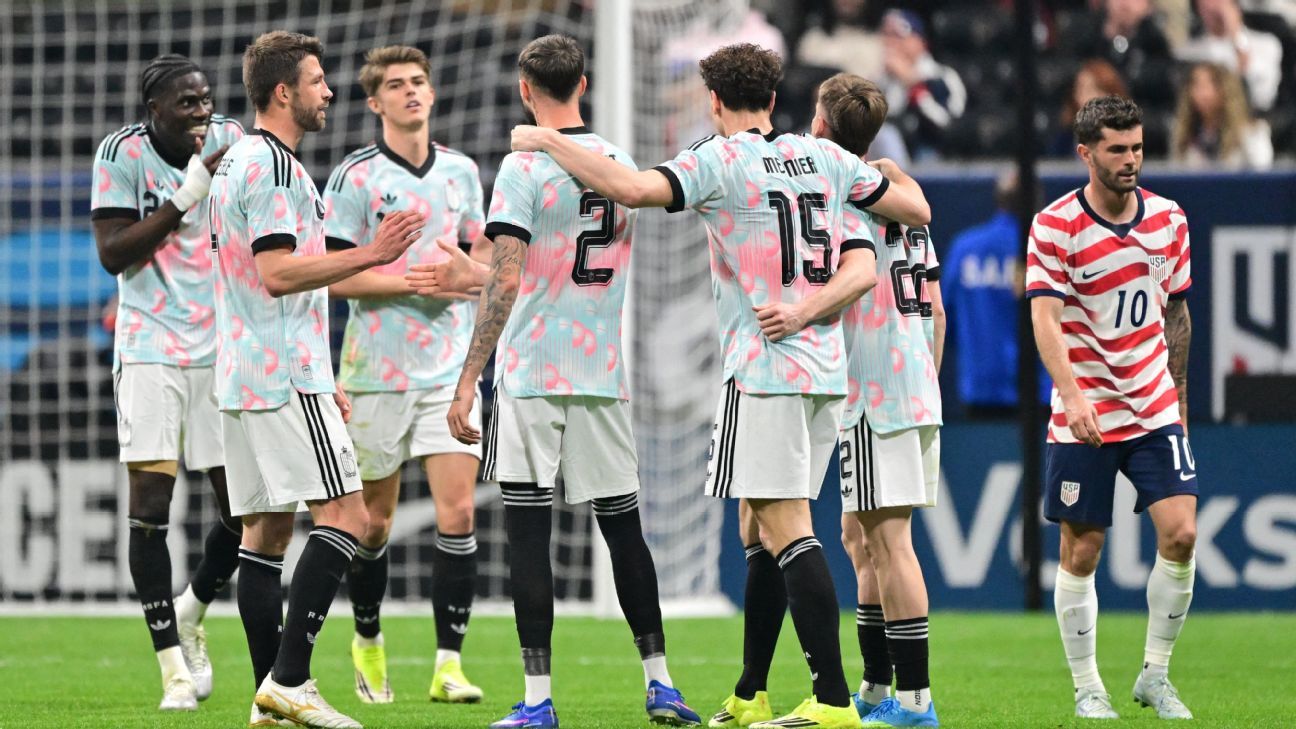
The United States men's national team suffered a setback in its preparations for the World Cup as Belgium ran rampant in the second half to emerge with a 5-2 win at Atlanta's Mercedes-Benz Stadium on Saturday.
The U.S. had not lost by three goals in a home game in which it scored the opening goal since an 8-1 defeat to England in 1959, according to Opta.
- Pulisic, U.S. 'shocked' by Belgium jersey clash
- USMNT handed reality check by Doku, Belgium ahead of World Cup
- Player ratings: Weah poor as USMNT suffer heavy Belgium defeat
"It's a good reality check for us," Pochettino said at a news conference.
"I think we need competitive games to arrive to the World Cup in our best," he added. "I think we cannot arrive with the wrong idea that we are so good, we are so handsome, we are so well-dressed and we are Americans.
"And it's good to feel that, but if we want to win the World Cup, if we want to go next to the next station in the group and we want to beat Paraguay, do you think that they are not going to fight?"
Weston McKennie started for the U.S. and scored the opening goal in the 39th minute off Antonee Robinson's corner. It was McKennie's 12th international goal and first in three years.
But Zeno Debast scored a long-range equalizer for Belgium right before halftime, and the No. 9-ranked visitors scored three more times in a 15-minute span in the second half to expose some defensive vulnerabilities for Pochettino's side.
Amadou Onana scored in the 53rd minute, and Charles De Ketelaere increased Belgium's lead to 3-1 with a penalty kick in the 59th minute. Dodi Lukebakio beat goalkeeper Matt Turner with a curling effort into the top corner to push the lead to 4-1.
Lukebakio added his second goal of the match in the 82nd minute as some fans among the largely pro-American crowd of 66,867 exited. U.S. substitute Patrick Agyemang scored in the 87th minute.
The loss snapped the U.S.'s five-game unbeaten streak, which was tied for the best run of Pochettino's tenure.
While acknowledging it was a humbling result for his side, Pochettino insisted there was no need to panic just over two months before the World Cup begins.
"I think it's the last thing to be concerned about the World Cup," he said.
"I think that, of course, 5-2 is always difficult to accept. It's painful, but at the same time, I think we need to take so many positive things. The first half was really good. I think we really play better than Belgium.
"I think we create chances to finish the 45 minutes in a positive way, but we concede in the last action of the first half, and then there was an impact. And it's true that after the second half, it really was difficult for us."
Christian Pulisic failed to convert several good scoring chances. He entered scoreless in his past 12 games with AC Milan and extended his U.S. goal drought to seven games since November 2024.
"Of course, I'm disappointed. I have to finish my chances," Pulisic said. "They aren't easy chances, but at certain moments, that I expect to do better, for sure."
Last fall's unbeaten streak included wins over Japan (currently No. 18), Australia (27), Paraguay (38) and Uruguay (17), plus a draw vs. Ecuador (23). The U.S. plays No. 5 Portugal on Tuesday in its last game before Pochettino announces his World Cup roster at the end of May.
"We have to beat teams like this if we want to have a chance to go far in the tournament," Pulisic said.
Injuries to Sergiño Dest, Chris Richards and Miles Robinson left the 15th-ranked U.S. short-handed in defense, while midfielder Tyler Adams was also unavailable Saturday. As a result, Tim Weah started at right back and struggled against Belgium's Manchester City winger Jérémy Doku.
It was also a frustrating afternoon for Turner, the former No. 1 American goalkeeper who made his first appearance since last June. Left back Antonee Robinson was making his first appearance since Nov. 18, 2024, because of injury.
"We didn't defend our box well enough," Turner said. "That's something that we cannot have. We can't accept that we didn't lay everything on the line to keep the ball out of the back of the net because that's when our tails should be up the most."
Belgium was missing striker Romelu Lukaku, midfielders Leandro Trossard and Hans Vanaken and goalkeeper Thibaut Courtois because of injuries and fitness issues. The Red Devils play Mexico in Chicago on Tuesday.
"This team is better than the result," Belgium coach Rudi Garcia said of the U.S. "We started bad, but also because the USA was more aggressive than us."
ESPN's Jeff Carlisle and The Associated Press contributed to this report.
Facts Only
The United States men's national soccer team lost 5-2 to Belgium in a World Cup preparation match on Saturday at Mercedes-Benz Stadium in Atlanta.
The U.S. had not lost by three goals in a home game where it scored first since an 8-1 defeat to England in 1959.
Weston McKennie scored the opening goal in the 39th minute, his 12th international goal and first in three years.
Zeno Debast equalized for Belgium right before halftime with a long-range shot.
Belgium scored three goals in a 15-minute span in the second half: Amadou Onana (53rd minute), Charles De Ketelaere (59th minute, penalty), and Dodi Lukebakio (63rd minute).
Lukebakio added a second goal in the 82nd minute, making it 5-1.
U.S. substitute Patrick Agyemang scored in the 87th minute to make the final score 5-2.
The loss ended the U.S.'s five-game unbeaten streak, tied for the best run under coach Mauricio Pochettino.
The U.S. was missing defenders Sergiño Dest, Chris Richards, and Miles Robinson, as well as midfielder Tyler Adams, due to injuries.
Tim Weah started at right back and struggled against Belgium's Jérémy Doku.
Matt Turner, the U.S. goalkeeper, made his first appearance since June 2024.
Antonee Robinson, the left back, played his first match since November 18, 2024, due to injury.
Belgium was without Romelu Lukaku, Leandro Trossard, Hans Vanaken, and Thibaut Courtois due to injuries and fitness issues.
The U.S. will play Portugal on Tuesday in its final match before Pochettino announces the World Cup roster at the end of May.
Executive Summary
The United States men's national soccer team suffered a 5-2 defeat to Belgium in a World Cup preparation match at Atlanta's Mercedes-Benz Stadium. The U.S. took an early lead with Weston McKennie's goal in the 39th minute, but Belgium responded with five unanswered goals, including two from Dodi Lukebakio. The loss ended the U.S.'s five-game unbeaten streak and exposed defensive vulnerabilities, particularly with key players like Sergiño Dest, Chris Richards, and Tyler Adams sidelined due to injuries. Coach Mauricio Pochettino described the match as a "reality check" but emphasized the need for competitive games ahead of the World Cup. Belgium, ranked ninth in the world, played without several key players, including Romelu Lukaku and Thibaut Courtois. The U.S. will face fifth-ranked Portugal in their final match before Pochettino announces the World Cup roster in late May.
The result highlighted both the U.S.'s potential and its defensive frailties, with Pochettino noting the team's strong first-half performance before conceding critical goals. Christian Pulisic, the team's star forward, continued his goal drought, missing several scoring opportunities. The match drew a largely pro-American crowd of 66,867, though some fans left early as Belgium extended its lead. Belgium's coach, Rudi Garcia, acknowledged the U.S.'s aggressive start but praised his team's resilience in the second half. The U.S. now faces the challenge of addressing its defensive issues and improving its finishing ahead of the World Cup.
Full Take
This match serves as a microcosm of the U.S. men's national team's current trajectory: flashes of promise undermined by persistent vulnerabilities. The strongest version of this narrative is that the U.S. is a work in progress, with Pochettino using this defeat as a teachable moment rather than a crisis. The team's first-half performance—dominant in possession and creativity—suggests they can compete with elite sides, but the defensive collapse in the second half reveals a fragility that opponents will exploit. Pochettino's framing of the loss as a "reality check" is strategically sound, shifting focus from the scoreline to the process of improvement. However, the pattern of defensive lapses and Pulisic's continued goal drought raises questions about whether this team can consistently perform under pressure.
The narrative aligns with a common sports media trope: the "useful defeat," where a loss is reframed as a necessary step toward growth. While this isn't inherently manipulative, it risks downplaying structural issues—such as the lack of depth in defense and the overreliance on Pulisic's creativity—under the guise of "learning experiences." The absence of key players due to injury further complicates the assessment: was this a systemic failure or a one-off due to a depleted squad? The emphasis on Belgium's missing stars (Lukaku, Courtois) serves as a subtle deflection, implying the U.S. might have fared better under different circumstances. Yet, the reality is that top teams adapt to absences; the U.S. did not.
Rooted in the broader paradigm of American soccer's ambition, this moment echoes past cycles where potential is celebrated more than results. The assumption that competitive games alone will prepare the team for the World Cup ignores the need for tactical cohesion and mental resilience. Historically, U.S. soccer has struggled with consistency against elite opposition, and this match reinforces that pattern. The implications for human agency are clear: the players and coaching staff must confront these weaknesses head-on, or risk repeating the same mistakes in the World Cup.
Bridge questions: If the U.S. cannot defend its box against a Lukaku-less Belgium, how will it fare against World Cup opponents with full-strength attacks? What would it take for Pulisic to regain his scoring form, and how does his drought affect team morale? How much of this loss is attributable to injuries versus tactical shortcomings?
Counterstrike scan: A coordinated influence campaign would amplify the narrative of U.S. soccer's "inevitable rise" while dismissing losses as anomalies, using emotional appeals to patriotism and progress. The actual content avoids this trap by acknowledging flaws, though it stops short of demanding accountability. No structural alignment with manipulation patterns detected.
Patterns detected: none
Sentinel — Human
While the text shows signs of a human writer, it's worth noting that AI-assisted journalism is becoming more sophisticated. Always verify information from multiple sources to maintain cognitive sovereignty.