Tenzin Nyidon
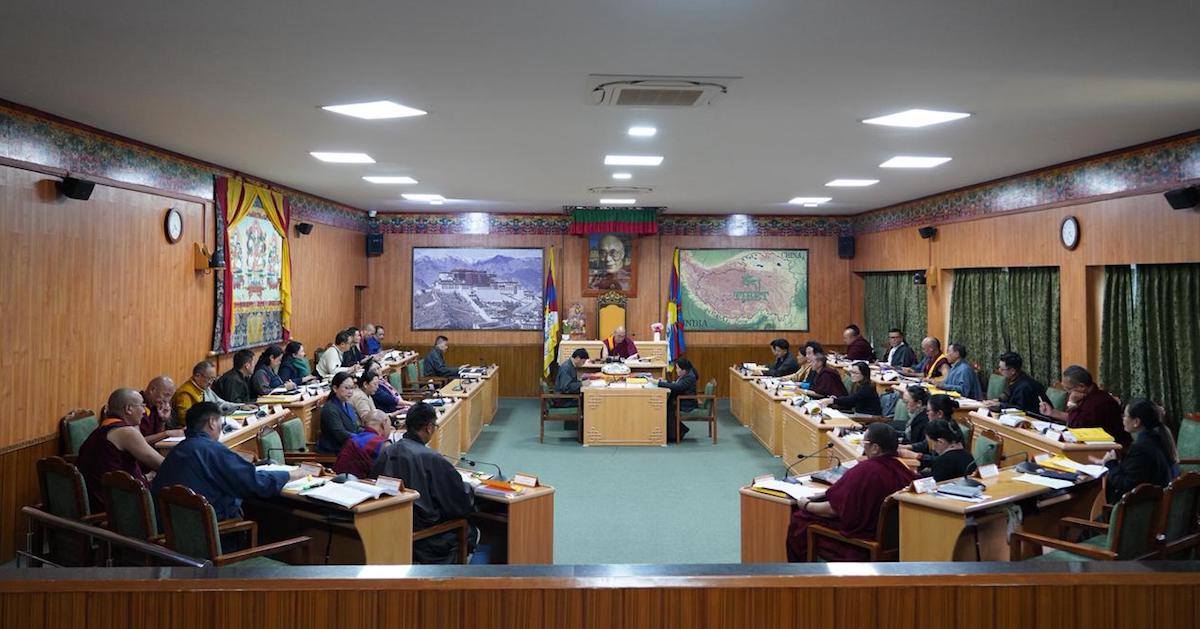
DHARAMSHALA, March 23: The Tibetan Parliament-in-Exile on Monday unanimously passed a strongly worded resolution condemning China’s newly introduced Law on Promoting Ethnic Unity and Progress, describing it as a coercive legal instrument aimed at erasing the distinct identity of the Tibetan people.
The resolution was tabled by the President of the Central Tibetan Administration (CTA), Penpa Tsering, proposed on behalf of the Cabinet, the motion received formal support from Norzin Dolma, Minister of the Department of Information and International Relations. Following deliberations, the resolution was adopted unanimously by the house.
In its preamble, the resolution highlighted that China’s National People’s Congress formally adopted the law on March 12, 2026, with its implementation scheduled to begin on July 1, 2026. The Tibetan Parliament asserted that the law fundamentally contradicts both international legal standards and the constitutional guarantees provided under China’s own legal framework, particularly those concerning ethnic autonomy and equality.
The seven-point resolution strongly criticized the law as a mechanism designed to institutionalize forced assimilation. It argued that the policy framework underpinning the legislation is rooted in the Chinese government’s so-called “second-generation ethnic policy,” which seeks to dismantle ethnic autonomy and subsume distinct identities under the broader construct of a singular “Chinese nation” or Zhonghua Minzu. The Parliament emphasized that such an approach denies the historical, cultural, linguistic, and religious uniqueness of the Tibetan people.
A central concern raised in the resolution is the law’s emphasis on fostering a “shared sense of identity” aligned with the Chinese nation. Lawmakers warned that this objective is being pursued through sweeping state interventions across education, governance, cultural expression, and religious practice. The resolution pointed to provisions mandating the dominance of Mandarin as the primary medium of instruction from early education, the standardization of curricula, and the marginalization of Tibetan language and knowledge systems.
Further, the resolution noted that the law enforces cultural transformation through policies that alter traditional architectural styles, place names, and social customs, while promoting the “Sinicization” of religion. It also raised alarm over directives encouraging inter-ethnic “integration” through population movement, cross-regional employment, and administrative restructuring—measures that Tibetan lawmakers argue are aimed at diluting demographic and cultural continuity in Tibetan areas.
The Parliament also expressed concern over the law’s governance mechanisms, which consolidate authority under the Chinese Communist Party and integrate ethnic affairs into an expansive surveillance and social control system. It warned that the weakening of regional autonomy, combined with enhanced monitoring and political vetting, would further restrict the already limited space for cultural and political expression within Tibet.
Another significant issue highlighted in the resolution is the extraterritorial scope of the law, which purports to hold individuals and organizations outside China accountable for actions deemed supportive of “separatism.” The Parliament viewed this as an alarming expansion of legal overreach that could target Tibetan diaspora communities and advocacy efforts worldwide.
Reaffirming its political position, the Tibetan Parliament declared that Tibet remains an occupied nation and rejected any attempt to reclassify Tibetans as merely a component of the Chinese national identity. The resolution called on the Chinese government to immediately withdraw the law and cease policies that undermine the fundamental rights of the Tibetan people.
The Parliament further urged the United Nations and the international community to undertake an urgent legal review of the legislation and to take concrete measures to prevent what it described as cultural genocide. It also appealed for accountability mechanisms to ensure that those responsible for such policies are held to account under international law.
In a message directed at Tibetans inside Tibet, the resolution called for resilience and steadfast commitment to preserving Tibetan identity, culture, language, and religious traditions. It also encouraged Tibetans in exile to intensify advocacy efforts, raise global awareness, and mobilize collective action against the law.
The resolution also proposed annual activities during the fourth week of September to preserve and promote Tibetan identity. It called on Tibetan organizations worldwide to strengthen coordinated international engagement to counter the implications of China’s policies.
Facts Only
The Tibetan Parliament-in-Exile passed a resolution condemning China’s Law on Promoting Ethnic Unity and Progress.
The law is scheduled to begin implementation on July 1, 2026.
The resolution asserts that the law contradicts international legal standards and Chinese constitutional guarantees for ethnic autonomy and equality.
Central concerns include the law's emphasis on a shared sense of identity with the Chinese nation, cultural transformation policies, governance mechanisms, and extraterritorial scope.
Tibetan Parliament declared that Tibet remains an occupied nation.
Executive Summary
The Tibetan Parliament-in-Exile, comprising the Central Tibetan Administration (CTA), has unanimously passed a resolution condemning China's newly introduced Law on Promoting Ethnic Unity and Progress. The law is viewed as a coercive measure aimed at erasing the distinct identity of the Tibetan people. The Parliament asserted that the law contradicts international legal standards and Chinese constitutional guarantees for ethnic autonomy and equality.
The resolution raised concerns over the law's emphasis on fostering a shared sense of identity with the Chinese nation, which is being pursued through interventions in education, governance, cultural expression, and religious practice. The law enforces cultural transformation through policies that alter traditional architectural styles, place names, and social customs while promoting the "Sinicization" of religion.
The Parliament also expressed concern over the law's governance mechanisms, which consolidate authority under the Chinese Communist Party and integrate ethnic affairs into an expansive surveillance and social control system. This could further restrict the already limited space for cultural and political expression within Tibet.
The resolution proposed annual activities during the fourth week of September to preserve and promote Tibetan identity. It called on Tibetan organizations worldwide to strengthen coordinated international engagement to counter the implications of China's policies.
Full Take
In Skeptical Mode:
Steelman: The Tibetan Parliament's resolution presents a strong case against China's Law on Promoting Ethnic Unity and Progress, portraying it as a coercive measure aimed at erasing the distinct identity of the Tibetan people. The resolution highlights concerns over the law's emphasis on fostering a shared sense of identity with the Chinese nation, cultural transformation policies, governance mechanisms, and extraterritorial scope.
Patterns Detected: ARC-0024 Ambiguity (the resolution does not explicitly define what constitutes a "distinct identity" or "coercive measure"); ARC-0043 Motte-and-Bailey (the resolution presents strong criticism of the law, while also advocating for increased international engagement and preservation of Tibetan identity).
Root Cause: The tension between China's desire for cultural homogeneity and the Tibetans' assertion of their distinct identity is rooted in historical disagreements over autonomy and self-determination.
Implications: If implemented, the law could significantly impact the cultural, political, and religious expression of Tibetan communities both within and outside China. The resolution calls for increased international scrutiny and intervention to prevent potential cultural genocide.
Bridge Questions: What are the long-term implications of this law on the relationship between China and the global community? How might these policies impact Tibetans living inside and outside China? What role should international organizations play in addressing the concerns raised by the Tibetan Parliament?
Sentinel — Human
The text appears to be written by a human journalist due to its idiosyncratic emphasis, personal voice, and varied sentence length, contrasting with the stylometric signals typically associated with AI-generated content.