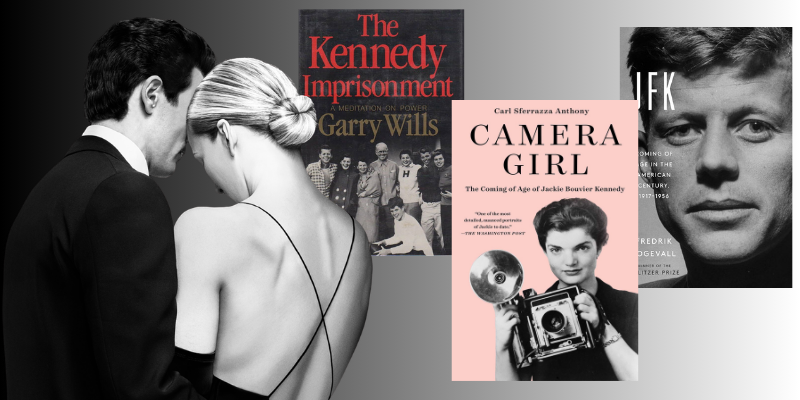
A Kennedy-curious reading list.
I can’t speak for your algorithm, but mine is a sea of tortoise-shell headbands and musings on the return of minimalism. This is care of Love Story, the latest entry in the Ryan Murphy multiverse. This new series depicts the whirlwind romance and tragic end of Carolyn Bessette-Kennedy and JFK Jr.
Another series on that same political dynasty is slated to hit Netflix soon, so I’m predicting the long term return of classy separates. Meanwhile, living Kennedys continue to shape our politics. For TBD-good? and definitely ill.
Why can’t America quit this family? From their aesthetics to their secrets to their disproportionately tragic ends?
In Book World, Kennedy-proximate memoirs and tell-alls form something of a cottage industry. (One such, Elizabeth Beller’s Once Upon a Time: The Captivating Life of Carolyn Bessette-Kennedy inspired Love Story.) But all the myth and sorrow around the dynasty mean many takes tilt hagiographic.
For those of us looking to glimpse behind that glamorous curtain, here are a few novels and histories that help contextualize an American obsession.
*
Don DeLillo, Libra
This book recently zipped to the top of my library hold list thanks to a recommendation from the late Greg Tate. A speculative reconstruction of JFK’s murder following Lee Harvey Oswald and the CIA, Libra is a plotty novel for a paranoid age.
Tate called this labyrinthine project inevitable. “Not just because [DeLillo’s] fascinated with the conspiratorial bent of the human species, but because in DeLillo’s fiction Everyman is as culpable for the state of things as the monstrous secret agencies of power.” Here be a yarn full of small-time operators, “ethical blind sides,” and “surgical and shamanistic” sentences.
Gary Wills, The Kennedy Imprisonment: A Meditation On Power
This 1982 book from a nuanced historian amounts to “a devastating portrait of an Irish-Catholic family who strove to be accepted at the most rarified heights of American society—and then, when they weren’t, relentlessly pursued political power.” Pick this one up if you want to better understand—or possibly debunk—the Kennedy mythos.
Kicking off with the patriarch, Joe, Wills’ masterpiece is a great counterpoint to only loving looks. For a great overview of this project, listen to this episode of “Know Your Enemy.”
Joyce Carol Oates, Black Water
This short, engrossing novel from one of our most prolific students of the 20th century follows a (lightly) fictional Senator and the companion he drowns in a disastrous accident. Modeled on the tragedy at Chappaquiddick Island—where Mary Jo Kopechne and Senator Edward Kennedy died under similar circumstances—Oates’ book shows how great power can beget violence.
As Oates told Richard Bausch on publication, Black Water is more concerned with the culture that allowed this incident than the Kennedys themselves. “I wanted the story to be somewhat mythical, the almost archetypal experience of a young woman who trusts an older man and whose trust is violated.”
Fredrik Logevall, JFK: Coming of Age in the American Century
This first part of a two volume biography is the culmination of a decade-long obsession. Harvard historian Logevall is determined to place Kennedy in political context. Here we find a rare analysis of the ideology guiding America’s closest-thing-to-a-prince, and a sweeping sense of the world that formed his thinking.
This book concludes in 1956, just as Kennedy is set to come second on the Vice Presidential ballot at the convention. There’s a lot of ground covered in this come-up, but plenty of “narrative drive.”
Carl Sferrazza Anthony, Camera Girl
Anthony, the author of a dozen books about presidential wives and families, here illuminates the early days of America’s most photographed woman.
Tracing Jackie’s origins from Vassar to post-war Paris to the American newsroom, this biography keeps a tight aperture. The first lady is placed in a legible constellation. There are the striving, dysfunctional parents, and the politically calculating peers. And of course, the handsome scion, before he’s fully formed.
This book was lauded on its release for getting candid about the woman known for her classy exterior. Did you know Jackie O once sent her mother a dead snake inside a hatbox?
Heroic? Maybe. But humans, all.
Brittany Allen
Brittany K. Allen is a writer and actor living in Brooklyn.
Facts Only
FX’s *Love Story* depicts the romance and tragic end of Carolyn Bessette-Kennedy and JFK Jr.
A Netflix series about the Kennedy political dynasty is forthcoming.
Elizabeth Beller’s *Once Upon a Time: The Captivating Life of Carolyn Bessette-Kennedy* inspired *Love Story*.
Don DeLillo’s *Libra* is a speculative novel about JFK’s assassination, focusing on Lee Harvey Oswald and the CIA.
Gary Wills’ *The Kennedy Imprisonment* (1982) critiques the Kennedy family’s pursuit of power and social acceptance.
Joyce Carol Oates’ *Black Water* fictionalizes the Chappaquiddick incident involving Senator Edward Kennedy and Mary Jo Kopechne.
Fredrik Logevall’s *JFK: Coming of Age in the American Century* is a political biography covering JFK’s life up to 1956.
Carl Sferrazza Anthony’s *Camera Girl* examines Jackie Kennedy’s early life, including her time at Vassar and in Paris.
Jackie Kennedy once sent her mother a dead snake in a hatbox.
The article is written by Brittany K. Allen, a writer and actor based in Brooklyn.
Executive Summary
Full Take
The strongest version of this narrative is its framing of the Kennedy family as a cultural obsession—both glamorous and tragic—while offering a curated reading list to contextualize their mythos. The piece acknowledges the family’s enduring influence on politics and aesthetics, and it balances admiration with critique, particularly through books like *The Kennedy Imprisonment* and *Black Water*, which challenge hagiographic portrayals.
Patterns detected: none. The article avoids emotional exploitation or distortion, presenting the Kennedys as a complex subject worthy of critical examination. It doesn’t force a binary view (e.g., "heroic vs. villainous") but instead invites readers to explore nuanced perspectives.
Root cause: The Kennedy family’s mythos persists because it embodies contradictions—power and tragedy, glamour and dysfunction—that resonate with broader American narratives about ambition, privilege, and downfall. The article assumes readers are already familiar with the Kennedys’ cultural footprint, focusing on how literature can deepen understanding rather than rehashing their story.
Implications: The Kennedy obsession reflects a societal tendency to mythologize political dynasties, often at the expense of critical scrutiny. The reading list serves as a corrective, offering tools to dissect power structures and the human costs of ambition. However, the focus on books and media risks reinforcing the very fascination it seeks to contextualize.
Bridge questions: How does the Kennedy mythos compare to other political dynasties in terms of cultural longevity? What perspectives are missing from this reading list—perhaps voices from outside the elite circles that shaped their legacy? Would a focus on policy over personality change how we view their impact?
Counterstrike scan: If this were part of a coordinated campaign, the playbook might emphasize the Kennedys’ tragic allure to drive engagement with related media (e.g., *Love Story*, Netflix’s upcoming series). The actual content, however, resists sensationalism, instead directing readers toward substantive analysis. No structural alignment with manipulation tactics is detected.
Sentinel — Human
The article exhibits strong human signals, including a distinct personal voice, erratic stylistic choices, and subjective cultural commentary, with no detectable AI-generated patterns.