Shipping executives meeting in Athens on Monday said that any peace deal worked out between the United States and Iran would need to offer clear rules allowing vessels to resume normal business via the Strait of Hormuz.
Shipowners and maritime industry officials met at a Capital Link conference and other events to begin Posidonia, a week-long biennial shipping exhibition.
Below are selected quotes (in alphabetical order):
ARSENIO DOMINGUEZ, SECRETARY GENERAL, INTERNATIONAL MARITIME ORGANISATION (IMO)
“There have been … recent announcements that there’s a possibility of a 60-day ceasefire. If that includes, of course, the Strait of Hormuz, and I can get guarantees from the countries that it is safe to start using the waterway, that’s where the evacuation framework immediately will come and kick in. That’s what we’re looking for, because the first objective is always to seafarers, to engage, so they can actually leave the conflict zone.”
PANKAJ KHANNA, PRESIDENT, HEIDMAR MARITIME HOLDINGS CORP
“What we need is obviously a framework, a rules regulation, whatever tells us exactly how we can go in and get out. So even if a peace deal was signed, that needs to be clarified and that we don’t know as yet.
Khanna said the company had a vessel stuck inside the Gulf for the past three months and noted the impact on seafarers: “Obviously the seafarers on board are missing out, not only on seeing their families but also on births, on deaths, on marriages.”
VASILIS KIKILIAS, GREECE’S SHIPPING MINISTER
“Can somebody predict (an end to the conflict)? Unfortunately, no… Things get messy in terms of conflicts very, very easily, and they get untangled, (but that is) very, very difficult.
“We are hoping, of course, that there will be a solution. We cannot accept that there will be no free (passage) for ships all over the globe. I wish that they would leave the shipping industry, the seafarers, and global trade out of the equation, but it seems like this is impossible.”
EVANGELOS MARINAKIS, FOUNDER AND CHAIRMAN, CAPITAL MARITIME & TRADING CORP
“We all agree that the war should stop, should finish yesterday even … the consumer pays the price all around the world.”
“On the other hand ..from what we have seen so far, we can afford to wait for two weeks more, one month more … if the final agreement was good for all of us… an agreement that would make us feel safe and confident for the future.
“I am quite optimistic that waiting for a couple of weeks or a month, a solution will be found.”
GEORGE PROCOPIOU, FOUNDER, DYNACOM TANKERS MANAGEMENT, DYNAGAS AND SEA TRADERS
“Freedom of navigation is essential and nobody can impose tolls or any other burden.”
“Greece has the tradition of breaking blockades since antiquity.”
YIANNIS PROCOPIOU, CEO, CENTROFIN MANAGEMENT
“While insurance might be available, this does not mean that the strait is really a place where you want to be transiting, at least until we have clear rules of engagement as the shipping industry, as to how we deal with the two nations that are involved here, the U.S. and Iran …That’s, right now, a very high risk proposition.”
(Reporting by Renee Maltezou and Jonathan Saul; editing by Jason Neely)
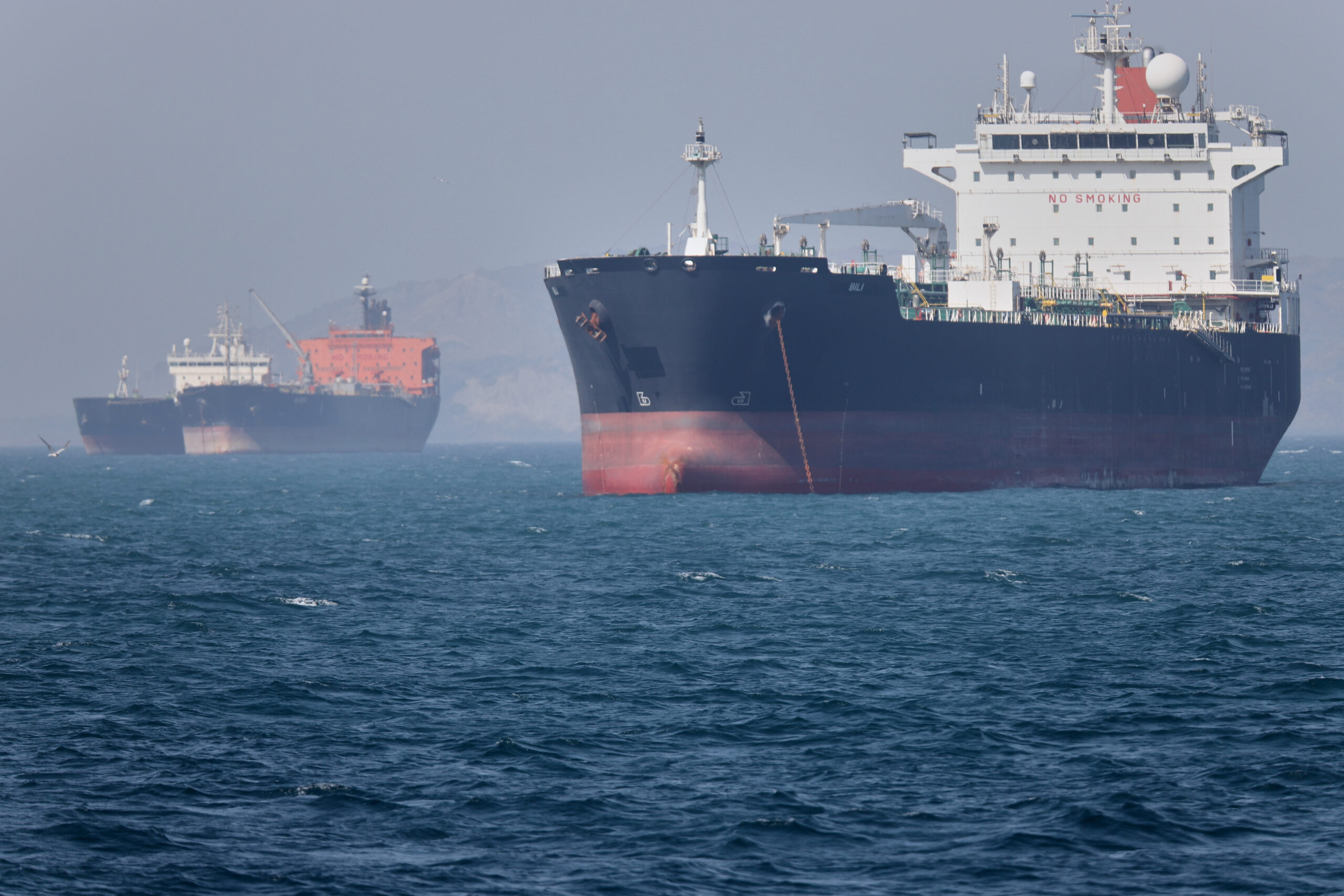
Photograph: Oil tankers sit at anchor offshore in the Strait of Hormuz off Bandar Abbas, Iran, Saturday, May 2, 2026. (Amirhosein Khorgooi/ISNA via AP)
Related:
Was this article valuable?
Here are more articles you may enjoy.
Facts Only
Shipping executives met in Athens on Monday during Posidonia, a biennial shipping exhibition.
The focus was on the need for clear rules allowing vessels to resume normal operations via the Strait of Hormuz.
Arsenio Dominguez, Secretary General of the International Maritime Organisation (IMO), mentioned a potential 60-day ceasefire and the need for safety guarantees to activate evacuation frameworks.
Pankaj Khanna, President of Heidmar Maritime Holdings Corp, stated that a peace deal must include clear regulations for vessel movement and noted a company vessel had been stuck in the Gulf for three months.
Vasilis Kikilias, Greece’s Shipping Minister, expressed uncertainty about predicting an end to the conflict and emphasized the importance of free passage for global trade.
Evangelos Marinakis, Founder and Chairman of Capital Maritime & Trading Corp, called for an end to the war and expressed optimism about a solution within weeks or months.
George Procopiou, Founder of Dynacom Tankers Management, stressed the essential nature of freedom of navigation and referenced Greece’s history of breaking blockades.
Yiannis Procopiou, CEO of Centrofin Management, highlighted the high risks of transiting the Strait of Hormuz without clear rules of engagement.
The conference included discussions on the impact of conflicts on seafarers, global trade, and insurance challenges.
A photograph showed oil tankers anchored in the Strait of Hormuz off Bandar Abbas, Iran, on May 2, 2026.
The event was reported by Renee Maltezou and Jonathan Saul, with editing by Jason Neely.
Executive Summary
Shipping executives gathered in Athens during Posidonia, a biennial maritime exhibition, to discuss the impact of geopolitical tensions on global trade, particularly focusing on the Strait of Hormuz. Key concerns included the need for a clear framework to ensure safe passage through the strait, which has been disrupted by conflicts involving the U.S. and Iran. Industry leaders emphasized the human cost, with seafarers stranded for months and global supply chains facing disruptions. While some expressed cautious optimism about potential ceasefires or peace deals, others highlighted the unpredictability of conflicts and the necessity of freedom of navigation. The International Maritime Organisation (IMO) indicated readiness to activate evacuation protocols if safety guarantees were provided. Insurers and shipowners stressed the high risks of transiting the strait without defined rules of engagement, underscoring the broader economic and humanitarian stakes.
The discussions reflected a mix of urgency and pragmatism, with stakeholders acknowledging the complexity of resolving geopolitical tensions while advocating for solutions that prioritize seafarer safety and uninterrupted trade. The Greek shipping minister and other executives called for shipping to be exempt from geopolitical conflicts, though they recognized the challenges of achieving this in practice. The tone was one of measured hope, with some suggesting that a short-term delay for a robust agreement might be preferable to a hasty, unstable resolution.
Full Take
The strongest version of this narrative centers on the shipping industry’s urgent need for stability in the Strait of Hormuz, framing it as a humanitarian and economic imperative. Executives and officials articulate a clear demand for predictable rules of engagement, emphasizing the plight of seafarers and the broader consequences of disrupted trade. The tone is pragmatic, acknowledging geopolitical complexities while advocating for shipping’s neutrality in conflicts. This steelman highlights the industry’s role as a stabilizing force in global commerce, appealing to shared interests in safety and continuity.
Patterns detected: none. The reporting avoids emotional exploitation or distortion, presenting multiple perspectives without forcing a binary choice. However, the root cause paradigm assumes that geopolitical conflicts can be neatly separated from economic interests—a questionable premise. The narrative echoes historical patterns of maritime neutrality claims, yet it understates how deeply shipping is entangled with state power and sanctions regimes. The implications for human agency are significant: seafarers bear the immediate costs of geopolitical brinkmanship, while consumers absorb long-term economic ripple effects. Who benefits? Insurers and states leveraging maritime chokepoints as bargaining chips. Second-order consequences include potential shifts in trade routes, insurance premiums, and even energy markets if the strait remains volatile.
Bridge questions: How might the shipping industry’s calls for neutrality clash with states’ strategic use of maritime blockades? What historical precedents exist for "rules of engagement" in contested waterways, and why have they succeeded or failed? Would a ceasefire in the Strait of Hormuz hold if broader U.S.-Iran tensions remained unresolved?
Counterstrike scan: If this were part of a coordinated campaign, the playbook might involve amplifying industry voices to pressure governments into concessions, framing shipping as a neutral victim to obscure its role in sanctions enforcement. However, the content does not structurally align with such manipulation—it reflects genuine industry concerns without overt advocacy for a specific geopolitical outcome. The focus remains on operational clarity rather than partisan alignment.
Sentinel — Human
This text is highly likely human-written journalistic content, characterized by direct attribution of expert opinions and context-specific reporting on maritime and geopolitical risks.