“‘In the beginning God created the heaven and the earth.’ When I think there was a day when a human hand first wrote those words, I am filled with awe. This sentence is a masterpiece of compression. It approximates as closely as words allow the instantaneous realization of an intent, the bringing into being of the diversity of things that make up the world of fundamental human experience.”
— Marilynne Robinson
The words that open Genesis — and the Bible — are so well and widely known, it’s easy to overlook their incredible uniqueness and power. As Robinson, a world-renowned novelist and essayist, points out, nothing quite like them exist anywhere else in ancient literature.
The Story of God Commentary series, with 11 volumes from the Old Testament now available with Bible Gateway Plus, is the perfect resource to help understand the full impact of those words (and many more) with fresh eyes and ears.
As you study, you’ll find that the commentary on each passage is broken into three sections:
- “Listen to the Story” presents the Bible passage in the New International Version (NIV).
- “Explain the Story” examines the passage for its essential message and meaning.
- “Live the Story” explores how we can live this text in the world today. It offers insightful reflections, illustrations, and practical suggestions for daily Christian life and practice.
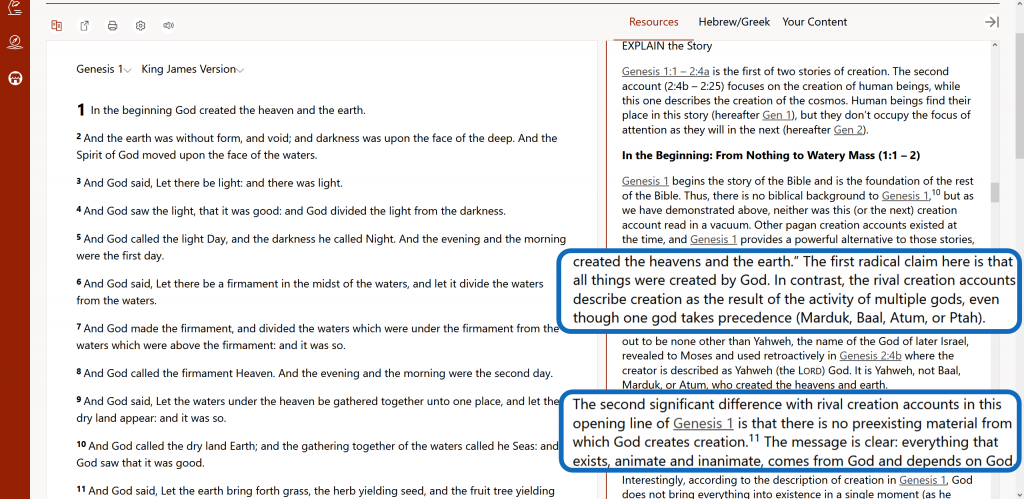
Let’s take a closer look at what “Explain the Story” highlights around Genesis 1:1. Two excerpts in particular reflect on what early pagans believed, how it differed from the account in Genesis, and how foundational these first few words are to our faith.
“The first radical claim here is that all things were created by God. In contrast, the rival creation accounts describe creation as the result of the activity of multiple gods, even though one god takes precedence (Marduk, Baal, Atum, or Ptah).”
“The second significant difference with rival creation accounts in this opening line of Genesis 1 is that there is no preexisting material from which God creates creation. The message is clear: everything that exists, animate and inanimate, comes from God and depends on God.”
We hope that this reinforces your beliefs and drives home how profound and life-altering these 10 opening words really are. To recreate this study with your Bible Gateway Plus membership, follow these steps:
- Search for Genesis 1 on BibleGateway.com.
- Click the Resources tab.
- Filter to Commentaries.
- Click the Story of God book cover to open the Resource.
- Scroll to the second article and click to expand.
- Then, scroll down until you find “EXPLAIN the Story” and continue reading.
As you deepen your study, we are pleased to provide the following volumes from this series to enhance your understanding of the Old Testament.
- Genesis
- Exodus
- Numbers
- Joshua
- Ruth, Esther
- 1-2 Samuel
- 1-2 Kings
- 1-2 Chronicles
- Proverbs
- Ecclesiastes, Song of Songs
- Daniel
Adding over $450 in value, while remaining less than $5/month, Bible Gateway Plus is the best value in Bible study with over $3,100 worth of resources.
Become a member today and learn more about The Story of God.
Facts Only
Marilynne Robinson is a world-renowned novelist and essayist.
The opening verse of Genesis is "In the beginning God created the heaven and the earth."
The Story of God Commentary series includes 11 Old Testament volumes.
The series is available through Bible Gateway Plus.
The commentary divides each passage into three sections: "Listen to the Story," "Explain the Story," and "Live the Story."
"Listen to the Story" presents the Bible passage in the New International Version (NIV).
"Explain the Story" examines the passage for its essential message and meaning.
"Live the Story" explores practical applications for daily Christian life.
Genesis 1:1 contrasts with pagan creation accounts by presenting a single creator God.
Pagan creation myths often involve multiple gods and preexisting material.
Bible Gateway Plus offers over $3,100 worth of resources for less than $5 per month.
The subscription includes volumes on Genesis, Exodus, Numbers, Joshua, Ruth, Esther, 1-2 Samuel, 1-2 Kings, 1-2 Chronicles, Proverbs, Ecclesiastes, Song of Songs, and Daniel.
Executive Summary
Full Take
The narrative presents Genesis 1:1 as a radical departure from ancient pagan creation myths, emphasizing its theological and literary uniqueness. The strongest version of this argument is that Genesis introduces a monotheistic creator who brings everything into existence ex nihilo, a concept absent in polytheistic traditions. The commentary series frames this as foundational to Christian faith, reinforcing its significance through structured analysis.
Pattern scan: The text employs authority games by invoking Marilynne Robinson’s reputation to bolster its claims (ARC-0012 Appeal to Authority). It also uses emotional exploitation by framing the opening of Genesis as "awe-inspiring" to evoke reverence (ARC-0008 Emotional Appeal). However, these are mild and contextually appropriate for a religious commentary.
Root cause: The paradigm driving this narrative is the defense of biblical uniqueness and divine sovereignty. It assumes the superiority of the Genesis account over pagan alternatives, which may overlook the cultural and historical context of these myths. The unstated assumption is that theological distinctiveness equates to truth, a common apologetic strategy.
Implications: For believers, this reinforces faith and provides tools for deeper study. For skeptics, it may highlight the subjective nature of interpreting ancient texts. The second-order consequence is the potential for insularity if readers only engage with materials that confirm their existing beliefs.
Bridge questions: How do other ancient creation myths compare in their literary and theological complexity? What historical evidence supports the claim that Genesis is unique in its monotheistic framework? Would the interpretation of Genesis 1:1 change if viewed through a non-theological lens?
Counterstrike scan: A coordinated influence campaign might use this narrative to promote exclusivist religious views, framing Genesis as superior to dismiss alternative traditions. However, the actual content focuses on educational commentary rather than overt proselytization, aligning more with scholarly engagement than manipulation.
Patterns detected: ARC-0012 Appeal to Authority, ARC-0008 Emotional Appeal
Sentinel — Human
The text exhibits signs of human authorship, such as varied sentence structure and a unique writing style that deviate from AI-generated patterns. However, it's important to note that these signs are not definitive and do not rule out the possibility of AI involvement.