Log in to your existing account or sign up today!
Log in to your existing account or sign up today!
Log in to your existing account or sign up today!
Nate Bargatze has built a career proving that comedy doesn't need coarse language or innuendo to make audiences laugh.
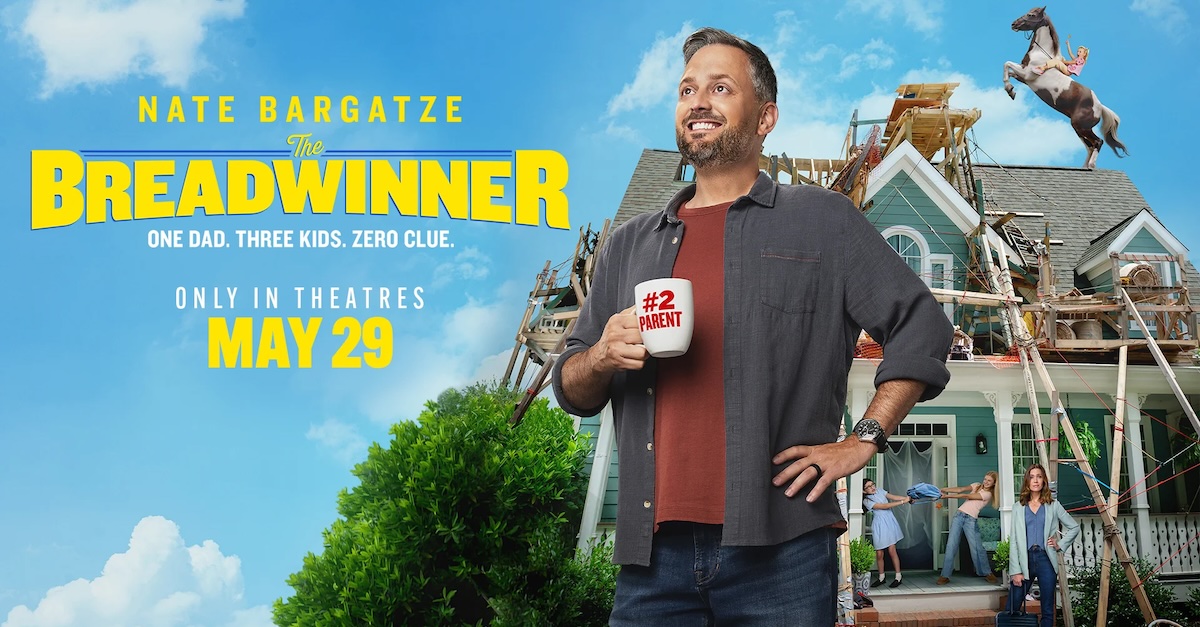
And now he has a movie, The Breadwinner (PG), delivering that same family-friendly punch.
The plot follows Bargatze’s character, Nate Wilcox, as he struggles with life as a stay-at-home dad after his wife (played by Mandy Moore) strikes a business deal on Shark Tank.
It’s a production of Wonder Project, Nateland Entertainment and One Man Canoe.
Here are three reasons families likely will love it:
1. Bargatze Takes Center Stage
Bargatze has become America's leading clean comedian thanks to a blend of deadpan delivery, relatable observations about everyday life and a trademark self-deprecating humor—a unique combination that has landed him on the Primetime Emmy Awards, Saturday Night Live and a CBS holiday special. He's the type of comedian mom and dad will enjoy just as much as the kids and the grandparents.
The Breadwinner is Bargatze's first feature film, and he takes center stage as a devoted dad who loves his three daughters—a teen, a tween and an elementary-age child—but quickly realizes he has plenty of catching up to do when it comes to the day-to-day responsibilities his wife has long handled.
Photo credit: ©WonderProject
2. It's a Rare Live-Action Family Comedy
2. It's a Rare Live-Action Family Comedy
SLIDE 1 OF 2
Critics of The Breadwinner will point to similar films such as Mr. Mom and Daddy Day Care and say there’s nothing new here. But those films were not nearly as family-friendly as The Breadwinner, and besides, this newest movie has plenty to set it apart.
The film opens with Nate Wilcox cruising through life as a successful car salesman—he's a six-time Salesman of the Year—while his wife, Katie, happily manages the household and cares for their three daughters. The story takes a turn when Katie's simple invention, a children's organizational tool called the “Star Minder,” catches the attention of friends who encourage her to market it and see if it has potential. Her dream quickly gains momentum when she lands a Shark Tank deal with Lori Greiner, sending her to South Korea for two weeks to find a manufacturer.
The film features Bargatze's trademark humor (“Dad, are you Mom now?” the kids ask, prompting him to reply with a deadpan, “Yes, I am your mother”). But it also includes several laugh-out-loud moments seemingly inspired by stories from his stand-up routines. He accidentally hires a roofer whom his wife specifically opposed. He buys his youngest daughter a horse in a misguided attempt to improve her behavior at school. Later, he discovers that the same horse is apparently dead in the backyard—a scenario drawn from one of his most famous comedy bits.
Admittedly, the film gets off to a somewhat generic start before finding its rhythm midway through. It culminates with Nate attempting an impossible balancing act: attending his tween daughter's spelling bee while simultaneously trying to accept his latest Salesman of the Year award back at the dealership.
(Comedians Colin Jost, Kumail Nanjiani, and Zach Cherry also have roles.)
There's also this: live-action comedies suitable for the entire family are becoming increasingly rare in Hollywood. In an era dominated by PG-13 fare, The Breadwinner offers something refreshingly different—a genuinely funny PG movie parents, children, and grandparents can enjoy together. We need more films like The Breadwinner, not fewer.
Photo credit: ©WonderProject
3. It Offers More Than Just Laughs
3. It Offers More Than Just Laughs
SLIDE 2 OF 2
The Breadwinner offers several worthwhile takeaways amid all the laughs. It affirms the role of stay-at-home moms (and dads), particularly early in the film, when Katie is shown embracing the daily responsibilities of motherhood not with frustration but with joy and purpose, knowing her work is making a lifelong difference. (Bargatze told media members he wanted the film to highlight the value of full-time moms.)
At the same time, the film offers a gentle reminder to parents: You can't be everywhere at once. Nate learns that lesson the hard way when he misses the final moments of his daughter's competition. Katie's overseas work, while necessary for a brief season, was likely not sustainable long-term. (This point is driven home when one of the children complains: “Our lives were fine before.”)
“We finally found the right work-life balance,” Nate says in the film’s closing scene. “We’re in this together now, which is how families should be.”
From a family content standpoint, The Breadwinner has only a few minor speed bumps. The teen daughter skirts Nate's rules by wearing midriff-baring tops to school (hidden beneath a sweater)—a rebellion that Nate counters by buying her a stack of turtlenecks. Nate himself attempts to conceal the house's deteriorating state from Katie, but he comes clean in the film's final moments and asks for her forgiveness.
Fans of Bargatze's humor will, no doubt, enjoy The Breadwinner—but I suspect the film’s appeal will extend far beyond his fan base.
Rated PG for some mild suggestive references. Coarse language: possibly two OMGs, heard in the background
Entertainment rating: 4 out of 5 stars.
Family-friendly rating: 4.5 out of 5 stars.
Photo credit: ©WonderProject
Log in to your existing account or sign up today!
Log in to your existing account or sign up today!
Log in to your existing account or sign up today!
Michael Foust has covered the intersection of faith and news for 20 years. His stories have appeared in Baptist Press, Christianity Today, The Christian Post, the Leaf-Chronicle, the Toronto Star and the Knoxville News-Sentinel.
Listen to Michael's Podcast! He is the host of Crosswalk Talk, a podcast where he talks with Christian movie stars, musicians, directors, and more. Hear how famous Christian figures keep their faith a priority in Hollywood and discover the best Christian movies, books, television, and other entertainment. You can find Crosswalk Talk on LifeAudio.com, or subscribe on Apple or Spotify so you never miss an interview that will be sure to encourage your faith.
Originally published May 29, 2026.
Facts Only
Nate Bargatze stars in *The Breadwinner*, his first feature film, as Nate Wilcox, a stay-at-home dad.
The film is rated PG and produced by Wonder Project, Nateland Entertainment, and One Man Canoe.
Mandy Moore plays Katie Wilcox, Nate’s wife, who secures a *Shark Tank* deal for her invention, the "Star Minder," and travels to South Korea.
Supporting roles include comedians Colin Jost, Kumail Nanjiani, and Zach Cherry.
The plot revolves around Nate struggling with household responsibilities after his wife’s business trip.
The film includes humor drawn from Bargatze’s stand-up routines, such as a dead horse in the backyard.
The story culminates with Nate trying to balance attending his daughter’s spelling bee and accepting a Salesman of the Year award.
The film affirms the value of stay-at-home parenting and explores work-life balance.
It is noted for being a rare live-action family comedy in a market dominated by PG-13 content.
The film received an entertainment rating of 4 out of 5 stars and a family-friendly rating of 4.5 out of 5 stars.
Minor content concerns include mild suggestive references and two background uses of "OMG."
The film was released on May 29, 2026.
Executive Summary
Full Take
*The Breadwinner* presents itself as a wholesome, family-friendly comedy, leveraging Nate Bargatze’s clean humor and relatable parenting struggles to appeal to a broad audience. The strongest version of this narrative is its emphasis on the value of stay-at-home parenting and the challenges of work-life balance, themes that resonate with many families. The film distinguishes itself in a market saturated with PG-13 content, offering a rare live-action comedy suitable for all ages. However, the premise—while heartwarming—is not entirely novel, echoing earlier films like *Mr. Mom* and *Daddy Day Care*. The film’s humor, drawn from Bargatze’s stand-up, reinforces its authenticity but may limit its appeal to those unfamiliar with his style.
Patterns detected: none. The narrative does not exhibit clear manipulation tactics, though it does rely on a familiar trope of parental role reversal for comedic effect. The underlying paradigm appears to be a celebration of traditional family values, with an unstated assumption that stay-at-home parenting is inherently noble and that work-life balance is achievable through mutual effort. This echoes broader cultural conversations about gender roles and parenting, though the film avoids overt political messaging.
The implications for human agency are mixed: while the film empowers stay-at-home parents, it also subtly reinforces the idea that one parent (typically the mother) should bear primary domestic responsibility, even as it critiques the unsustainability of such arrangements. The second-order consequence may be a reinforcement of traditional gender norms under the guise of progressive messaging about shared responsibility.
Bridge questions: How might the film’s portrayal of stay-at-home parenting resonate with families where both parents work full-time? Would the humor land as effectively without Bargatze’s established comedic persona? What perspectives on modern parenting are missing from this narrative?
Counterstrike scan: If this were part of a coordinated campaign, the playbook might involve promoting traditional family values under the banner of "wholesome entertainment" to appeal to conservative audiences while avoiding overt political alignment. However, the film’s content does not align with a structured influence operation; it appears to be a genuine attempt at family-friendly comedy.
Sentinel — Human
The text displays a highly polished, promotional style typical of human-written media review or editorial content, characterized by specific narrative details and subjective emotional appeals.