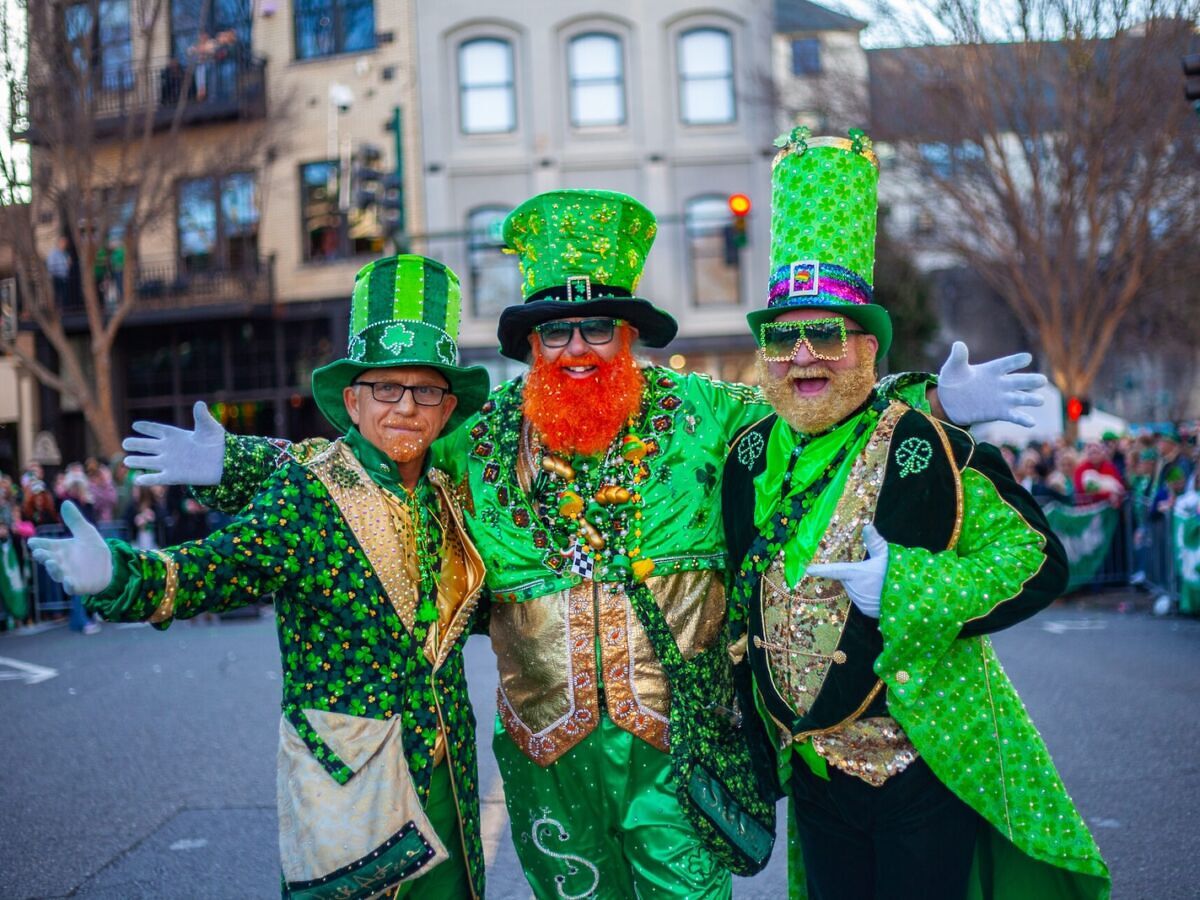
People around the US tend to celebrate St. Patrick’s Day in a fairly uniform manner: wearing green, attending parades, pretending Guinness has always been their favorite drink, and using their six percent Irish heritage as an excuse to eat a massive dinner of corned beef, cabbage, and soda bread. Some towns, however, celebrate more unconventionally. For these places, the holiday isn’t just an excuse to drink on a weekday — it’s a genuine celebration of the area’s Irish heritage. In trying to carve out a unique way to mark the holiday, these places have created some truly quirky rituals. From dyeing a river green in Chicago to taking a 5:30 AM plunge into the freezing-cold ocean in Portland, Maine, these are some of the wildest St. Patrick’s Day traditions around the country.
5 Unique St. Patrick's Day Traditions Around the US
The shortest St. Patrick’s Day parade in the world (Hot Springs, Arkansas)
If you blink, you might miss this small town’s St. Patrick’s Day celebration. Hot Springs, Arkansas, may be more associated with the national park of the same name more than anything else. But it’s also home to Bridge Street, named “The Shortest Street in Everyday Use in the World” in the 1940s by Ripley’s Believe It or Not because it’s only 98 feet long. It certainly doesn’t let that designation go to waste, as each year the town proudly hosts the “World’s Shortest St. Patrick’s Day Parade” down Bridge Street, lasting about an hour.
Past events have included celebrity hosts and musical performers like Sugar Ray, Smash Mouth, Three Dog Night, Grand Funk Railroad, and the Dallas Cowboys cheerleaders. There’s also a Blarney Stone Kissing Contest, a festival king and queen crowning, and a St. Patrick’s Day Zero-K race, which one of the founders claims is for “athletes who do not like to get up early or break a sweat.” (It starts at 6 PM and cover only 299 feet.)
Changing of the highway signs (New London, Wisconsin)
An outside observer might say that New London, Wisconsin, sounds more English than Irish. It would be a fair assumption, too, since for decades, members of the town’s Shamrock Club have been replacing the New London highway signs to read “New Dublin” around St. Patrick’s Day. The Shamrock Club is composed of residents dressed as leprechauns, who sneakily change the signs as an annual tradition. The reason behind this strange custom seems to lie in an influx of Irish immigrants who came to New London in the 19th century, shifting what was primarily a German-influenced town and seeking to give the town more Irish character. In addition to the highway sign mischief, the town also hosts an “Irish Fest,” where a variety of Celtic bands perform in a heated tent.
Dyeing the river green (Chicago, Illinois)
At first glance, it might look like pollution, but it’s actually quite the opposite. This Midwest tradition began in 1962, when Chicago plumbers poured more than 100 pounds of fluorescein into the river in an effort to track the illegal dumping of waste in the waterway. Although the practice has now become a time-honored St. Patrick’s Day tradition, the dyeing is still sponsored by the local plumbers’ union, using an eco-friendly and biodegradable vegetable-based dye. Every year, thousands of spectators gather on the city’s bridges on the Saturday before St. Patrick’s Day to witness the Chicago River turn green. It takes about 45 minutes for the green dye to take effect, though the lovely shade of shamrock can last for a few days. In 2027, the event will take place on Saturday, March 13.
Celebrating in the ‘Irish Capital of Nebraska’ (O’Neill, Nebraska)
In case anyone forgets that O’Neill is the official Irish capital of Nebraska, the permanent giant shamrock painted in the middle of the road serves as a reminder. At the intersection of US-281 and US-20, the massive clover, widely billed as the largest shamrock in the world, anchors a town of just over 3,500 people in its Irish identity.
Visitors to O’Neill for St. Patrick’s Day each year will find a full slate of festivities that lean into that heritage with equal parts sincerity and small-town quirk. Events typically include the Shamrock Fun Run, a community parade, live music, and the crowning of the St. Patrick’s Day King and Queen, along with family-friendly programming like children’s activities and free treats downtown. Recent years have also seen expanded programming across the weekend, rather than a single-day celebration.
The town’s commitment doesn’t end on March 17. In a tradition that feels almost improbable, residents still wear green on the 17th day of every month — a year-round nod to the identity O’Neill has spent decades cultivating.
A St. Paddy’s Day cold-water plunge (Portland, Maine)
Instead of starting St. Patrick’s Day with a pint of the Guieness or Jamison, head to Maine, and you can instead jump[ straight into the icy waters of the Atlantic Ocean. The Paddy’s Day Plunge is a 17-year-old Portland tradition in which people gather on the East End beach at 5:30 AM for a good, old-fashioned Viking shower. After the plunge, the Rí Rá restaurant opens its doors for a complimentary Irish breakfast, live auction, and raffle. The whole thing might sound a little unusual, but it’s for a good cause. Participants raise money from supporters for the Portland Firefighters Children’s Burn Foundation, which assists with treatment expenses for burn survivors. To sign up for the plunge, or simply to donate, visit the official campaign website.
Facts Only
* The World’s Shortest St. Patrick’s Day Parade is held in Bridge Street, Hot Springs, Arkansas.
* The parade lasts approximately one hour.
* Celebrity hosts and musical performers have participated in the parade.
* A Blarney Stone Kissing Contest and a St. Patrick’s Day Zero-K race are part of the event.
* The Shamrock Club in New London, Wisconsin, replaces highway signs to read “New Dublin.”
* This tradition began in the 19th century with an influx of Irish immigrants.
* The Irish Fest is held annually in New London, Wisconsin.
* The Chicago River is dyed green every year before St. Patrick’s Day.
* The dyeing is sponsored by the local plumbers’ union.
* Thousands of spectators gather to watch the dyeing.
* The event takes approximately 45 minutes to complete.
* O’Neill, Nebraska, is designated as the “Irish Capital of Nebraska.”
* The town features a giant shamrock and various St. Patrick’s Day festivities.
* Residents of O’Neill wear green on the 17th day of every month.
* The Portland, Maine, Paddy’s Day Plunge occurs at 5:30 AM on the East End beach.
* The event benefits the Portland Firefighters Children’s Burn Foundation.
Executive Summary
Full Take
Sentinel — Likely Human
This article describes several unique St. Patrick’s Day traditions across the US, presented in a detached, observational style. While the details are vivid, the overall presentation suggests a process of information aggregation rather than a deeply engaged human perspective, raising a moderate concern regarding potential AI assistance.